Not long ago, buying a class ring was a simple yes-or-no decision.
Each member of a school’s graduating class would choose whether to buy an identical piece of gold jewelry, adorned with the year of graduation and the school’s mascot or other emblem, and a large stone of the school’s traditional color set in the middle. Each student would pay the same price, around $60, and the only customized feature would be the initials engraved inside the ring band.
Today, though, buying a class ring is all about choices and the personal touch.
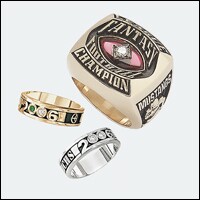
Customization is now the norm. Students choose from a variety of ring styles with names such as Minuet, Vanguard, and Endeavor, and metals from 18-karat white or yellow gold to less expensive jeweler’s alloys. A ring can be encrusted with real or imitation diamonds, and a variety of semiprecious stones are offered as a ring’s centerpiece.
Most class-ring companies have several hundred images for the ring’s sides in their catalogs, ranging from baseball, basketball, and band, to calf roping, dart throwing, and mariachi musicians. Jostens Inc., the Minneapolis-based leader in high school class-ring and yearbook sales, boasts of having 500 “Design-A-Side” icons for its customers to choose from.
And the graduation-products provider Herff-Jones Company of Indiana Inc., based in Indianapolis, tells potential customers on its class-ring Web site: “Your class ring is an expression of who you are.”
Some Cost $500
But are students really buying?
Jostens’ director of communications, Rich Stoebe, reports that although the company’s profits from high school rings “have been fairly stable,” the number of students purchasing rings has fallen over the past few decades. Since the early 1970s, when ArtCarved—now owned by the second-largest producer of class rings and yearbooks, American Achievement Corp. of Austin, Texas—became the first company to offer personalized rings, the share of high school students buying rings has dropped from one-half to one-third, Mr. Stoebe said.

One reason for the drop in sales is soaring prices. Sales representatives estimate that the average high school student now spends $250 on a class ring, usually made of sterling silver. A 14-karat gold customized ring can cost as much as $500.
Although high school students generally have more disposable income than they did a generation or more ago, many also have other hefty school-related expenses. After paying for senior photos, proms, yearbooks, college-application fees, and college-admission tests, many students aren’t able to shell out an additional $250 for a ring, that, as Mr. Stoebe said, “tells a personal story.”
Plus, the marketing of school rings as a personal statement rather than a shared symbol of academic attainment has curbed sales, some people in the class-ring business say.
“In the long run, [customization] has hurt sales,” said Tom Scarry, the owner of the class-ring and graduation-products provider National Quality Products, based in Fairfax, Va., and a former sales representative for Austin-based Balfour, a division of American Achievement. “It has taken away the uniqueness of a particular school’s ring.”
Mr. Scarry said he has higher sales in schools that limit or don’t allow customization—usually private schools that have a traditional ring or a ring ceremony.
Mike McClanahan, a Balfour sales representative in Kansas and Missouri for the past 30 years, said that he often has his highest sales in schools where a ring is still associated with academic achievement.
Students in poorer districts, where smaller percentages of students go to college, tend to buy more rings and spend more money on the ones they buy, he said, because high school graduation is a highly valued accomplishment.
But, he added, “the ring means less when it’s so personalized.”
To offset the declining interest among high school students, ring makers are employing an arsenal of marketing techniques.
For instance, to address soaring prices, nearly every ring producer offers inexpensive jeweler’s alloys as a metal alternative to the traditional gold and silver. Bentonville, Ark.-based Wal-Mart, the country’s biggest retailer and a recent entrant in the class-ring business, offers a minimally personalized ring, with the school name and mascot appearing on one side and a selected activity on the other, for $70 when made of an alloy and $250 when made of 14-karat gold.
Championship Rings
Makers are now targeting younger students, with the pitch that they’ll have several years to wear the ring before graduation, when many students consign their high school rings to the jewelry box, dresser drawer, or pawnshop. Many schools allow sales representatives to sell to high school students as young as 14. Some companies, such as Wal-Mart, are even offering junior high and middle school rings.
Most companies also work with home schooling organizations and offer products to view and purchase online specifically for home-schooled students.
But the fastest-growing sector of the business is championship rings, according to people in the class ring industry. In the past five years, ring makers across the board report a tremendous increase in sales of customized rings for boys’ and girls’ high school teams, both athletic and academic.
Inspired by professional championship rings, most of which are manufactured by Jostens and American Achievement, high school teams are clamoring to mark their accomplishments in jewelry form, for regional, state, or national championships. Sales representatives carry replicas of Super Bowl and World Series rings with them when visiting schools, and they approach local coaches when their teams win championships.
According to Mr. Scarry, the rise in championship rings is easily explainable: “It goes back to what makes a ring important—a symbol of achievement.”


