The federal No Child Left Behind Act is spurring a host of states to craft alternative state tests in reading and mathematics for children who are learning English.
But the states’ efforts could be for naught if the U.S. Department of Education, which enforces the far-reaching 2001 federal law, doesn’t accept the tests.
Kathleen Leos, the associate deputy undersecretary of the department’s office of English-language acquisition, said last week that her department is not encouraging states to use alternative tests and she can’t guarantee that they’ll be approved.
“Without knowing what specifically we are talking about— what state, and what they are doing—a blanket statement would send the wrong message,” she said.
She added that to develop such tests, the states would have to align them with state content standards. “It is not an easy task,” Ms. Leos said. “It takes a good year or 18 months to do that.”
In the past, many states excluded English-language learners from state testing until the students had been in U.S. schools for at least three years. Now, Title I of the federal law, a reauthorization of the Elementary and Secondary Education Act, requires English-language learners to be tested in reading and math in the first round of state exams given after the students enter school.
Some educators argue that, regardless of how students are tested, the fundamental policy on testing time frames in the federal policy is misguided.
“The student who enters school in April and has to take a test two weeks later shouldn’t be forced to do that—to sit for two hours and fill in bubbles,” said Deborah J. Short, the director of the language-education and academic-development division for the Washington-based Center for Applied Linguistics.
A more reasonable policy, she said, would have been for the No Child Left Behind law to require all English-language learners to be tested if they had been in U.S. schools for at least one year.
One provision of Title I may soften the impact of the law for some children. It permits students to take tests in their native languages for the first three years they spend in U.S. schools, with the possibility of extending that time by two years.
For many states, it’s not practical to take advantage of that provision.
“One hundred and ninety-two languages are spoken in Maryland,” said Ron A. Peiffer, the deputy state education superintendent there. “Any one foreign-language test would not work too well.”
Only a limited number of states—including Colorado, New York, and Texas—give some academic tests to students in their native languages.
States are considering two alternatives to their regular state tests: “plain English” assessments and portfolio assessments.
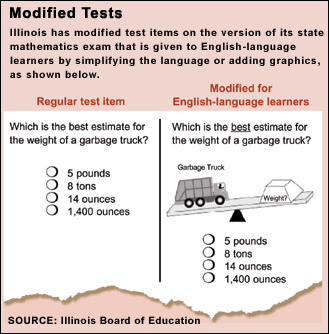
Ms. Leos said the first option is not technically considered a separate test and is permitted under Title I as an “accommodation” for English-language learners.
But, the portfolio assessment would likely be considered a “multiple assessment” under the law, she said, and would require federal approval.
Illinois was the first state to design special academic tests for English-language learners, according to Margaret Gottlieb, the director of assessment and evaluation for the Illinois Resource Center, which provides technical assistance for schools in serving English-language learners.
In 1996, Illinois prepared a language arts test for English-language learners. Later, it produced a simplified-English version of the state math test, which now has been in use for two years.
Items on the math test have been altered to use simple English grammar and vocabulary, with the exception of math terminology, such as “mean,” that is crucial to the content. Many items on the original math test have also been changed to include pictures or other graphics. For the time being, Illinois plans to continue to use both tests for English-language learners under the federal law.
The No Child Left Behind Act has been the catalyst for Virginia to create a plain- English math test, said Roberta Schlicher, the English-as-a-second-language coordinator for the Virginia Department of Education.
“It’s worth it so that the child has the best opportunity to be successful,” she said. The test, being developed by Harcourt Assessment, is expected to be ready next spring.
Oregon has created simplified English tests for math and reading, which it used with English-language learners for the first time last school year.
Portfolios
The more popular alternative, however, appears to be a portfolio, or a system of assessments in which teachers are trained to rate student work.
In 1999, Wisconsin pioneered a portfolio assessment for English-language learners to test all the academic-content areas that are part of the state accountability system. Now, Arkansas, Delaware, the District of Columbia, Rhode Island, and Vermont are working together as part of a consortium to develop an assessment similar to that of Wisconsin.
With the portfolio approach, said M. Elizabeth Cranley, a consultant on assessment of English-language learners for the Wisconsin Department of Public Instruction, educators can have students draw pictures, do math, and show what they know in ways that don’t only use language.
Wisconsin also permits some students to do the work in their native languages.
And still other states—through the Mountain West Assessment Consortium and another consortium working with a Washington-based firm called AccountabilityWorks—are exploring how they might comply with Title I requirements for testing the reading skills of English- language learners by using augmented versions of tests they are developing for English proficiency.
As states try to find valid ways to include children in academic assessments who know almost no English, some are turning to the work of Jamal Abedi, a professor of research and evaluation at the University of California, Los Angeles.
Generally, Mr. Abedi recommends that states write versions of their tests that use simplified English. But he also emphasizes that test items must be changed very systematically and in a way “not to touch the concept” being tested.


