
Whether the national picture is of states taking baby steps or giant steps toward meeting the “highly qualified” teacher provisions of the No Child Left Behind Act remained anyone’s guess last week.
Some had hoped for figures that would at least clear up the magnitude of the challenges states face, since state officials were required to submit data on teacher matters to the federal Department of Education under the sweeping law for the first time last week. But confronted with hundreds of pages of documentation, Education Department officials did not release them, saying they were wrestling with how to make the figures available.
Meanwhile, an independent tabulation of policy changes wrought by the states to bring their rules on teachers into line with the federal law shows that most states have made some progress—although more so in setting criteria for highly qualified teachers than for high-quality professional development for teachers.
“In some areas, the states are much further along than they were at the beginning, and in others, they are still struggling,” said Kathy Christie, a vice president of the Education Commission of the States, the Denver-based group that made the tabulation. The ECS, which provides information and assistance to state education officials, has been tracking policy changes related to the federal law with a grant from the Education Department.
The Education Trust, a Washington-based advocacy group for poor and minority students that was influential in shaping the No Child Left Behind law, took, if anything, a dimmer view of how much had been accomplished.
Ross Wiener, the policy director of the Education Trust, said his organization did not have a “very strong sense” of whether states were making progress, and only in part because the first data for the last school year were just coming in.
A report from the group last week faults the Education Department for poor leadership on the teacher-quality provisions of the law and calls on federal officials to give the states clearer and more stringent guidance on meeting them. The department has promised to release additional guidelines.
In a written response, Secretary of Education Rod Paige defended the department’s record, maintaining that it has “worked vigorously to educate the nation on the significance of the highly qualified provisions in the law and to ensure its implementation at the state and local levels.”
State Efforts
|
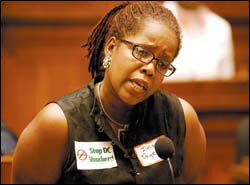
Washington parent Iris Toyer speaks out Sept. 3 against the proposed voucher pilot program for the District of Columbia. |
Under the legislation, every elementary classroom teacher and secondary school teacher of core subjects—English, mathematics, science, foreign language, social studies, and the arts—in public schools must be “highly qualified” by the end of the 2005-06 school year. Newly hired teachers in schools that receive federal money to serve disadvantaged students under Title I were supposed to have met the necessary criteria a year ago.
In general, a teacher deemed highly qualified must hold a bachelor’s degree, be fully licensed by a state, and have demonstrated knowledge of the subjects taught. But it is up to each state to devise the specific criteria that allow the state to determine whether a particular teacher’s qualifications meet the federal law.
States provided a first look at their progress in the data that went to the Education Department last week. In that information, according to department officials, the states were to have detailed the percentage of classes being taught by highly qualified teachers statewide and in the states’ high-poverty schools, along with the percentage of teachers receiving “high quality” professional development.
But experts have been doubtful that the state numbers will be reliable, because many states do not have adequate data systems. That was a point made in a report released in July by the General Accounting Office, the investigative arm of Congress. (“Many Teachers Missing ‘Highly Qualified’ Mark,” Aug. 6, 2003.)
According to the ECS tracking of state policy, at least 10 states have put all the federal requirements for what constitutes a highly qualified teacher into state law or regulation, and at least another 22 have done a lot of that work. That leaves a maximum of 18 states with “a ways to go,” said Ms. Christie.
Forty-one states now require a test of subject-matter knowledge and teaching skills for new elementary teachers, as mandated by the federal law, but only 10 have set ways of gauging subject expertise for experienced teachers that seem to be fully in accordance with the law, according to the ECS. Even fewer have devised annual measurable objectives for reaching the goal of a highly qualified teacher in every classroom by 2005-06 or come up with a system to ensure high-quality professional development for teachers.
Connecticut, which has been consciously working on teacher quality for some 15 years, came out the best in the ECS tabulation, and even that state does not have a detailed plan for meeting the 2005-06 goal.
Still, state policymakers have been active. For example:
- New York has reminded teachers and administrators that certified teachers are not necessarily highly qualified under the law.
- Wisconsin has come up with a succinct definition for “highly qualified.” It says requirements usually include a bachelor’s degree, completion of an approved licensing program, and passing a rigorous exam in the subjects taught. Teachers with their own classrooms who enrolled in “a state-approved alternative teacher-training program” are an exception to the general rule and meet the standard.
- Tennessee will allow teachers to meet the highly qualified standard by using student test-score gains, an attempt to link good teaching with what students actually learn.
- Starting this school year, Alabama has prohibited issuing new alternate-route certificates to teachers who have already held such certificates for three years.
- California has decided to phase out emergency licenses and credential waivers in the next two years, and it has encouraged districts to move teachers with those statuses into training programs, where they can be licensed.
Conundrum on Veterans
One of the thorniest issues states face is determining how to deal with experienced teachers who do not have college majors in the subjects they teach. The federal law requires that they demonstrate subject mastery, but the idea of a mandatory test has not been popular.
Among the criteria that are under consideration or have been adopted are gaining certification in the subject from the National Board for Professional Teaching Standards, satisfactorily meeting assessment requirements set up under an individual professional-development plan, and service on curriculum committees.
More controversial are allowing teachers to meet the standard by receiving three satisfactory evaluations or completing college coursework amounting to 21 credit hours, or about seven semester-long courses. The latter choice requires significantly less training than the typical college major gets, which in the law serves as the gold standard of subject-matter preparation.
Mr. Wiener of the Education Trust said those were examples of how “states are all over the place with respect to compliance with the provisions of the law.” As a result, he said, the Education Department should “send a clear signal” that “highly qualified” means what it says and not some lesser standard.


