Professors of education hold an idealistic view of public education that differs so markedly from the concerns of parents, taxpayers, teachers, and students that it amounts to “a kind of rarefied blindness,” a report released last week says.
“Different Drummers: How Teachers of Teachers View Public Education” presents the results of a poll of education professors by Public Agenda. The nonprofit opinion-research organization, based in New York City, has conducted a series of studies on attitudes toward the public schools.
The disconnect between what education professors believe and the concerns expressed by parents, teachers, and students is “often staggering,” the survey found. The study paints a picture of a professoriate preparing teachers for an idealized world that prizes “learning how to learn” but disdains mastery of a core body of knowledge and gives short shrift to fundamentals such as classroom management.

|
In contrast, previous Public Agenda studies have found that the public wants schools to emphasize the basics: reading, writing, and mathematics, taught in orderly and disciplined classrooms. While Public Agenda is accustomed to identifying gaps between ordinary Americans and leaders on a variety of issues, the report says, “it is unusual to find disparities of this magnitude about such fundamental goals, and involving an issue--public education--that is so close to the public’s heart.”
The study was underwritten by the Washington-based Thomas B. Fordham Foundation, headed by Chester E. Finn Jr., a former assistant U.S. secretary of education under President Reagan and a prominent critic of the education establishment. Mr. Finn said he was “tantalized and alarmed” by the findings.
The sample of 900 randomly selected respondents has a margin of error of 3 percentage points. The telephone interviews, conducted between July and September, were supplemented by focus groups with teacher-educators conducted in Boston, Chicago, Los Angeles, and New York City.
Process vs. Content
Education professors, the report says, define the essence of teaching as showing students how to learn. To that end, they expressed an overwhelming preference for process over content.
When asked about teaching math or history, 86 percent said it was more important for students “to struggle with the process of seeking the right answers,” while 12 percent considered it more important for students to end up knowing the correct answer.
“Giving people tools is probably more important than all of that information--which they can now get on a computer,” one Boston professor said in a focus group.
Survey respondents also emphasized active learning, the survey found, with six in 10 saying that teachers faced with unruly classes have probably failed to make their lessons engaging enough.
|
Nearly 60 percent said intrinsic love of learning should motivate students, not the threat of failing a course or being held back a grade. They took a similarly dim view of academic competition as a way of motivating students; only 33 percent considered rewards such as honor rolls a valuable incentive to foster learning, while 64 percent said schools should avoid competition. “I don’t like hearing about a kid who’s high-achieving [and] doing things in the classroom for stars,” one Chicago professor said.
Memorizing factual information and standardized testing also got low marks from the professors, 78 percent of whom called for less reliance on multiple-choice exams in schools. Nearly 80 percent endorsed the use of portfolios and other assessments considered to be more authentic measures of what students can do.
When asked to rate qualities that are “absolutely essential” in teachers, 84 percent said that teachers should be lifelong learners and constantly updating their skills. A far smaller proportion, 57 percent, agreed that teachers should be deeply knowledgeable about the content of the subjects they will be teaching.
The professors expressed many of the same doubts about their own students in teacher education programs as Public Agenda has reported from members of the public about students in general. Three out of four of the teacher-educators said too many of their students have trouble writing essays free of grammatical and spelling mistakes. And 67 percent endorsed “without reservation” a proposal to require teachers to pass tests demonstrating proficiency in key subjects before they are hired, the survey found.
Out of the Classroom
The respondents also voiced worries that they themselves are too detached from “the daily realities of public schools.” More than 80 percent said education professors should spend additional time in K-12 classrooms.
|
More than half of those surveyed said it had been longer than 15 years since they had been a precollegiate classroom teacher, and 34 percent had not taught elementary or secondary students in more than 20 years.
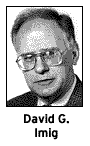
David G. Imig, the chief executive officer of the American Association of Colleges for Teacher Education, a Washington-based group of education schools, said the study showed the professors’ “convictions are right, their idealism is right, but they are out of touch.”
Mr. Imig also pointed out that teacher-candidates typically spend about half their time in schools, not just in college courses.


