
Twenty teachers hefted 40-pound packs onto their backs and stepped uncertainly into a summer night’s drizzle.

Walking single file under a rusty railway trestle, past honking cars, they were embarking on what would be an exhausting and exhilarating weeklong foray into urban America, but more important, into their own hearts and minds. They came to New York City this past July from city, suburb, and small town, from the coasts and the heartland, to take part in an expedition designed to make them better teachers by examining their beliefs and biases.
See a related professional-development story,
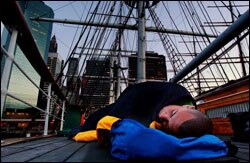
Trekking through four of the city’s five boroughs, often for 15 hours a day, they were immersed in activities as diverse as visiting a Sikh temple, talking with students, learning salsa dancing, climbing a ropes course, and handing out sandwiches to homeless people in a park. They slept communally on the floors of community centers, an office, a leaky ship. The participants in this “urban expedition” came from schools that work with Outward Bound USA, the Garrison, New York, nonprofit that has led wilderness and ocean expeditions for four decades. It partners with more than 125 such schools, many of them charter and alternative schools, to offer a hands-on, expeditionary approach to learning, and participants in last summer’s program were teachers at schools that use the Outward Bound model.

Driving all Outward Bound ventures is the notion that great learning happens through leaving a safe, everyday environment and taking on new challenges. And the teachers on this trip confronted new experiences hourly. They worked in small groups to navigate their way through Spanish Harlem. They removed their shoes to enter a Sikh temple, where they listened to the Sikhs’ stories of discrimination since the September 11, 2001, terrorist attacks. They mustered up the courage to try lamb’s head at a Greek restaurant. The weeklong expedition surprised even veteran urban teachers.
“I grew up in the inner city, so I walked in saying, ‘Man, I got it, I know what’s going on here.’ But I learned a lot about myself that I need to work on,” Gil Rosa, who teaches social studies and English to students from low-income families at an alternative high school in Rochester, New York, reflects after the course ended. “I’m a pretty open-minded person, but I saw I have my own stereotypes. Without a doubt, this will affect how I go back to teaching.”
The experiences are meant to lure participants “out of their comfort zone” and enable them to see their jobs and their beliefs with fresh eyes, explains Alex Yarde, one of four Outward Bound instructors who led the trip. He sees climbing a 60-foot ropes-and-poles tower in Brooklyn, one of the participants’ many challenges, as an apt way for teachers to examine their practice.
“What do you do when you have a problem student? The same thing you do on the tower,” says Yarde, a 36-year-old Bronx-born teacher whose parents are from Barbados. “These are things you have to figure out while teaching, as well as dealing with your own personal issues. You come into the room as a teacher with every hat you’ve ever worn, your politics, your bias. Being aware you’re coming in with those things, knowing how not to belittle anyone or do any harm, making a safe space for students, means checking your own stuff. It starts with trust and communication. It means putting yourself out there and facing your fear, and that’s what we do when we climb.”
Back at ground level, even the simplest activities were deliberately designed to put participants in unfamiliar situations with little idea of what would happen next. By risking failure or discomfort to open themselves to new things or overcome obstacles, the thinking is that teachers will develop more empathy for their students, who are being asked to do just that every day. That was the lesson learned by 26-year-old Brian Berger, who teaches 7th grade social studies in Wautoma, Wisconsin.
“Getting up so early every day and feeling not able to focus, and having to overcome obstacles, I thought about how my students are going through the same thing,” he said after returning home. “Having to jump in and do new things and meet strangers all over the city, I think I can go back to my students and say, ‘I know you don’t have a clue what we’re doing on this project, but please just keep an open mind.’ ”


