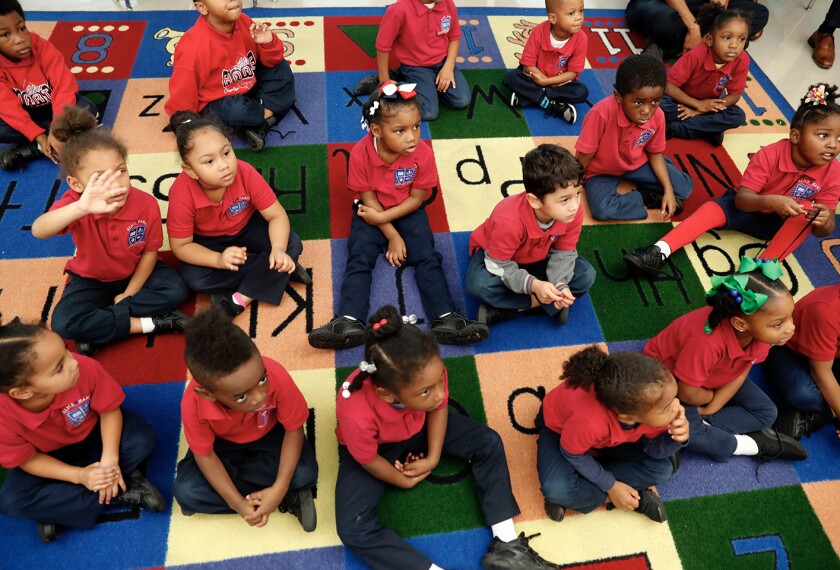
An issue that never really goes away is back again this year: the starting age for kindergarten.
Lawmakers in at least three states are debating whether to move the cutoff deadline for kindergarten eligibility to an earlier date so children will be at least 5 years old when they start school.
In Arkansas, Connecticut, and Tennessee, where the proposals are at various stages in the legislative process, sponsors say too many children enter kindergarten without the social or academic skills they need to do well—especially given the pressure on schools to make sure children are prepared for tests down the road.
Betty B. Davis, the president of the Central Arkansas Association for the Education of Young Children, agrees.
“Some children are really too young to be part of kindergarten,” said Ms. Davis, whose group is an affiliate of the Washington-based National Association for the Education of Young Children. “The lack of maturity is perhaps an issue.”
In her state, the Senate already has unanimously passed a bill that gradually would push back the current Sept. 15 cutoff date to Aug. 1 by 2010.
Connecticut lawmakers are discussing moving their state’s cutoff from Jan. 1 to the preceding September or October. In Tennessee, the recommendation is to move the Sept. 30 date back three months.
If the legislation passes in Tennessee, it could have a ripple effect on the state’s growing pre-K program. Rep. David Hawk, the Republican legislator sponsoring the bill, has said that he believes the cutoff dates for the two programs should be aligned.
A shift in kindergarten entry times, however, can inconvenience working parents who are eager to stop paying for preschool or child care or who are wondering if their child will be bored with another year of preschool.
The most common date by which children need to turn 5 in order to enter kindergarten in the fall is Sept. 1, and most states set their dates at before Oct. 1. California’s is the second-latest, at Dec. 2, and Indiana’s is the earliest, July 1.
‘A Shell Game’
Despite all the discussion it stirs, changing the date may be pointless, many experts in early-childhood education say.
“It’s an incredibly interesting political conversation that means very little,” said Kristie Kauerz, a coordinator at the National Center for Children and Families, based at Columbia University in New York City. “I still think it’s a shell game. Simply shifting the date isn’t going to solve anything.”
Many experts say that no matter what date is set, teachers will have roughly a 12-month distribution in the skills of children in their classrooms.
“There will always be variability in kids’ skills that is correlated with their age,” said Robert Pianta, an education professor at the University of Virginia, in Charlottesville, and an expert on the transition into kindergarten.
Some observers argue that if academic expectations weren’t being pushed down from 1st grade into kindergarten, teachers wouldn’t be so aware of the differences in children’s abilities.
But Ms. Davis said she doesn’t see the pendulum swinging toward less academic rigor any time soon.
“We’re in a global economy,” she said. “And we’re constantly getting reports of how children in other countries are outperforming ours.”
Ms. Kaurez also suggests that there may be, in effect, a “push up” from the early-childhood-education field because of the continuing expansion of public preschool programs, as well as attention to building high-quality programs with specific learning standards.
“Kids are entering public schools more ready. They’re coming with different skill sets,” Ms. Kaurez said. But because of what she called an “inequitable distribution” of programs—meaning not all children attend preschool—wide disparities remain in children’s social and academic abilities.
Other Options
Ms. Kaurez added that schools can take other steps, such as moving toward full-day kindergarten, to make sure children are acquiring the necessary skills.
Several districts in New Mexico operate a program called Kindergarten-Plus, which allows children from low-income families to start kindergarten 20 days before their peers. The children also spend an additional 20 days in school during the summer after kindergarten to get a jump on 1st grade work.
And in Hawaii, the legislature in 2004 created an optional “junior kindergarten” program for children who have not yet reached the cutoff date of Aug. 1. The program allows teachers to target students’ individual needs and can prevent the need to hold a kindergartner back from promotion to 1st grade.
Carol Nicoli, the president of the California Kindergarten Association, said that she too often has had to recommend that some children repeat kindergarten. That’s why she supports gradually moving her state’s cutoff date from December to September.
“You’re asking them not to succeed,” she said of children who start kindergarten too young. “And I’d like to do something to change that.”