Exciting
“Come see this work,” she said with a huge smile on her face. I traveled down the hallway to the 3rd grade teacher’s classroom where she had a stack of student artwork ready for me to view.
“I am just really amazed at how well this lesson went. Even my lowest student got it. I mean, he really got it,” she bragged.
Demanding
We had planned this arts-integrated math lesson together. The students were learning about multiplying by multiples of ten in math class, and the teacher wanted the students to learn more about Cubism. So I created a presentation about Cubism. Since I teach visual art to these same students, I know what visual art background knowledge they have and what visual art skills they have been taught. I used this information to create a relevant presentation for the teacher to use in her math classroom.
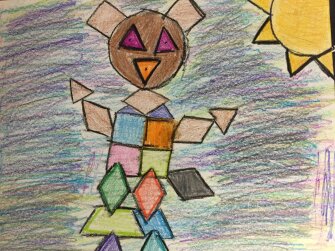
To create the artwork, the students cut out shapes. Then, they traced at least one but no more than nine of each shape onto a piece of paper to create an image. Next, they collected data from their artwork. They created a tally chart of how many of each shape they used. Once they had the tally, they referred to a key that assigned a value to each shape. For instance, squares were assigned a value of 40. They had to multiply the value of each shape with the amount of times they had used that shape. If a student used a square 8 times in their artwork, he or she would multiply 8 and 40. Finally, students reflected on this process by describing their artwork. Here is the data recording sheet used by the students for this lesson

Engaging
A full two weeks after the teacher had taught this lesson, I was able to have some conversations with the students to gauge how they thought the project went. One student said he thought the project was fun. It made him feel proud and happy that “the principal told my mama about it. He called her while she was at church, and she told all her friends about how well I did.” He went on to say that, “I learned that even when you use ten shapes, instead of nine like the teacher said, that it is okay. Everything will be okay. You just get an even bigger number when you multiply.” I showed this student a photo that I’d taken of his work and asked him to explain the multiplication to me. He explained each of the equations he’d gotten by tallying his shapes and multiplying by a multiple of ten.
Another student said he thought that the project was “kinda hard, even though I liked it a lot.” He said it made him think harder than usual. “I had to find a way to make all these shapes fit together to make a picture. The parallelogram was hard to fit,” he explained. He went on to tell me that he learned some shapes that he didn’t know before, citing the parallelogram as one. “I don’t think I’ll ever forget what a parallelogram is,” he stated.
Finally, another student said she created a dog and a dog house with her shapes. She said she really likes dogs and enjoys reading about, drawing, and spending time with dogs. She explained that, “Cubism is interesting, because it has all these different shapes and colors. It makes me think of broken glass.” She said, “This project was fun, but we were still doing math. It was like fun-math.” She also explained that you could get the answer just by multiplying or by counting the shapes. She said that if you had four squares you could touch each one and count 40, 80, 120, 160 to get the answer.
Meaningful
The conversations that I had with these students offer evidence for how meaningful this project was to them. The student who was so proud that the principal had called his mom experienced a sincere, positive reward for his efforts. The reward did not cost anything and wasn’t tangible, but it meant something to the student. This is how intrinsic motivation is developed. This student also learned that it is okay to make mistakes. Even though he used too many of one shape, he discovered he could still multiply. He just took his learning a step beyond what the teacher had intended. He didn’t feel the need to start over on his artwork. He adapted what he was doing and moved on. Students need to develop this adaptive behavior to thrive in the world.
The student who admitted that the project was hard for him was able to articulate that he had to think harder than usual. He makes it clear that he had to work to get his product finished. This shows persistence and determination.
Finally, the student who said she was doing fun-math figured out how to count by multiples of ten and connected it to multiplication. She better understands the theory behind multiplication. The project was special to her because she was able to create an image of something related to her interests. The fact that these students could still explain the process to me after two weeks had passed definitely shows a high rate of retention for the concept.
Worthwhile
Art really does reach learners in a way that basic worksheets and common textbooks cannot. Art gives students the opportunity to construct something, to build something, or to create something. This lesson did all of those things but also taught the students the concept of multiplying by multiples of ten. When these students are formally assessed on this skill, they will think back to the time they created the artwork. They won’t be as likely to think back to the time they completed a worksheet.
We can think of using art in our regular classrooms as a superpower strategy to reach all of our students. Art is exciting, demanding, engaging, meaningful, and worthwhile. Why not add it to your arsenal of teaching methods?
Captions for images: 1. This student has created a “Ninja- Lion.” 2. This student has created a bear enjoying the sunshine.


