
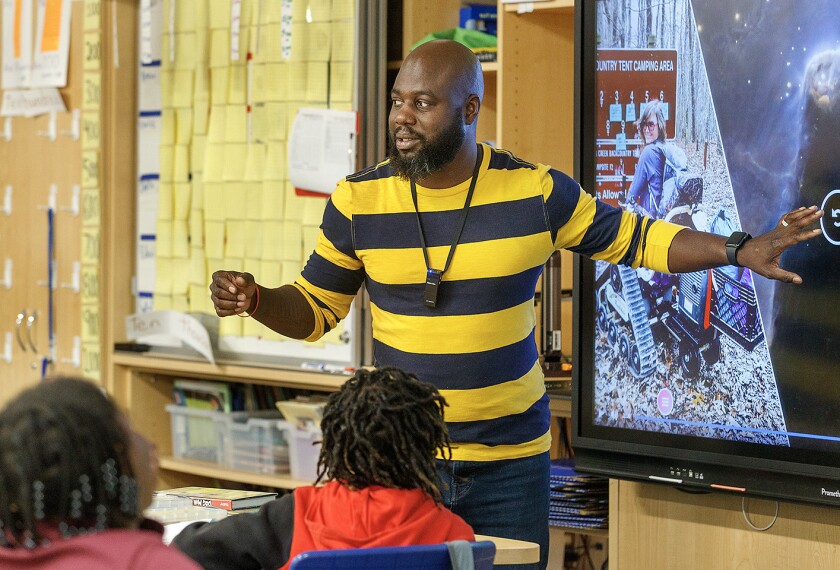
Black teachers have one of the highest rates of turnover in the profession—yet new survey data show that they also have the highest job-related morale.
As district leaders and policymakers work to diversify the teaching profession, the tension between those two trends is a central piece of the puzzle. Black teachers, who make up just 6.1 percent of the workforce, tend to find their work meaningful and fulfilling, which can lead to higher morale. Even so, their dedication to students can feel all-encompassing—and the stresses of the job, combined with the challenges of working in a predominately white field, can push them out of the classroom before they’re ready.
“I came into this profession seeking a particular outcome, wanting to make a difference, wanting to push the needle, wanting to prepare my students for the world,” said Genelle Faulkner, a high school science teacher in Boston. “I see my students as a reflection of me—all my potential, with all the places I could get to. I want to make sure that all the doors possible are open for them.”

New national data on the teaching profession, vivid reporting from classrooms, and resources to help support this essential profession. Explore the Project→
But that commitment can lead to burnout, she said: “It’s a lot of pressure on yourself. It’s a lot of work, it’s a lot of energy. ... I think the job overall is very unsustainable, especially as a teacher of color.”
The Education Week State of Teaching survey, which polled a nationally representative sample of nearly 1,500 teachers in October, found that overall teacher morale stands at –13 on a scale ranging from –100 to +100. A negative score suggests that, on average, teachers are feeling more negatively than positively about their jobs.
But teachers’ perception of their morale at work varied by race or ethnicity. White teachers have a morale score of –13; teachers of two or more races have a morale score of –14; and Hispanic teachers have one of –6.
Black teachers’ morale, meanwhile, stands at +5, suggesting they feel more positively than negatively about their jobs.
How teacher morale relates to the broader Black experience
The differences in morale might be partly due to the wider societal context and the broader Black experience, experts say.
“When I think about morale, I also think about hope, and to be Black in America, one has to have ... a sense of hope, a sense that life would always get better,” said Travis Bristol, an associate professor of teacher education and education policy at the University of California, Berkeley’s school of education.
That sense of optimism and faith started during slavery and continues to this day, with Black people still confronting systemic racism, he said.
“I suspect those Black teachers are bringing with them 400 years of belief and hope that so long as we are doing the work, life for our students will get better even if we don’t see it, [just as] our ancestors believed that even if we don’t see freedom, it will come,” he said.
I see my students as a reflection of me—all my potential, with all the places I could get to.
A body of research confirms that having Black teachers in classrooms matters, especially for Black students, although students of all races and ethnicities benefit.
Black students are more likely to graduate from high school and enroll in college when they have just one Black teacher in elementary school. Black students are also more likely to be placed in gifted education programs if they have a Black teacher, and are less likely to receive suspensions, expulsions, or detentions. Black teachers tend to have higher expectations for Black students than white teachers.
“When you feel like you’re contributing something mightily to a group of people who you identify with, who you share a cultural background with, ... it gives you hope, it gives you inspiration,” said Sharif El-Mekki, the founder and chief executive officer of the Center for Black Educator Development. (He is also an opinion contributor to EdWeek.) “It feels like this is something weighty and worthy of my best efforts, my best thinking.”
How teachers of color view the teaching profession
A new survey by Educators For Excellence, a national group that advocates for teachers, found a similar trend. Teachers of color were more likely than teachers in general to say that the profession is dynamic, rewarding, collaborative, sustainable, and diverse.
The survey was taken by a nationally representative sample of 1,000 public school teachers, as well as a nationally representative sample of 300 teachers of color, in January and February.
For Michael Simmon, a middle school history teacher in New York City and a member of E4E’s National Teacher Leader Council, the work is rewarding because he knows firsthand how important it is for Black students, and boys in particular, to have a teacher who looks like them. He didn’t have a male teacher of color until he got to high school.
“You saw an image of the future, of what you could be in a professional environment,” he said of that experience. And now, “working with young students of color, especially males, I see the respect that I get.”
Another EdWeek Research Center survey, conducted in January 2023, found that Black teachers were significantly more likely to say that they are respected and seen as a professional by the general public—at 79 percent, compared to 58 percent of Hispanic teachers and 53 percent of white teachers.
That’s not surprising, Bristol said. In spaces like Black churches, for instance, “Black teachers, Black professionals are revered,” he said.
Black communities tend to place a high value on education, which translates to respecting teachers, El-Mekki said. As a teacher in west Philadelphia, he would walk home from school and receive warm greetings and words of support and encouragement from parents and other community members, he said.
Why Black teachers leave the profession
Even so, the E4E survey found that only 29 percent of teachers of color said they were “very likely” to spend their entire career as a classroom teacher, compared to 44 percent of the national sample of teachers. That aligns with other research, which has found that teachers of color leave the classroom at a higher rate than their white counterparts.
One potential explanation: burnout. The EdWeek State of Teaching survey found that Black teachers typically work the most, at 65 hours per week. Hispanic teachers report 64-hour work weeks, and white teachers report 56-hour work weeks.
Faulkner, who is also a part of E4E’s National Teacher Leader Council, said she regularly spends extra time after school helping students with their schoolwork so they are set up for success. And she attends students’ basketball or softball games so she can get to know their family and cheer them on.
Putting in the extra hours can be tiring, but it’s important to her that students know she cares about them as people, she said.
“There are ways I could make my job easier for myself, more manageable, but I wouldn’t feel satisfied that I was actively doing my job,” she said. “I end up pushing and pushing and pushing, in addition to [meeting] district expectations or my school’s expectations and all these other things that pile on to make [the job] not very sustainable.”
Scholars say teachers of color often pay an “invisible tax” at work, taking on extra unpaid tasks. For example, Black men are often expected to be disciplinarians at school, and teachers of color are often tapped to lead efforts related to cultural diversity and equity.

And the work can be lonely.
“In many public schools, it’s predominately white women teachers,” said De’Shawn Washington, a 4th grade teacher in Lexington, Mass., and the state’s 2024 teacher of the year. “Black teachers feel ostracized. There’s just one or two of us. [Feeling like] I’m the spokesperson for all Black teachers is high pressure.”
The work can also feel daunting, since schools are not always set up to meet the needs of students of color, Washington said. Across the country, recently passed laws in some states that limit how teachers can discuss race and racism in the classroom have exacerbated some of these concerns.
“The curriculum doesn’t always match the lived experience of the classroom teacher, nor the students we’re serving,” Washington said.
Oftentimes, too, Black teachers had a bad experience in school when they were students, El Mekki said.
“Now suppose I’m trying to protect Black children who look like me from the policies that I suffered from,” he said, adding that the decision to either push back or stay quiet is fraught, with either choice taking a toll.
Keeping Black teachers in the classroom
Experts say the findings about higher morale among Black teachers should serve as a call to action for school and district leaders and policymakers.
“Given that [Black] educators have a great deal of hope, how do we create more of them, and how do we create conditions in their schools to make them want to stay?” Bristol said.
He added that Black teachers—who are able to “be hopeful amid the sky seemingly falling"—have much to teach other teachers. For example, Bristol said, what kind of practices are they implementing in their classrooms to make them joyful places that foster positive morale?
To retain Black educators, administrators need to make sure they feel respected, fulfilled, and effective, El-Mekki said.

Washington, the Massachusetts teacher of the year, said there were times early in his career when he thought teaching wasn’t for him. But now, he feels energized by the impact he sees he has on students and the relationship he has built with them—shown through random hugs, grins, and little messages of appreciation.
“When you have those moments, your morale is going to be high because you see your value, and you see your purpose,” he said.