
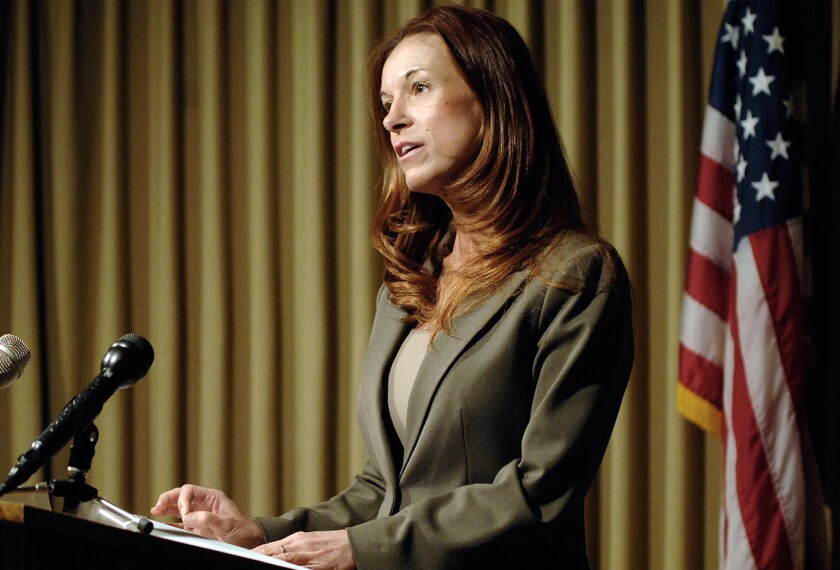
President Donald Trump has tapped North Dakota’s Kirsten Baesler—a former school leader and technology integration coach and the nation’s longest-serving state superintendent, with a record of working across the political aisle—to a key post overseeing K-12 policy at the U.S. Department of Education.
If confirmed by the U.S. Senate as assistant secretary of elementary and secondary education, Baesler would be one of two nationally respected officials from the state chief ranks to serve in the department during Trump’s second term. She would join Penny Schwinn, who led schools in Tennessee and has been nominated to the post of deputy secretary.
Baesler’s would-be boss, Linda McMahon, a former wrestling executive and head of the federal small business administration, had her confirmation hearing this week. Schwinn and Baesler will also need Senate signoff and may have confirmation hearings of their own.
The longest-serving current state education chief, Baesler was first elected to her nonpartisan post in 2012. She’s worked as president of the bipartisan Council of Chief State School Officers and has cultivated deep relationships with state education leaders around the country as well as district leaders in her home state.
“Superintendent Baesler is an educator who has to work with politics. She’s not a politician who has to work with educators, and that’s really important to our field,” said Cory Steiner, superintendent of the Northern Cass district in North Dakota. “It doesn’t matter if it’s a Republican or a Democrat or even where they are within their own political party. If you’re for kids, she’ll find a way to work with you.”
Washington state Superintendent Chris Reykdal described Baesler similarly.
“Kirsten is a dynamic leader who has a track record of thinking outside the box and always pushing for progress,” Reykdal, whose elected position is nonpartisan but who previously served as a Democrat in Washington’s state legislature, said in an email. “She deeply respects the unique role of state education agencies in each of the states. Her voice, experience, and viewpoint are a needed addition to the U.S. Department of Education.”
‘Everyone in the state has her cellphone number’
In North Dakota, Baesler has championed legislation that helped position her state as a national leader in competency-based education, including measures allowing the state department of education to waive districts’ seat-time requirements and enable students to get credit for out-of-school experiences, such as work-based learning.
And she’s positioned North Dakota as a leader in computer science education. The state was the first to require students to take either cybersecurity or computer science to graduate. She’s pushed for every school in the state—from the elementary level up through high school—to offer some instruction in both computer science and cybersecurity.

She’s also known for her accessibility and for reaching out extensively to district leaders, parents, and students, said Aimee Copas, the executive director of the North Dakota Council of Education Leaders, which represents district superintendents in the Peace Garden State.
“Everyone in the state has her cellphone number,” Copas said. “She’s very, very easy to work with at every level.”
More recently, Baesler’s pragmatic and non-ideological approach has been a political liability in deep red North Dakota.
During her re-election bid last year, she sought and lost the North Dakota Republican Party’s endorsement, which she had secured in previous years. A homeschooling advocate who wanted to require that schools teach the Ten Commandments won it instead, but he did not draw enough votes to make it through the primary election. Baesler won reelection in November with 57 percent of the vote.
Baesler cited a changed political climate on K-12 as a reason for the GOP’s lack of support.
“Over the past 12 years, I’ve seen a significant shift from our voters in superintendents’ [elections] being really deeply focused on the technical expertise of who this leader should be,” Baesler told Education Week last year. “Now it has moved to a different arena … the social wars that are consuming much of the conversation our nation is having around education.”
Not a ‘top-down type of leader’
Trump—who campaigned on getting rid of the U.S. Department of Education—has already taken steps to hobble the agency. Earlier this week, the Department of Government Efficiency—an office led with little transparency by billionaire Elon Musk—canceled scores of Education Department contracts, including for many long-standing research-based services such as the What Works Clearinghouse.
Dozens of employees have been placed on administrative leave in recent weeks as the administration has tried to rid federal agencies of their diversity, equity, and inclusion initiatives. And an executive order is reportedly in the works that will seek to kick off the dismantling of the 45-year-old agency.
Those actions may seem at odds with Trump’s decision to place experienced educators like Baesler and Schwinn in key roles.
But those choices aren’t surprising to Copas, who sees Trump’s push for local control of K-12 as compatible with Baesler’s approach to her job as North Dakota’s top education official.
“She doesn’t like to be a very top-down type of leader,” Copas said.
In fact, Baesler penned an opinion piece that ran in the GOP-leaning Washington Times in December, outlining how her work cutting 20 percent of staff at North Dakota’s department of public instruction and moving mental health services to another state agency could serve as a blueprint for what the Trump administration wants to accomplish at the federal level.
She suggested, for instance, shifting civil rights investigations to the Department of Justice and student lending to the Treasury Department—suggestions also made in the conservative policy agenda Project 2025.
Whatever happens politically, Steiner sees Baesler’s potential ascension to a top Washington policy post as a step toward redirecting the national K-12 conversation to students’ needs.
“This is an opportunity to take the narrative on education in this country and take it back to where it should be, which is to be centered around learners,” he said.


