Federal

Trends in China: Schooling Shifting With Market Forces

By Sean Cavanagh — April 22, 2008 3 min read
  • Save to favorites
  • Print

China’s education system has undergone significant changes over the past quarter-century, some brought into classrooms directly by government policy, others swept along by the rising tide of free-market reforms.

Many of the policies pushed by national leaders in recent years have focused on increasing access to education for students in impoverished rural areas, while also improving curriculum and building broader academic skills among older students.

Teaching and learning in China have long been shaped heavily by the country’s exam system, which determines admission to high schools and colleges in the nation of 1.3 billion.

Nation at Risk: 25 Years Later
America Scouts Overseas to Boost Education Skills
Researchers Gain Insight Into Education’s Impact on Nations’ Productivity
Catching Up on Algebra
Trends in China: Schooling Shifting With Market Forces
Trends in India: Expanding Middle Class Drives Private Schooling
Trends in the European Union: Education Seen Driving Prosperity
Trends in Japan: Japan Continues Search for Academic Triumph
COMMENTARY
E.D. Hirsch Jr.: An Epoch-Making Report, But What About the Early Grades?
Howard Gardner: E Pluribus...A Tale of Three Systems

But in recent years, the central government, which sets national education policy, has encouraged schools to emphasize applied skills and independent thinking, as opposed to simply exam-driven content—a difficult undertaking.

Many schools and colleges were closed during the Cultural Revolution. Following the death of Mao Zedong, the rise of reformist leader Deng Xiaoping sparked plans to rebuild and reorganize the education system.

Two of the most far-reaching changes were the establishment of nine years of compulsory education, and the re-establishment of a national college-entrance exam, said Jinfa Cai, a professor of mathematics and education at the University of Delaware. High school courses were tailored to meet exam content, he said; teachers were evaluated on students’ test performance.

Today, Chinese students attend schools with different academic demands. “Normal” schools offer a more standard curriculum, and more-elite “key” schools generally present a more demanding one. Students’ ability to gain access to more selective schools is often limited by economic circumstance, among other factors. Vocational education greatly increased in the 1980s, though the trend has been toward a general education in recent years, according to a 2008 study by the RAND Center for Asia Pacific Policy.

Education Highlights

Curriculum: Schools follow a curriculum established by the national government. A government agency, the People’s Education Press, has responsibility for curriculum and textbook development. The number of private or independent curriculum and textbook developers has grown in recent years, however. Most private schools follow the government curriculum, though some have adopted their own model, PEP officials have said.

Testing: Students take exams to gain admission to high school (grades 10-12) and college. Those exams, which shape curriculum and instruction, are especially important given the limited spaces in elite secondary schools and in China’s growing postsecondary market.

Spending: China’s spending on public education, as a proportion of its gross domestic product, is about 2 percent, roughly half that of India’s, according to the UNESCO Institute for Statistics. In recent years, much of the burden of financing education has shifted from the national level to state and local governments, which has resulted in higher enrollment fees, a 2008 report by the RAND Center for Asia Pacific Policy says.

Access: Education is compulsory in grades 1-9, although school access and quality vary significantly by region. Access tends to be greater in the cities and eastern provinces, though the millions of migrant families entering urban areas struggle to find services; some have turned to low-cost, often unregulated private schools as a result.

Another change, emerging in the late 1990s, was the government’s attempt to implement stronger curriculum guidelines at the high school level, Mr. Cai said. Those changes have placed a greater emphasis on critical thinking, applied skills, and more in-depth content in mathematics and other subjects, as well as the integration of technology into the curriculum, said the professor, who has studied math curriculum in China.

Other factors have the potential to diversify China’s curriculum further, said Jianjun Wang, a professor of education at California State University-Bakersfield. In a reflection of growing free-market influences, more independent publishers, such as universities, are developing classroom materials that were once crafted almost exclusively by the government, said Mr. Wang, a former Ministry of Education official.

While U.S. officials have cited the need to improve schools in response to foreign competition, Mr. Cai said, the motives of Chinese officials are different. There is a sense that good schools are needed for the nation “to be prosperous,” he said. “Education serves society. … [There’s] not so much talk of ‘global competitiveness.’ ”

Related Tags:

Special coverage marking the 25th anniversary of the landmark report A Nation at Risk is supported in part by a grant from the Eli and Edythe Broad Foundation.
A version of this article appeared in the April 23, 2008 edition of Education Week as Schooling Shifting With Market Forces

Events

This content is provided by our sponsor. It is not written by and does not necessarily reflect the views of Education Week's editorial staff.
Sponsor
Artificial Intelligence Webinar
Managing AI in Schools: Practical Strategies for Districts
How should districts govern AI in schools? Learn practical strategies for policies, safety, transparency, as well as responsible adoption.
Content provided by Lightspeed Systems
This content is provided by our sponsor. It is not written by and does not necessarily reflect the views of Education Week's editorial staff.
Sponsor
Reading & Literacy Webinar
Unlocking Success for Struggling Adolescent Readers
The Science of Reading transformed K-3 literacy. Now it's time to extend that focus to students in grades 6 through 12.
Content provided by STARI
Jobs Virtual Career Fair for Teachers and K-12 Staff
Find teaching jobs and K-12 education jubs at the EdWeek Top School Jobs virtual career fair.

EdWeek Top School Jobs

Teacher Jobs
Search over ten thousand teaching jobs nationwide — elementary, middle, high school and more.
View Jobs
Principal Jobs
Find hundreds of jobs for principals, assistant principals, and other school leadership roles.
View Jobs
Administrator Jobs
Over a thousand district-level jobs: superintendents, directors, more.
View Jobs
Support Staff Jobs
Search thousands of jobs, from paraprofessionals to counselors and more.
View Jobs

Read Next

Federal Will the Ed. Dept. Act on Recommendations to Overhaul Its Research Arm?
An adviser's report called for more coherence and sped-up research awards at the Institute of Education Sciences.
6 min read
The U.S. Department of Education building is pictured on Oct. 24, 2025, in Washington, D.C.
The U.S. Department of Education building in Washington is pictured on Oct. 24, 2025. A new report from a department adviser calls for major overhauls to the agency's research arm to facilitate timely research and easier-to-use guides for educators and state leaders.
Maansi Srivastava for Education Week
Federal Trump Talks Up AI in State of the Union, But Not Much Else About Education
The president didn't mention two of his cornerstone education policies from the past year.
4 min read
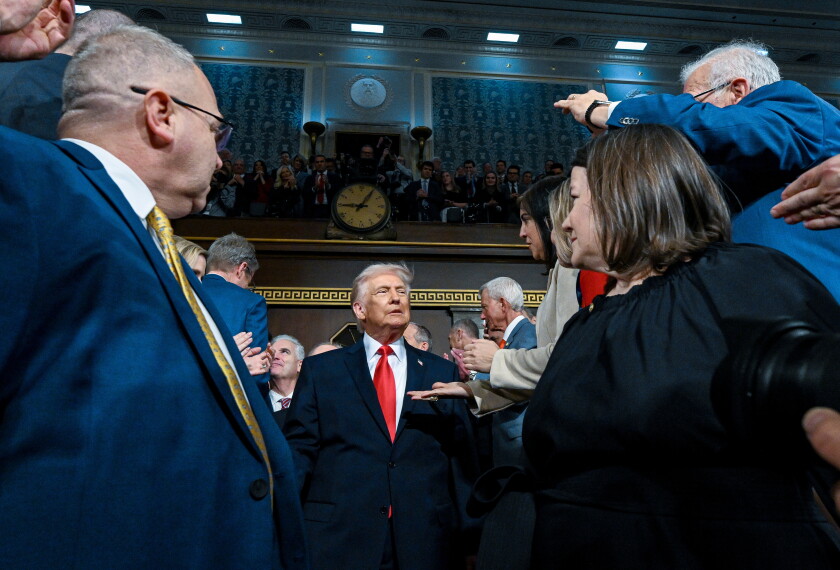
President Donald Trump enters to deliver the State of the Union address to a joint session of Congress in the House chamber at the U.S. Capitol in Washington, Tuesday, Feb. 24, 2026.
President Donald Trump enters to deliver the State of the Union address to a joint session of Congress in the House chamber at the U.S. Capitol in Washington, Tuesday, Feb. 24, 2026. The president devoted little time in the speech to discussing his education policies.
Kenny Holston/The New York Times via AP, Pool
Federal Education Department Will Send More of Its Programs to Other Agencies
Education grants for school safety, community schools, and family engagement will shift to Health and Human Services.
4 min read
Various school representatives and parent liaisons attend a family and community engagement think tank discussion at Lowery Conference Center on March 13, 2024 in Denver. One of the goals of the meeting was to discuss how schools can better integrate new students and families into the district. Denver Public Schools has six community hubs across the district that have serviced 3,000 new students since October 2023. Each community hub has different resources for families and students catering to what the community needs.
A program that helps state education departments and schools improve family engagement policies is among those the Trump administration will transfer from the U.S. Department of Education to the U.S. Department of Health and Human Services. In this photo, school representatives and parent liaisons attend a family and community engagement discussion on March 13, 2024, in Denver to discuss how schools can better integrate new students and families into the district.
Rebecca Slezak For Education Week
Federal New Trump Admin. Guidance Says Teachers Can Pray With Students
The president said the guidance for public schools would ensure "total protection" for school prayer.
3 min read
MADISON, AL - MARCH 29: Bob Jones High School football players touch the people near them during a prayer after morning workouts and before the rest of the school day on March 29, 2024, in Madison, AL. Head football coach Kelvis White and his brother follow in the footsteps of their father, who was also a football coach. As sports in the United States deals with polarization, Coach White and Bob Jones High School form a classic tale of team, unity, and brotherhood. (Photo by Jahi Chikwendiu/The Washington Post via Getty Images)
Football players at Bob Jones High School in Madison, Ala., pray after morning workouts before the rest of the school day on March 29, 2024. New guidance from the U.S. Department of Education says students and educators can pray at school, as long as the prayer isn't school-sponsored and disruptive to school and classroom activities, and students aren't coerced to participate.
Jahi Chikwendiu/Washington Post via Getty Images
