Law & Courts

Supreme Court Backs Idaho’s Payroll-Deduction Curb

By Mark Walsh — March 03, 2009 3 min read
  • Save to favorites
  • Print

The U.S. Supreme Court ruled last week that a state’s restriction on school district and other local government employee-payroll deductions for politics does not violate the free speech rights of unions, a decision that could lead to an increase in states’ attempts to curtail the power of public-employee unions.

The justices ruled 6-3 in a case from Idaho involving that state’s Voluntary Contributions Act, which prohibits school districts and other local government bodies from using their payroll systems to let workers voluntarily deduct money from their paychecks for political causes, such as for the unions’ political-action funds.

“Idaho’s law does not restrict political speech, but rather declines to promote that speech by allowing public-employee checkoffs for political activities,” Chief Justice John G. Roberts Jr. wrote for the majority in Ysursa v. Pocatello Education Association (Case No. 07-869). “Such a decision is reasonable in light of the state’s interest in avoiding the appearance that carrying out the public’s business is tainted by partisan political activity.”

The chief justice’s opinion, issued Feb. 23, was joined by Justices Antonin Scalia, Anthony M. Kennedy, Clarence Thomas, and Samuel A. Alito Jr. Justice Ruth Bader Ginsburg concurred in the outcome of the case.

Justice Stephen G. Breyer filed an opinion saying he agreed with some of the chief justice’s reasoning, but that he believed the case should be sent back to the lower courts for clarification of certain matters.

Justices John Paul Stevens and David H. Souter each filed dissenting opinions in the case, which was argued in November. (“Justices Weigh Bar on Payroll Deductions for Politics,” Nov. 12, 2008.)

“Because it is clear to me that the restriction [on payroll deductions] was intended to make it more difficult for unions to finance political speech, I would hold it unconstitutional in all its applications,” Justice Stevens said.

Five labor unions and the Idaho state AFL-CIO successfully argued in lower federal courts that a 2003 Idaho law forcing cities, counties, and school districts to eliminate a payroll deduction financing union political action committees violated the First Amendment.

Similar Laws Elsewhere

At least two other states—Ohio and Utah—have similar laws that have also faced court challenges, typically led by the teachers’ unions. In 2007, the Supreme Court, in Davenport v. Washington Education Association, upheld a Washington state law that made it more difficult for teachers’ unions to raise political funds through checkoffs. (“High Court Upholds Wash. State Law on Union Fees,” June 20, 2007.)

John Rumel, a lawyer for the Idaho Education Association, said the decision could prompt anti-labor state legislatures to eliminate payroll checkoff for political activity in hopes it would hurt unions.

But in the wake of the passage of the 2003 law, IEA members moved away from payroll deductions and toward electronic funds transfer as a means of making their political donations, the union has said.

“While we’re certainly disappointed in the outcome, we’ve moved on,” Mr. Rumel said.

The National Right to Work Legal Defense Foundation, a Springfield, Va.-based group that filed a friend-of-the-court brief on the side of Idaho, praised the court’s ruling.

“Payroll deduction should not be a constitutionally protected right,” said Stefan Gleason, vice president of the group. “We feel it’s bad public policy to have government bodies essentially be bagmen for union political monies.”

Before 2003, Idaho employers could authorize both a payroll deduction for union dues and one for union political activities through a political action committee. But the state legislature in 2003 passed the Voluntary Contributions Act, which prohibits payroll deductions for political activities.

A federal judge and the 9th U.S. Circuit Court of Appeals in San Francisco concluded that local units of government and school districts could stop making the payroll deductions, but that the state could not require that.

The unions did not appeal the elimination of the payroll deduction for state-level employees, and “we are aware of no case suggesting that a different analysis applies under the First Amendment depending on the level of government affected,” said Chief Justice Roberts.

“The ban on political payroll deductions furthers Idaho’s interest in separating the operations of government from partisan politics,” the chief justice said. “That interest extends to all public employers at whatever level of government.”

Mark Walsh is a contributing writer for Education Week. The Associated Press contributed to this story.
A version of this article appeared in the March 04, 2009 edition of Education Week as Supreme Court Backs Idaho’s Payroll-Deduction Curb

Events

This content is provided by our sponsor. It is not written by and does not necessarily reflect the views of Education Week's editorial staff.
Sponsor
Artificial Intelligence Webinar
Managing AI in Schools: Practical Strategies for Districts
How should districts govern AI in schools? Learn practical strategies for policies, safety, transparency, and responsible adoption.
Content provided by Lightspeed Systems
This content is provided by our sponsor. It is not written by and does not necessarily reflect the views of Education Week's editorial staff.
Sponsor
Student Absenteeism Webinar
Turning Attendance Data Into Family Action
This California district cut chronic absenteeism in half. Learn how they used insight and early action to reach families and change outcomes.
Content provided by SchoolStatus
This content is provided by our sponsor. It is not written by and does not necessarily reflect the views of Education Week's editorial staff.
Sponsor
College & Workforce Readiness Webinar
Climb: A New Framework for Career Readiness in the Age of AI
Discover practical strategies to redefine career readiness in K–12 and move beyond credentials to develop true capability and character.
Content provided by Pearson

EdWeek Top School Jobs

Teacher Jobs
Search over ten thousand teaching jobs nationwide — elementary, middle, high school and more.
View Jobs
Principal Jobs
Find hundreds of jobs for principals, assistant principals, and other school leadership roles.
View Jobs
Administrator Jobs
Over a thousand district-level jobs: superintendents, directors, more.
View Jobs
Support Staff Jobs
Search thousands of jobs, from paraprofessionals to counselors and more.
View Jobs

Read Next

Law & Courts Appeals Court Blocks Ruling Bolstering Parental Rights Over Gender Identity
A federal appeals court blocked a groundbreaking ruling over the disclosure of students' gender identities.
4 min read
Students carrying pride flags and transgender flags leave Great Oak High School on Sept. 22, 2023, in Temecula, Calif., after walking out of the school in protest of the Temecula school district policy requiring parents to be notified if their child identifies as transgender.
Students carrying pride flags and transgender flags leave Great Oak High School on Sept. 22, 2023, in Temecula, Calif., after walking out of the school in protest of the Temecula school district policy requiring parents to be notified if their child identifies as transgender. But many districts in California follow a state policy limiting when schools can inform parents about a student's gender identity without the student's consent.
Anjali Sharif-Paul/The Orange County Register via AP
Law & Courts Appeals Court Halts Ruling Letting Teachers Disclose Students' Gender Identity
A federal appeals court has temporarily paused enforcement of the ruling but has not yet decided whether to grant a longer-term stay.
Kristen Taketa, The San Diego Union-Tribune
3 min read
Students carrying pride and transgender flags leave Great Oak High School in Temecula, Calif., on Sept. 22, 2023, after walking out of the school in protest of the Temecula school district policy requiring parents to be notified if their child identifies as transgender.
Anjali Sharif-Paul/The Orange County Register via AP
Law & Courts Schools Can’t Bar Teachers From Telling Parents If Kids Are Transgender, Judge Rules
The injunction bans any public school employee from misleading parents about their child’s gender presentation at school.
Kristen Taketa, The San Diego Union-Tribune
5 min read
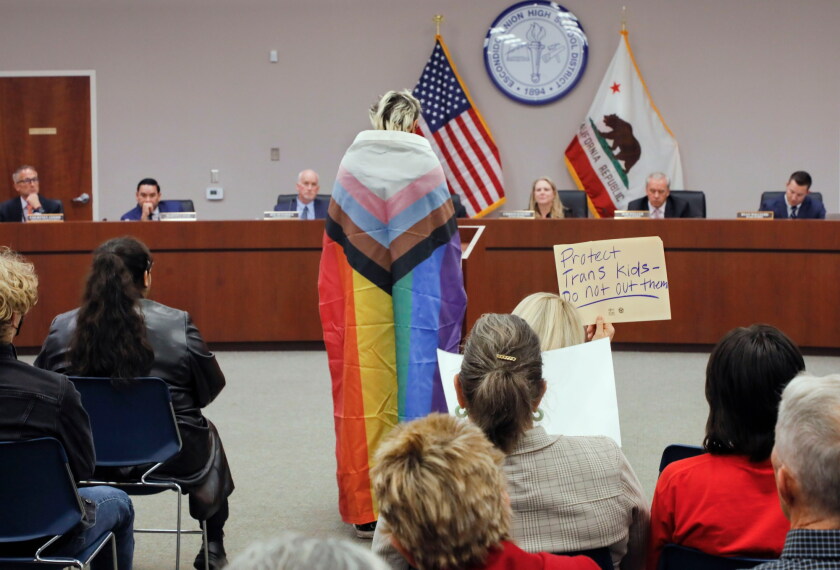
Teacher’s aide Amelia Mester, wrapped in a Pride flag, urges Escondido Union High School District not to have employees notify parents if they believe a student may be transgender in November 2025. A policy on the issue in the city’s elementary school district is the subject of a federal class-action lawsuit in which a judge just sided against the district.
Teacher’s aide Amelia Mester, wrapped in a Pride flag, urges Escondido Union High School District not to have employees notify parents if they believe a student may be transgender. A policy on the issue in the city’s elementary school district is the subject of a federal class-action lawsuit in which a judge just ruled against the district.
Charlie Neuman for The San Diego Union-Tribune/TNS
Law & Courts Federal Appeals Court Upholds 8th Grader's Expulsion Over Gun Comments in Class
Shortly after a nearby mass school shooting, a student allegedly discussed bringing a gun to school.
3 min read
Photo of stone columns.
E+