Special Report
Federal

Student Travels 3,000 Miles to Reunite With Parents

By Jaclyn Zubrzycki — June 01, 2012 2 min read
Adiel Granados, 17, reviews a quiz in his Advanced Placement Chemistry class at Wheaton High School in Silver Spring, Md. Born in El Salvador, the junior plans to go to college and become an engineer.
  • Save to favorites
  • Print

To get to the United States, 11-year-old Adiel Granados traveled more than 3,000 miles by land, leaving his grandparents’ home in El Salvador to live in Silver Spring, Md., with his parents. They had immigrated eight years earlier and settled into work—his father drives a recycling truck, and his mother works for a local government program for young, pregnant women—while Granados and his younger brother attended school in El Salvador.

Granados, now 17, said that as a child he missed his parents, who kept in touch over the phone but never returned to El Salvador. Though he always knew he would eventually make the move to the United States, he was nervous about the transition and leaving his friends.

After Granados and his brother finally arrived in Silver Spring, they found a large and well-established Salvadoran community, including several relatives. Many of his peers at Wheaton High School, where he is a junior and his brother is a freshman, also moved here from El Salvador or have parents or grandparents who made journeys similar to his.

The boys arrived in summer 2006. Their parents had already researched how to go about enrolling them in school, and Granados and his brother entered the Montgomery County public school system that fall. Granados entered an English-as-a-second-language program right away, and by 8th grade, he had exited the program.

Still, language was his biggest challenge, the teenager says. He has never had a Salvadoran teacher, and most of his teachers do not speak Spanish.

At first, since he spoke almost no English, “I could only make a certain kind of friend,” he says. “It was about a year before my English got good enough to make other friends.” But now, he says, he doesn’t stick to one group and is in classes with students from many backgrounds. “I’m from nowhere—I’ve never been a person [who] thought I represented my whole country,” he says. Since arriving in the United States, however, Granados says it sometimes seems as though “everyone [from El Salvador] is thought of as the same.”

Granados and his brother attended school in a suburban community in El Salvador, but learning the system at his new school in this country took time. “Here, there’s more money [in school], and it’s more organized,” he says. There, often, “no one was trying to learn.” Here, too, he sees peers who seem “discouraged,” he says, but he is set on college and has done well in school. Mathematics and science, in particular, made sense even as he was learning English.

According to Granados, the biggest difference between his home and school is the food. At home with his family, Granados mainly eats Salvadoran food like pupusas, whereas at Wheaton High, it’s “hamburgers and stuff I would never eat.”

At school, Granados plays soccer and is enrolled in several Advanced Placement courses. He takes his studies seriously and hopes to become an engineer. “I want to go to college because I like to learn and because I want to be a better person. It will open many opportunities to do better. My parents want me to do better than them,” Granados says. “And I want to help my parents so they can stop working.”

“I’m trying to help people see that it is possible” for Hispanic students to do well, he says. He tells classmates: “You can do better than you think. You have to try hard.”

Events

This content is provided by our sponsor. It is not written by and does not necessarily reflect the views of Education Week's editorial staff.
Sponsor
Artificial Intelligence Webinar
Managing AI in Schools: Practical Strategies for Districts
How should districts govern AI in schools? Learn practical strategies for policies, safety, transparency, and responsible adoption.
Content provided by Lightspeed Systems
This content is provided by our sponsor. It is not written by and does not necessarily reflect the views of Education Week's editorial staff.
Sponsor
Reading & Literacy Webinar
Two Jobs, One Classroom: Strengthening Decoding While Teaching Grade-Level Text
Discover practical, research-informed practices that drive real reading growth without sacrificing grade-level learning.
Content provided by EPS Learning
Jobs Virtual Career Fair for Teachers and K-12 Staff
Find teaching jobs and K-12 education jubs at the EdWeek Top School Jobs virtual career fair.

EdWeek Top School Jobs

Teacher Jobs
Search over ten thousand teaching jobs nationwide — elementary, middle, high school and more.
View Jobs
Principal Jobs
Find hundreds of jobs for principals, assistant principals, and other school leadership roles.
View Jobs
Administrator Jobs
Over a thousand district-level jobs: superintendents, directors, more.
View Jobs
Support Staff Jobs
Search thousands of jobs, from paraprofessionals to counselors and more.
View Jobs

Read Next

Federal Will the Ed. Dept. Act on Recommendations to Overhaul Its Research Arm?
An adviser's report called for more coherence and sped-up research awards at the Institute of Education Sciences.
6 min read
The U.S. Department of Education building is pictured on Oct. 24, 2025, in Washington, D.C.
The U.S. Department of Education building in Washington is pictured on Oct. 24, 2025. A new report from a department adviser calls for major overhauls to the agency's research arm to facilitate timely research and easier-to-use guides for educators and state leaders.
Maansi Srivastava for Education Week
Federal Trump Talks Up AI in State of the Union, But Not Much Else About Education
The president didn't mention two of his cornerstone education policies from the past year.
4 min read
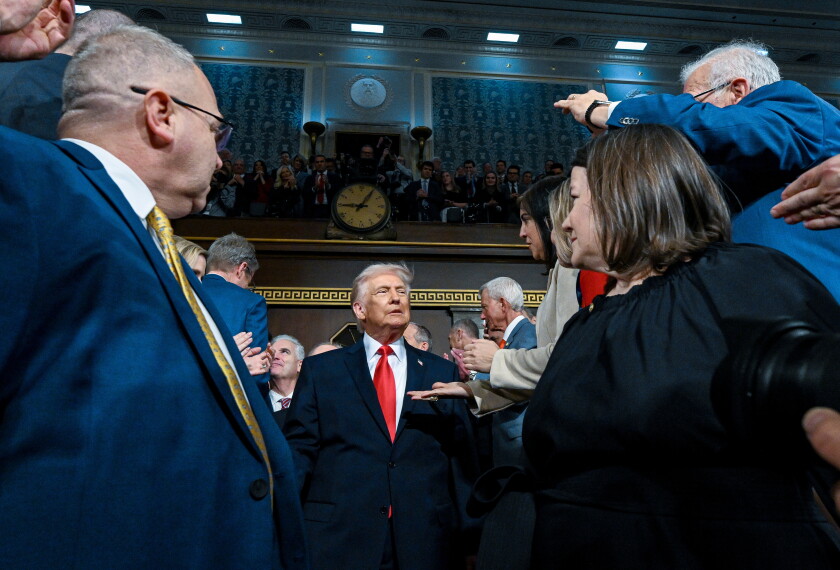
President Donald Trump enters to deliver the State of the Union address to a joint session of Congress in the House chamber at the U.S. Capitol in Washington, Tuesday, Feb. 24, 2026.
President Donald Trump enters to deliver the State of the Union address to a joint session of Congress in the House chamber at the U.S. Capitol in Washington, Tuesday, Feb. 24, 2026. The president devoted little time in the speech to discussing his education policies.
Kenny Holston/The New York Times via AP, Pool
Federal Education Department Will Send More of Its Programs to Other Agencies
Education grants for school safety, community schools, and family engagement will shift to Health and Human Services.
4 min read
Various school representatives and parent liaisons attend a family and community engagement think tank discussion at Lowery Conference Center on March 13, 2024 in Denver. One of the goals of the meeting was to discuss how schools can better integrate new students and families into the district. Denver Public Schools has six community hubs across the district that have serviced 3,000 new students since October 2023. Each community hub has different resources for families and students catering to what the community needs.
A program that helps state education departments and schools improve family engagement policies is among those the Trump administration will transfer from the U.S. Department of Education to the U.S. Department of Health and Human Services. In this photo, school representatives and parent liaisons attend a family and community engagement discussion on March 13, 2024, in Denver to discuss how schools can better integrate new students and families into the district.
Rebecca Slezak For Education Week
Federal New Trump Admin. Guidance Says Teachers Can Pray With Students
The president said the guidance for public schools would ensure "total protection" for school prayer.
3 min read
MADISON, AL - MARCH 29: Bob Jones High School football players touch the people near them during a prayer after morning workouts and before the rest of the school day on March 29, 2024, in Madison, AL. Head football coach Kelvis White and his brother follow in the footsteps of their father, who was also a football coach. As sports in the United States deals with polarization, Coach White and Bob Jones High School form a classic tale of team, unity, and brotherhood. (Photo by Jahi Chikwendiu/The Washington Post via Getty Images)
Football players at Bob Jones High School in Madison, Ala., pray after morning workouts before the rest of the school day on March 29, 2024. New guidance from the U.S. Department of Education says students and educators can pray at school, as long as the prayer isn't school-sponsored and disruptive to school and classroom activities, and students aren't coerced to participate.
Jahi Chikwendiu/Washington Post via Getty Images