States have made progress in building data systems that track student performance over time, but are behind the curve in sharing the information in a way that leads to meaningful decisionmaking, according to a national survey released today.
The Data Quality Campaign, a foundation-funded organization in Washington that promotes and tracks the use of data in education, has been focused since 2005 on identifying the key components of state data systems and pushing for their development. Now that much of that work is under way, the group is shifting its focus to describe and promote the use of the data.
“The education sector is on the cusp of becoming an information-based enterprise,” the report says. “But reaching this goal depends on states taking actions that change the historically entrenched culture of using data for compliance reporting into one that values analysis of data and prioritizes constant communication to all stakeholders of the education system.”
The movement to create state data systems got a boost from the American Recovery and Reinvestment Act, because states had to agree to complete their data systems by 2011 in order to receive money from the stimulus act’s State Fiscal Stabilization Fund.
This year’s survey marks the first time the DQC has released information on states’ efforts in 10 areas the group believes will make data use more prevalent.
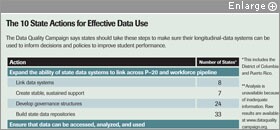
The Data Quality Campaign says states should take these steps to make sure their longitudinal-data systems can be used to inform decisions and policies to improve student performance.
SOURCE: Data Quality Campaign
“While it is a monumental task to build the infrastructure to do this, it is an even more monumental task to help people understand how to access this information, how to use the information, and to change the education culture to teach people how to take this information into account on a daily basis,” said Aimee R. Guidera, the executive director of the Data Quality Campaign.
With stimulus money driving the construction of the systems, Ms. Guidera said, state policymakers need to seize the opportunity to make them so useful that education leaders will be willing to fight for sustaining the data infrastructure in coming years, when state budgets will be cash-strapped and funding will be harder to maintain.
“I applaud the Data Quality Campaign for challenging states to not only develop good data systems, but put them to use,” U.S. Secretary of Education Arne Duncan said in a statement on the report. “While we need to expose the good, the bad, and the ugly about our schools, the Data Quality Campaign recognizes that assessing where we are at is only the first step.”
Work to Do
In a November survey, DQC reported that 44 states collect data that can identify the schools producing the strongest academic growth for students, up from 21 states in 2005. In addition, 47 states now have the components needed to calculate a longitudinal graduation rate using the method agreed upon in 2005 via a National Governors Association compact. (“Report Finds States on Course to Build Pupil-Data Systems,” Dec. 2, 2009.)
The new report specifies 10 state actions necessary for effective data use. But 43 states have taken three or fewer of the actions, which call for states to expand their data systems to include higher education and workforce information; ensure that the data can be accessed, analyzed, and used; and build the capacity of stakeholders to use the data.
Just eight states had linked their K-12 data systems with others in the state, for example, including postsecondary education, workforce information, and social service agencies, the report found. They are required to create such linkages in order to receive money from the second phase of the State Fiscal Stabilization Fund, it notes.
Part of the culture shift Ms. Guidera wants to see is one where local and state agencies are proactive in sharing data with administrators, teachers, the news media, and other members of the public, rather than waiting for requests. And that information, she said, needs to be presented in ways that are readily understandable and meet the needs of those groups.
The group will offer technical assistance to states in helping to develop policy frameworks that allow for easier integration of data collected across state agencies into a useful format, she said.
Data Leaders Named
To help highlight the type of leadership the DQC believes is necessary, the group last week honored policymakers and educators who have made substantial progress in promoting data use.
Mickey Garrison, the school improvement director for Oregon’s Education Enterprise Steering Committee, was named as State data director of the year for her work as the training director for the Oregon Direct Access to Achievement, or DATA, Project, which has brought together the state’s education department, universities, school districts, and others to focus on making sure teachers are trained in how to use data in a way that helps them improve instruction.
Ms. Garrison said the project set out to bridge a key gap for educators in the state’s 198 school districts.
“Data is in the forefront in education,” she said in an interview. “Teachers and administrators are being told to use data to do program evaluations, to align their curriculum, and to ensure they are meeting students’ needs. But often what we do in education is, we identify what people need to do, but we don’t help them understand how to do it.”
Key to the project’s success, Ms. Garrison said, was making sure teachers receive ongoing, on-the-job training that is done within the context of the needs and culture of their schools and districts.
“The implementation and sustainability support, and the nuances that surround individual teacher teams and each school and district, are really critical to take into consideration to make any change long-lasting,” she said.
For his efforts in promoting the power of data in schools, Peter C. Gorman, the superintendent of the Charlotte-Mecklenburg, N.C., school district was named data leader of the year.
A group of four Illinois policymakers won the award for state policymaker of the year for pulling together the state’s education community to get a law passed guiding the state’s building and use of a longitudinal data system. The law, passed last year, requires the state to collect student records and integrate them with management tools.
“We wanted to celebrate the collaborative leadership of that work and the fact it was very public,” Ms. Guidera said. “We think it was a model that a lot of states can benefit and learn from.”
Over the next four years, the Data Quality Campaign will continue to produce surveys as a way to help states learn from the best practices in other states and highlight policies and strategies that are especially effective, she said.


