
Since the mid-1960s, a far-flung system of regional laboratories has served as the federal government’s bridge between research and practice in education.
Until recently, many of those labs had been run by the same organizations since the program’s inception. Education administrators had long called on the labs for professional-development programs, management help, research reviews, and various other expert services.
Those long-standing relationships were jolted last spring, however, when the Institute of Education Sciences, the arm of the U.S. Department of Education that oversees the labs, announced the results of its latest laboratory competition.
Under the new five-year contracts, the 10 regional labs received new missions, and in four cases, new operators. Their new charge is to spend more time doing slow, careful, and rigorous education research and less time on some of the constituent services that some educators in the field had been used to getting.
Now, nearly a year later, the shift in focus is prompting complaints from some longtime customers.
Those practitioners say they support the Education Department’s efforts to nurture better-quality studies in education. But that kind of research takes time, they note, and with state and federal accountability deadlines looming, such educators say time is a luxury they don’t have.

“It’s like the labs have been shrink-wrapped into this research mode,” said Polly Feis, Nebraska’s deputy commissioner of education and a member of the governing board for the Central Regional Education Laboratory, which has long been run by Mid-Continent Research for Education and Learning, in Denver. “We’ve been so used to getting quality expert responses from them quickly, so it’s kind of like we’re left without something.”
Rigor vs. Relevance
The Nebraska educator was among a number of governing-board members from around the country who voiced concerns about the labs’ change in emphasis during a meeting last month in Washington with IES officials.
The U.S. Department of Education contracts with private organizations to run 10 regional education labs charged with disseminating research findings, undertaking their own long-term studies, and conducting short-term research projects.
*Click image to see the full chart.
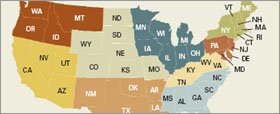
SOURCE: U.S. Department of Education
Tensions have not cropped up in every federal-laboratory region. But an informal survey by Education Week suggests that laboratory governing-board members in at least four regions have concerns about the labs’ change in direction.
In fact, the board for WestEd, the San Francisco-based lab that serves Arizona, California, Nevada, and Utah, passed a resolution on the subject at its regular meeting in January.
Urging that “rigor not compromise relevance,” the resolution called on staff members at the regional education lab “to work with IES to assure relevance as defined by the region and increase timeliness of delivery as well as rigor.”
Institute officials, for their part, said the concerns may be a temporary part of the transition for the labs as they grow accustomed to their new missions.
The stepped-up emphasis on rigorous research grows out of the institute’s campaign—a priority for the Bush administration—to foster more education studies that are “scientifically based.” Through studies seen as more scientifically credible, federal officials hope to transform the field into an “evidence based” practice akin to medicine.
Officials say the labs also have to assume new roles to avoid duplicating the work of the federally financed network of 20 regionally based comprehensive-assistance centers. The centers were created two years ago to advise states and districts on complying with the No Child Left Behind Act and offer technical assistance in specialized areas, such as special education.
“I think it’s a question of adjusting and trying to understand what the new regional-education-laboratory program is,” said Phoebe H. Cottingham, the commissioner of the National Center for Education Evaluation and Regional Assistance, which oversees the lab system for the IES. “We expect the labs will come to know what their niche is.”

Under their new contracts, the labs must divide their time equally among three activities: dissemination, research, and rapid-response projects. The last category refers to studies that can be turned around in 12 months.
The problem, some members of the regional labs’ governing boards say, is that “rapid response” hasn’t been rapid enough. None of the 60 projects begun in the labs’ first contract year has yet been published, according to federal research officials. Ms. Cottingham said most of those projects are in review; 10 to 12 have yet to be submitted.
“It’s great to have all this rigorous research, but we would also like quick response to be quick response,” said Deanna D. Winn, who chairs WestEd’s board and recently retired from her job as associate commissioner for higher education in Utah.
The slowdown stems in part from new requirements that applied to the new laboratory contracts, including one that all lab-produced studies had to be vetted by outside peer-review panels twice—once in the beginning to get the proposals approved and again once the studies had been completed.
Under another federal directive, rapid-response projects were required to be completed within a contract year. That led some labs to postpone study requests that came too late to be completed by the contract year’s end.
In response to the concerns about timeliness, the Institute of Education Sciences in recent weeks changed its rules to allow rapid-response projects to straddle two contract years.
In addition, lab researchers may now release a small percentage of rapid-response studies before they are peer-reviewed, Ms. Cottingham said. Instead, those reports can now be vetted at the end of the contract year, when the labs undergo general performance reviews.
‘Decisions in a Vacuum’
Ms. Cottingham said the lab system plans to set up a centralized “reference desk” for practitioners and policymakers who want to know what research says about a particular topic.
The IES is also producing practice guides that will synthesize the “best available evidence”—rigorous studies, studies that fall short of that benchmark, and practitioner wisdom—and add another layer of practical help.
“It is true that maybe in the past, for instance, more attention was paid in the labs to running seminars for teachers, but there are now many people who do professional-development services,” Ms. Cottingham said. “Now the focus is on what do we know about professional-development strategies.”
Whether the recent IES efforts will address board members’ concerns in all 10 regions remains to be seen.
“They’re a step in the right direction,” said David V. Abbott, the deputy commissioner of the Rhode Island Department of Elementary and Secondary Education. He sits on the governing board for the Northeast and Islands Regional Education Laboratory, run by the Newton, Mass.-based Education Development Center, which wants more flexibility for the labs.
“We don’t need it to be perfect,” he added. “We just need more answers than we currently have, because we’re out here making decisions in a vacuum.”
Coverage of education research is supported in part by a grant from the Spencer Foundation.


