Federal

Senate Panel OKs Voc. Ed. Reauthorization

By Michelle R. Davis — October 02, 2004 3 min read
  • Save to favorites
  • Print

The Senate education committee last week unanimously approved a bill to reauthorize the main federal vocational education law, but its prospects for final passage remain uncertain.

Several key differences remain between the House and Senate bills for renewing the Carl D. Perkins Vocational and Technical Education Act of 1998, which is set to expire this year.

“Given the hang-ups we’ve had with other bills in similar circumstances, it is difficult to predict” whether work on the bill will be finished this year, said Gayle Osterberg, a spokeswoman for Republicans on the Senate Health, Education, Labor, and Pensions Committee.

Measures to reauthorize the Individuals with Disabilities Education Act, the Head Start program, and the Higher Education Act have also languished in the current Congress, although the IDEA bill made progress last week. (“IDEA Reauthorization Gets Boost as House, Senate Plan Discussions,” this issue.)

“This legislation will help provide more benefits to people who need jobs or want better jobs by creating better pathways for academic and vocational skills enhancement,” said Sen. Michael B. Enzi, R-Wyo., a co-sponsor of the bill.

The Senate version of the vocational education bill does not include some controversial proposals put forward by President Bush earlier this year. In May, the president proposed a series of overhauls to the vocational program, including the replacement of two existing streams of federal funding with a single program for distributing the money, to be called the Secondary and Technical Education Excellence Program. (“Bush Plan Calls for More Rigor in Vocational Education,” June 9, 2004.)

Advocacy groups worried that the result would be a cut to the $1.3 billion program, said Christin M. Driscoll, the senior director of public policy for the Association for Career and Technical Education, in Alexandria, Va. The Senate bill would keep the two current sources of federal vocational funding, state grants and Tech Prep, separate.

“By and large the committee chose to keep the structural integrity of Perkins intact,” Ms. Driscoll said. “The president’s proposal would have amounted to significant changes in the program, and we’re pleased that those in Congress ... listened to the education community, which said, ‘This is a program that works.’”

However, the House version of the bill, which is awaiting a floor vote after being approved by the House Education and the Workforce Committee on July 21, would merge the Tech Prep and state grants, Ms. Driscoll said.

The Senate version of the bill emphasizes stronger academic and technical skills for students. It would require states to support local programs developing “career pathways” designed to improve graduation rates and lead students from secondary schools to postsecondary education and training. It would also require that businesses be consulted in the drafting of state and local plans.

The bill also calls for increased accountability. It emphasizes the importance of testing students in math and reading, core academic subjects required to be tested by the No Child Left Behind Act, to make sure they’re held to the same standards that other students must meet.

The Senate plan would allow states to withhold funds if local programs did not improve after a period of intervention.

A Change in Wording

It also emphasizes the importance of a strong state role in vocational education. It would keep the 15 percent allocation of funding that states are allowed to keep for administrative and other costs and remove some strictures on how that money must be spent.

The Senate bill would continue the current law’s mandate that 85 percent of federal vocational education money be distributed to local programs. The House version would let states keep no more than 12 percent of the federal funds for state-level costs, funneling more money to the local level.

For the technical education community, one of the most important aspects of the Senate bill is a wording change, Ms. Driscoll said.

Language throughout the bill has been changed from “vocational education” to “career and technical education.” Some consider the term “vocational education” outdated. The House version of the bill does not reflect this change in language.

“That kind of language reflects what’s happening in the field, with career and technical education moving forward in many areas and keeping up with current technical and training standards,” Ms. Driscoll said. “We’re constantly updating and adding new technology.”
Related Tags:

Events

This content is provided by our sponsor. It is not written by and does not necessarily reflect the views of Education Week's editorial staff.
Sponsor
Artificial Intelligence Webinar
Managing AI in Schools: Practical Strategies for Districts
How should districts govern AI in schools? Learn practical strategies for policies, safety, transparency, as well as responsible adoption.
Content provided by Lightspeed Systems
This content is provided by our sponsor. It is not written by and does not necessarily reflect the views of Education Week's editorial staff.
Sponsor
Reading & Literacy Webinar
Unlocking Success for Struggling Adolescent Readers
The Science of Reading transformed K-3 literacy. Now it's time to extend that focus to students in grades 6 through 12.
Content provided by STARI
Jobs Virtual Career Fair for Teachers and K-12 Staff
Find teaching jobs and K-12 education jubs at the EdWeek Top School Jobs virtual career fair.

EdWeek Top School Jobs

Teacher Jobs
Search over ten thousand teaching jobs nationwide — elementary, middle, high school and more.
View Jobs
Principal Jobs
Find hundreds of jobs for principals, assistant principals, and other school leadership roles.
View Jobs
Administrator Jobs
Over a thousand district-level jobs: superintendents, directors, more.
View Jobs
Support Staff Jobs
Search thousands of jobs, from paraprofessionals to counselors and more.
View Jobs

Read Next

Federal Ed. Dept. Wants to Revamp Assistance Program It Calls 'Duplicative,' 'Confusing'
The department's Comprehensive Centers have already been through a year of shakeups.
3 min read
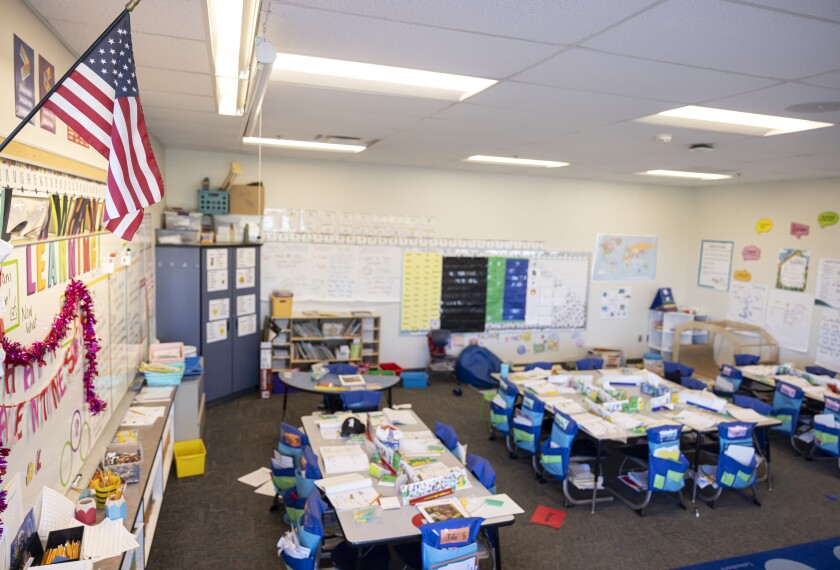
A first grade classroom at a school in Colorado Springs, on Feb. 12, 2026.
A 1st grade classroom at a school in Colorado Springs, Colo., on Feb. 12, 2026. The U.S. Department of Education released a proposal to rework a decades-old program charged with helping states and school districts problem-solve and deploy new initiatives, calling the current structure “duplicative” and “confusing.”
Kevin Mohatt for Education Week
Federal Will the Ed. Dept. Act on Recommendations to Overhaul Its Research Arm?
An adviser's report called for more coherence and sped-up research awards at the Institute of Education Sciences.
6 min read
The U.S. Department of Education building is pictured on Oct. 24, 2025, in Washington, D.C.
The U.S. Department of Education building in Washington is pictured on Oct. 24, 2025. A new report from a department adviser calls for major overhauls to the agency's research arm to facilitate timely research and easier-to-use guides for educators and state leaders.
Maansi Srivastava for Education Week
Federal Trump Talks Up AI in State of the Union, But Not Much Else About Education
The president didn't mention two of his cornerstone education policies from the past year.
4 min read
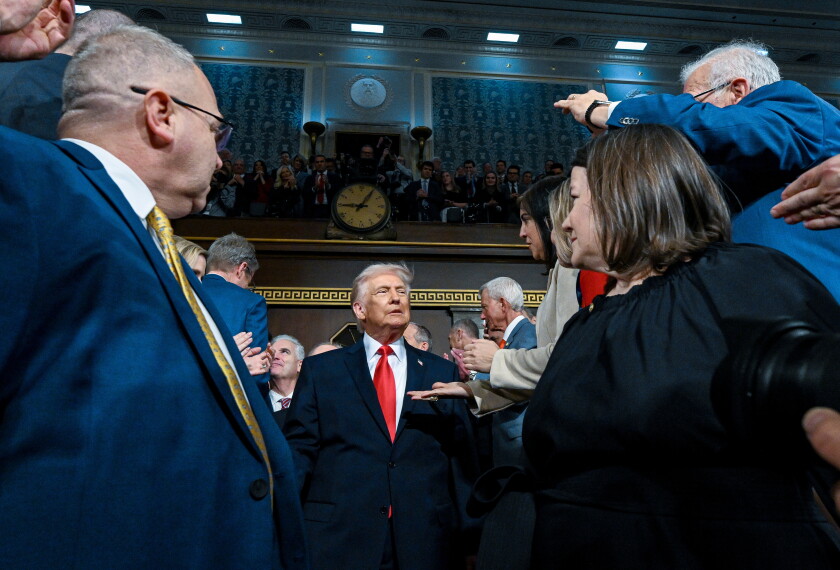
President Donald Trump enters to deliver the State of the Union address to a joint session of Congress in the House chamber at the U.S. Capitol in Washington, Tuesday, Feb. 24, 2026.
President Donald Trump enters to deliver the State of the Union address to a joint session of Congress in the House chamber at the U.S. Capitol in Washington, Tuesday, Feb. 24, 2026. The president devoted little time in the speech to discussing his education policies.
Kenny Holston/The New York Times via AP, Pool
Federal Education Department Will Send More of Its Programs to Other Agencies
Education grants for school safety, community schools, and family engagement will shift to Health and Human Services.
4 min read
Various school representatives and parent liaisons attend a family and community engagement think tank discussion at Lowery Conference Center on March 13, 2024 in Denver. One of the goals of the meeting was to discuss how schools can better integrate new students and families into the district. Denver Public Schools has six community hubs across the district that have serviced 3,000 new students since October 2023. Each community hub has different resources for families and students catering to what the community needs.
A program that helps state education departments and schools improve family engagement policies is among those the Trump administration will transfer from the U.S. Department of Education to the U.S. Department of Health and Human Services. In this photo, school representatives and parent liaisons attend a family and community engagement discussion on March 13, 2024, in Denver to discuss how schools can better integrate new students and families into the district.
Rebecca Slezak For Education Week