Promising to put more money in taxpayers’ pockets, Republicans won the heated New Jersey and Virginia gubernatorial races last week. But the GOP momentum did not extend to legislatures, where the balance of power remained unchanged in the 11 states with legislative elections.
In two major school bond ballots, New Yorkers convincingly defeated a $2.4 billion school construction bond, while Oregonians easily approved a $150 million lottery fund for school improvement.
“This is a relatively benign time, and the public is not angry,” said Thomas E. Mann, the director of governmental studies for the Brookings Institution, a centrist think tank in Washington. “It’s a good time for incumbents.”
Encouraging Signs
Whether the election results will bring good times for education remains an open question. In New Jersey, educators are hopeful that a school funding dividend could be a byproduct of the governor’s race. And, one day after his win, Virginia’s governor-elect promised to make education as important as his popular tax-cut proposal.
|
Last week, Gov. Christine Todd Whitman of New Jersey barely held on to her job, beating Democratic state Sen. James E. McGreevey by 1 percentage point, or 26,000 votes. Libertarian candidate Murray Sabrin captured a 5 percent of the vote.
During a hard-fought campaign that had the candidates tied much of the way, Mrs. Whitman and Mr. McGreevey each claimed to have the best plan for rigorous classrooms and early education opportunities. (“Education Prominent in N.J. Governor’s Race,” Oct. 29, 1997.)
But Mrs. Whitman likely owes her victory to her last-minute advertisements acknowledging voter anger over property taxes and high auto-insurance rates.
Frank Belluscio, the spokesman for the New Jersey School Boards Association, hopes that the governor will seek property-tax relief by raising the state share of school spending, which is now 38 percent.
“A look at property taxes is long overdue,” Mr. Belluscio said last week. “Voters said property taxes are too high, and Ms. Whitman said, ‘I’ve heard you.’”
‘A Model’
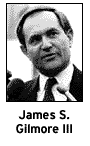
In Virginia, voters apparently liked a promise by Republican James S. Gilmore III to phase out the annual state personal-property tax on automobiles over the next five years. The former state attorney general won easily with 56 percent of the votes. Democratic nominee Donald S. Beyer Jr., the state’s current lieutenant governor, collected 43 percent. (“Va. Gubernatorial Hopefuls Debate Education,” Oct. 22, 1997.)
Mr. Beyer, who owns a car dealership in northern Virginia, was endorsed by the Virginia Education Association. While pledging to raise teacher salaries, he also said that ending the “car tax” would lower school aid.
|
But in his victory speech, Mr. Gilmore reiterated his campaign promise to hire 4,000 additional classroom teachers to help shrink class sizes in grades K-6. “No student should get lost because a class is too big,” he said.
At a press conference the next day, he told reporters he would not rush the tax cut because doing so would force cuts in social programs. “We certainly want to make sure that we deliver on our promise of excellence in education,” he said.
David C. Blount, the lobbyist for the Virginia School Boards Association, said he believes that Mr. Gilmore will continue to make schools a priority.
“We’ve talked to Mr. Gilmore’s policy people, and they’ve been very knowledgeable and willing to listen,” he said. “That’s very encouraging.”
Mr. Blount said he hopes that Mr. Gilmore will show some flexibility on the school accountability standards pushed by outgoing Republican Gov. George F. Allen, who could not succeed himself, and approved in September by the state school board. For example, local school boards want the new, test-based school accreditation standards to include other criteria, such as student portfolios. The standards will come under legislative scrutiny next year.
The school boards’ group could also butt heads with Mr. Gilmore over school vouchers, which it opposes. The governor-elect has not proposed a voucher plan, but, speaking on the issue during the Nov. 5 press briefing, he said, “I simply would want to leave every tool on the table.”
Republicans also won Virginia’s races for lieutenant governor and attorney general. That means that for the first time this century, none of the three elected statewide posts will be held by a Democrat. Further, the new Republican lieutenant governor, John Hager, gives his party the tie-breaking vote in the state Senate, where each party has 20 members.
Jim Nicholson, the chairman of the Republican National Committee, said the Virginia campaigns “are going to become a model that we are going to study and follow around the country next year.”
Elsewhere, 226 seats were contested in legislative ballots in 11 states. Going into those races, Democrats controlled 50 state legislative chambers, Republicans held a majority in 46, and two were tied. The numbers were unchanged by last week’s elections.
N.Y. Nixes Bond
Voters in New York, meanwhile, elected last week not to change spending on school construction. They rejected a state bond that called for $2.4 billion in funding to cover school renovation, repairs, and technology upgrades.
The ballot measure, Proposal 3, failed to spell out how, when, and where the money would be spent. In the end, suspicion over the vaguely worded measure helped bring about a 52 percent “no” vote.
Mike Long, the chairman of the state chapter of the Conservative Party, which campaigned against the bond, said, “The message to the legislature is clearly that voters aren’t going to approve a blank check.”
While agreeing that the measure lacked details, Proposal 3 backers argued that something had to be done to improve school facilities. “We maintain that it was not good enough reason to reject this,” said Linda Rosenblatt, the spokeswoman for the New York State United Teachers, the state affiliate of the American Federation of Teachers.
The Albany-based group and New York City business leaders pushed the bond to help remedy an estimated $15 billion in school facility needs.
Schools in Oregon were more fortunate. By an overwhelming 75 percent, Oregon voters passed Measure 52, a plan that will allow the state to sell up to $150 million in bonds to set up a school improvement fund.
One of the reasons for the measure’s popularity, according to state school officials, is that taxes will not be raised to repay the bonds. Instead, the debt will be repaid with state lottery revenues.


