Law & Courts

Ruling Sends Kansas Back to Square One on K-12 Funding

By Daarel Burnette II — October 10, 2017 3 min read
  • Save to favorites
  • Print

After years of frustrating and politically contentious wrangling over school funding, Kansas policymakers find themselves back at the drawing board in the wake of that state’s supreme court ruling that struck down the latest K-12 funding method as unconstitutional because it still fails to assure an “adequate” and “equitable” public education for the state’s nearly 500,000 students.

Though the court gave state lawmakers until the middle of next year to come up with a new system, that’s likely to do little to cool the tensions the fight has set off between state and local officials, or the bad blood between legislators and the judges they say are overstepping their mandate.

“This ruling shows clear disrespect for the legislative process and puts the rest of state government and programs in jeopardy,” stated Republican Senate leaders Susan Wagle, Jeff Longbine, and Jim Denning in response to the Oct. 2 ruling. “As promised, Senate Republicans remain committed to providing every Kansas student with an exceptional education; however, raising taxesto fund this unrealistic demand is not going to happen.”

Republican Gov. Sam Brownback in a statement called the ruling “another regrettable chapter in the never-ending cycle of litigation over Kansas school funding. The court should not substitute its decision for that of the legislature.”

But the ruling brought elation amongst the state’s public school officials and their lawyers.

“It’s another in a line of great court decisions for Kansas kids,” said John Robb, one of the plaintiff’s lawyers. “The court has recognized multiple times that Kansas kids are not getting what the constitution guarantees them.”

Falling Short

In its fifth ruling regarding the case, the state’s high court rejected the latest formula that included a $293 million spending increase this fiscal year for K-12 in an attempt to satisfy the court’s demand. The court also said expanding local tax revenue leads to a public school system of haves and have nots.

Lawyers for the four districts that originally sued the state in the Gannon v. Kansas case said districts should be given more flexibility in spending and that nothing less than $893 million over the next two years—a number based on a 2016 ruling by the state’s high court — would satisfy the constitutionalrequirement or help districts close achievement gaps. The state is spending close to $4.3 billion on K-12 in the current fiscal year.

“While we stay the issuance of today’s mandate through June 30, 2018, after that date we will not allow ourselves to be placed in the position of being complicit actors in the continuing deprivation of a constitutionally adequate and equitable education owed to hundreds of thousands of Kansas schoolchildren,” the judges said in the tersely worded ruling.

The justices asked lawmakers to present something before April 30 of next year so the court will have time before the next school year commences to determine whether the funding formula passes muster.

The funding formula, approved in the waning days of the legislature’s session this year, more closely dictated how schools should spend their money, cracked down on academically wayward schools, and expanded the use of all-day kindergarten and vouchers. The state’s attorney general said the spending methods would dramatically improve educational outcomes and that the court should be patient to see how effective the funding formula was.

Almost a quarter of the state’s students don’t meet basic reading and writing standards.

The legislature, already dealing with a series of spending cuts after a years-longrevenue shortfall, will now have to figure out how to raise more money to spend on its public schools—and do so facing a deadline in the 2018 election year. Legislators have been reluctant to raise taxes, though a growing chorus of teachers and parents in the state have pushed for more spending on schools.

The ruling also will likely amp up the ongoing and closely watched battle between the state’s Republican-dominated legislature and the appointed supreme court over who should decide how to spend money on public schools and how to close an achievement gap between the state’s wealthier, white students and its poor and minority students.

The state’s legislature has said in the past that the court is out of its lane in telling legislatures how to spend. As in previous rulings, the Oct. 2 decision found the funding formula unconstitutional, but did not tell the state how much to spend or what to spend the money on. It also did not give many clues as to how the state should work to improve its schools.

A political effort to unseat the judges and change the language of the state’s constitution in 2016 failed.

A version of this article appeared in the October 11, 2017 edition of Education Week as Ruling Sends Kansas Back to Square One on K-12 Funding

Events

This content is provided by our sponsor. It is not written by and does not necessarily reflect the views of Education Week's editorial staff.
Sponsor
Artificial Intelligence Webinar
Managing AI in Schools: Practical Strategies for Districts
How should districts govern AI in schools? Learn practical strategies for policies, safety, transparency, and responsible adoption.
Content provided by Lightspeed Systems
This content is provided by our sponsor. It is not written by and does not necessarily reflect the views of Education Week's editorial staff.
Sponsor
Reading & Literacy Webinar
Two Jobs, One Classroom: Strengthening Decoding While Teaching Grade-Level Text
Discover practical, research-informed practices that drive real reading growth without sacrificing grade-level learning.
Content provided by EPS Learning
Jobs Virtual Career Fair for Teachers and K-12 Staff
Find teaching jobs and K-12 education jubs at the EdWeek Top School Jobs virtual career fair.

EdWeek Top School Jobs

Teacher Jobs
Search over ten thousand teaching jobs nationwide — elementary, middle, high school and more.
View Jobs
Principal Jobs
Find hundreds of jobs for principals, assistant principals, and other school leadership roles.
View Jobs
Administrator Jobs
Over a thousand district-level jobs: superintendents, directors, more.
View Jobs
Support Staff Jobs
Search thousands of jobs, from paraprofessionals to counselors and more.
View Jobs

Read Next

Law & Courts Appeals Court Blocks Ruling Bolstering Parental Rights Over Gender Identity
A federal appeals court blocked a groundbreaking ruling over the disclosure of students' gender identities.
4 min read
Students carrying pride flags and transgender flags leave Great Oak High School on Sept. 22, 2023, in Temecula, Calif., after walking out of the school in protest of the Temecula school district policy requiring parents to be notified if their child identifies as transgender.
Students carrying pride flags and transgender flags leave Great Oak High School on Sept. 22, 2023, in Temecula, Calif., after walking out of the school in protest of the Temecula school district policy requiring parents to be notified if their child identifies as transgender. But many districts in California follow a state policy limiting when schools can inform parents about a student's gender identity without the student's consent.
Anjali Sharif-Paul/The Orange County Register via AP
Law & Courts Appeals Court Halts Ruling Letting Teachers Disclose Students' Gender Identity
A federal appeals court has temporarily paused enforcement of the ruling but has not yet decided whether to grant a longer-term stay.
Kristen Taketa, The San Diego Union-Tribune
3 min read
Students carrying pride and transgender flags leave Great Oak High School in Temecula, Calif., on Sept. 22, 2023, after walking out of the school in protest of the Temecula school district policy requiring parents to be notified if their child identifies as transgender.
Anjali Sharif-Paul/The Orange County Register via AP
Law & Courts Schools Can’t Bar Teachers From Telling Parents If Kids Are Transgender, Judge Rules
The injunction bans any public school employee from misleading parents about their child’s gender presentation at school.
Kristen Taketa, The San Diego Union-Tribune
5 min read
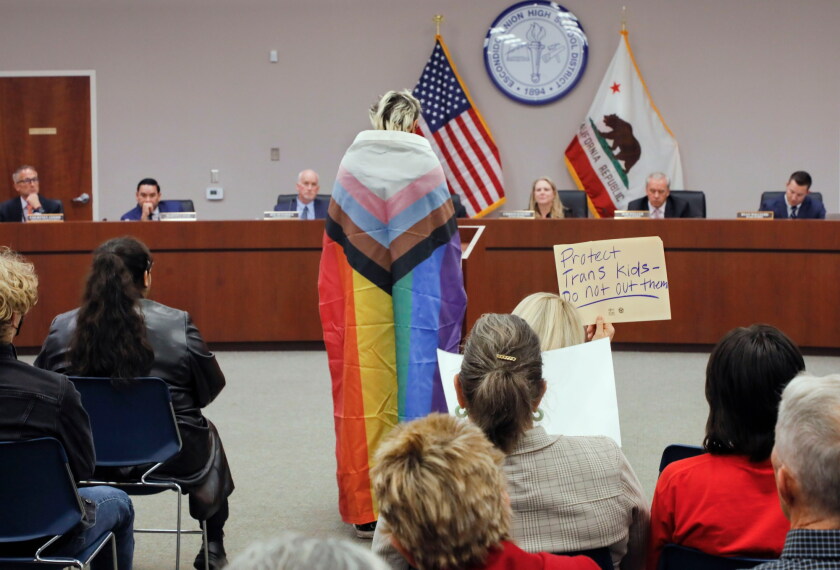
Teacher’s aide Amelia Mester, wrapped in a Pride flag, urges Escondido Union High School District not to have employees notify parents if they believe a student may be transgender in November 2025. A policy on the issue in the city’s elementary school district is the subject of a federal class-action lawsuit in which a judge just sided against the district.
Teacher’s aide Amelia Mester, wrapped in a Pride flag, urges Escondido Union High School District not to have employees notify parents if they believe a student may be transgender. A policy on the issue in the city’s elementary school district is the subject of a federal class-action lawsuit in which a judge just ruled against the district.
Charlie Neuman for The San Diego Union-Tribune/TNS
Law & Courts Federal Appeals Court Upholds 8th Grader's Expulsion Over Gun Comments in Class
Shortly after a nearby mass school shooting, a student allegedly discussed bringing a gun to school.
3 min read
Photo of stone columns.
E+