Opinion
Law & Courts Opinion

How (and When) Researchers Should Speak Truth to Power

Four guidelines for academics who want to participate in heated education debates
By Pedro A. Noguera — January 16, 2018 2 min read
  • Save to favorites
  • Print

In many respects, the polarization that characterizes the national political climate has long been present in the debates over the direction of public education, which took a particularly rancorous turn with the enactment of No Child Left Behind 16 years ago. Fierce conflicts over the expansion of charter schools, school closures, high-stakes testing, teacher evaluation, and the merits of the common core have been common in communities across the country. Unlike the current political debates over immigration, taxes, and healthcare, which typically pit Republicans against Democrats, the fault lines in these long-running conflicts over education have frequently put leaders in the Democratic Party against constituencies that are typically regarded as a stable part of their base, namely teachers’ unions and parents and activists in low-income communities of color.

Not surprisingly, some academics (myself included) have chosen to weigh in on these education conflicts. Some have participated actively out of a sense of moral obligation because the research they have done has a direct bearing on the issues under debate. Others have done so because of their close political or ideological alignment to one side or the other. Most do quickly learn that becoming embroiled in such heated debates, especially when the stakes are high, always comes with risks to reputation, and in some cases, even job security.

Commentary Collection

BRIC ARCHIVE

In this special collection of Commentary essays, Frederick M. Hess and four education scholars discuss the pros and cons for academics who want to wade into public debate.

Read more from the collection.

Having participated in some of these battles over the years, I have arrived at an understanding about how and when to intervene in the debate through our scholarship and writing. Here are criteria that I have found helpful:

1) Avoid calling upon others to take stands that you are not taking yourself. For example, although I have been critical of high-stakes testing for many years, I have never encouraged parents to “opt out.” I feel that this is a decision that each parent must make on their own, and while I feel it is appropriate to explain the merits and drawbacks associated with high-stakes testing, I draw the line at telling parents what to do with their children.

2) Only enter conflicts in which you have a knowledgeable position that can be supported by research. This may seem like an obvious rule of thumb, but I have seen many scholars drawn into debates where they lack the expertise to offer well-reasoned positions. Invariably, their reputations are sullied when it turns out they can’t effectively defend a position they have taken.

3) Don’t be afraid to acknowledge the complexity of an issue even if it angers some people who want you to declare your allegiance to their position. For example, I have been asked repeatedly to weigh-in on the debate over charters and single-gender schools. My answer has consistently been that some are good, some are not, and there’s no evidence to suggest that expanding either will lead to significant improvements in educational outcomes.

4) Don’t be afraid of speaking truth to power. If you are confident about your position on an issue, don’t be afraid of speaking out or writing on the issue. Even if your position may be at odds with the position of powerful political or economic interest groups, you shouldn’t hesitate to speak for the interests of vulnerable and disadvantaged children. Sometimes, silence is a form of complicity.

Related Tags:

A version of this article appeared in the January 17, 2018 edition of Education Week as How to Decide When Your Voice Is Necessary

Events

This content is provided by our sponsor. It is not written by and does not necessarily reflect the views of Education Week's editorial staff.
Sponsor
Artificial Intelligence Webinar
Managing AI in Schools: Practical Strategies for Districts
How should districts govern AI in schools? Learn practical strategies for policies, safety, transparency, as well as responsible adoption.
Content provided by Lightspeed Systems
This content is provided by our sponsor. It is not written by and does not necessarily reflect the views of Education Week's editorial staff.
Sponsor
Reading & Literacy Webinar
Unlocking Success for Struggling Adolescent Readers
The Science of Reading transformed K-3 literacy. Now it's time to extend that focus to students in grades 6 through 12.
Content provided by STARI
Jobs Virtual Career Fair for Teachers and K-12 Staff
Find teaching jobs and K-12 education jubs at the EdWeek Top School Jobs virtual career fair.

EdWeek Top School Jobs

Teacher Jobs
Search over ten thousand teaching jobs nationwide — elementary, middle, high school and more.
View Jobs
Principal Jobs
Find hundreds of jobs for principals, assistant principals, and other school leadership roles.
View Jobs
Administrator Jobs
Over a thousand district-level jobs: superintendents, directors, more.
View Jobs
Support Staff Jobs
Search thousands of jobs, from paraprofessionals to counselors and more.
View Jobs

Read Next

Law & Courts Appeals Court Halts Ruling Letting Teachers Disclose Students' Gender Identity
A federal appeals court has temporarily paused enforcement of the ruling but has not yet decided whether to grant a longer-term stay.
Kristen Taketa, The San Diego Union-Tribune
3 min read
Students carrying pride and transgender flags leave Great Oak High School in Temecula, Calif., on Sept. 22, 2023, after walking out of the school in protest of the Temecula school district policy requiring parents to be notified if their child identifies as transgender.
Anjali Sharif-Paul/The Orange County Register via AP
Law & Courts Schools Can’t Bar Teachers From Telling Parents If Kids Are Transgender, Judge Rules
The injunction bans any public school employee from misleading parents about their child’s gender presentation at school.
Kristen Taketa, The San Diego Union-Tribune
5 min read
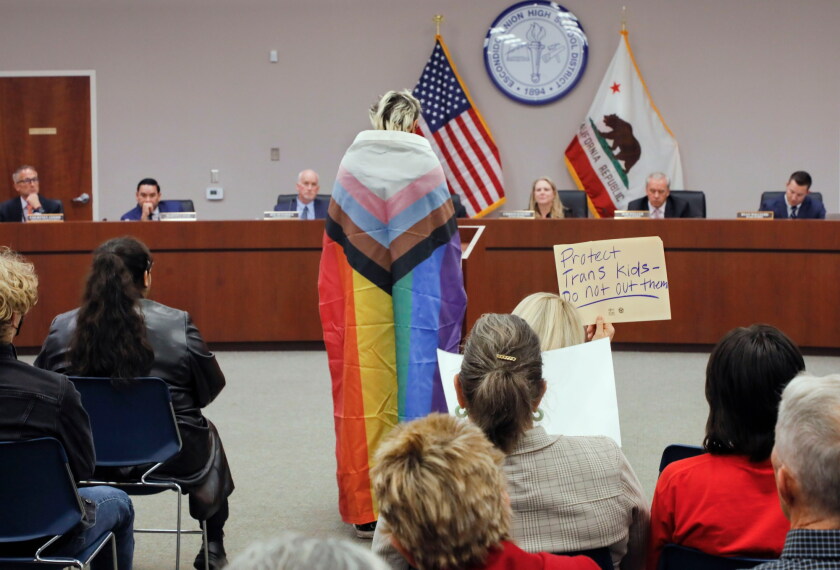
Teacher’s aide Amelia Mester, wrapped in a Pride flag, urges Escondido Union High School District not to have employees notify parents if they believe a student may be transgender in November 2025. A policy on the issue in the city’s elementary school district is the subject of a federal class-action lawsuit in which a judge just sided against the district.
Teacher’s aide Amelia Mester, wrapped in a Pride flag, urges Escondido Union High School District not to have employees notify parents if they believe a student may be transgender. A policy on the issue in the city’s elementary school district is the subject of a federal class-action lawsuit in which a judge just ruled against the district.
Charlie Neuman for The San Diego Union-Tribune/TNS
Law & Courts Federal Appeals Court Upholds 8th Grader's Expulsion Over Gun Comments in Class
Shortly after a nearby mass school shooting, a student allegedly discussed bringing a gun to school.
3 min read
Photo of stone columns.
E+
Law & Courts Trump's Education Policies Spurred 72 Lawsuits in 2025. How Many Is He Winning?
The legal challenges show which policies have had a big impact and how 2026 could go.
5 min read
President Donald Trump holds up an executive order after signing it at an indoor Presidential Inauguration parade event in Washington, Jan. 20, 2025.
President Donald Trump holds up an executive order after signing it at an indoor presidential inauguration parade event in Washington on Jan. 20, 2025. Trump's executive actions prompted legal challenges virtually from the moment he took office, and education-related policies were not immune.
Matt Rourke/AP
