Law & Courts Federal File

Note Worthy

By Andrew Trotter — November 15, 2005 2 min read
  • Save to favorites
  • Print

While toiling toward his 1975 degree at Yale Law School, Judge Samuel A. Alito Jr. wrote his “note”—the heavily footnoted paper that is a major chore of a second-year law student—on U.S. Supreme Court decisions on school “released time,” or plans in which students are excused from public school to study religion.

The paper, which was published in the Yale Law Journal in May 1974, has now been added to the tea leaves being examined to predict how President Bush’s nominee for the seat of retiring Justice Sandra Day O’Connor might decide cases on religion—including those involving the public schools.

Released-time plans by states and school districts enrolled about 2 million students in 1948, Mr. Alito wrote, when the court’s decision in McCollum v. Board of Education struck down an Illinois district’s released-time plan, in which children took religion classes at their school during the school day.

Four years later, in Zorach v. Clauson, however, the court upheld a New York state released-time plan, in a 6-3 decision that has confounded lower courts and commentators for its inconsistency with McCollum.

The brunt of Mr. Alito’s paper was not to analyze the court’s twisting rationale on the issue but to show how behind-the-scenes brokering among the justices led to majority opinions with ambiguous language.

His prime example, drawn from his research in the archives of several justices, was a secret 1948 stipulation in which Justice Felix Frankfurter assured Justice Harold H. Burton that if he joined the majority in McCollum, Justice Frankfurter would keep as an “open question” the constitutionality of New York’s released-time plan, which Justice Burton viewed as constitutional.

Because of that agreement, “McCollum was a very tentative compromise reached only after painstaking negotiations” that resulted in “cosmetic” consensus, Mr. Alito wrote. “Virtually no time seems to have been spent discussing far-reaching establishment clause issues.”

That consensus was shattered when the court upheld the New York plan in Zorach, with Justice Frankfurter in dissent, Mr. Alito wrote.

Terry Jean Seligmann, a law professor and the director of legal research and writing at the University of Arkansas’ law school, in Fayetteville, Ark., called Judge Alito’s note “clear, well written, really well researched.”

“I also thought it was a brave kind of topic to pick, it kind of breaks the mold, and it involves a lot of historical material he handled very well,” she said.

Related Tags:

Events

This content is provided by our sponsor. It is not written by and does not necessarily reflect the views of Education Week's editorial staff.
Sponsor
Reading & Literacy Webinar
Unlocking Success for Struggling Adolescent Readers
The Science of Reading transformed K-3 literacy. Now it's time to extend that focus to students in grades 6 through 12.
Content provided by STARI
Jobs Virtual Career Fair for Teachers and K-12 Staff
Find teaching jobs and K-12 education jubs at the EdWeek Top School Jobs virtual career fair.
This content is provided by our sponsor. It is not written by and does not necessarily reflect the views of Education Week's editorial staff.
Sponsor
College & Workforce Readiness Webinar
Portrait of a Learner: From Vision to Districtwide Practice
Learn how one district turned Portrait of a Learner into an aligned, systemwide practice that sticks.
Content provided by Otus

EdWeek Top School Jobs

Teacher Jobs
Search over ten thousand teaching jobs nationwide — elementary, middle, high school and more.
View Jobs
Principal Jobs
Find hundreds of jobs for principals, assistant principals, and other school leadership roles.
View Jobs
Administrator Jobs
Over a thousand district-level jobs: superintendents, directors, more.
View Jobs
Support Staff Jobs
Search thousands of jobs, from paraprofessionals to counselors and more.
View Jobs

Read Next

Law & Courts Appeals Court Halts Ruling Letting Teachers Disclose Students' Gender Identity
A federal appeals court has temporarily paused enforcement of the ruling but has not yet decided whether to grant a longer-term stay.
Kristen Taketa, The San Diego Union-Tribune
3 min read
Students carrying pride and transgender flags leave Great Oak High School in Temecula, Calif., on Sept. 22, 2023, after walking out of the school in protest of the Temecula school district policy requiring parents to be notified if their child identifies as transgender.
Anjali Sharif-Paul/The Orange County Register via AP
Law & Courts Schools Can’t Bar Teachers From Telling Parents If Kids Are Transgender, Judge Rules
The injunction bans any public school employee from misleading parents about their child’s gender presentation at school.
Kristen Taketa, The San Diego Union-Tribune
5 min read
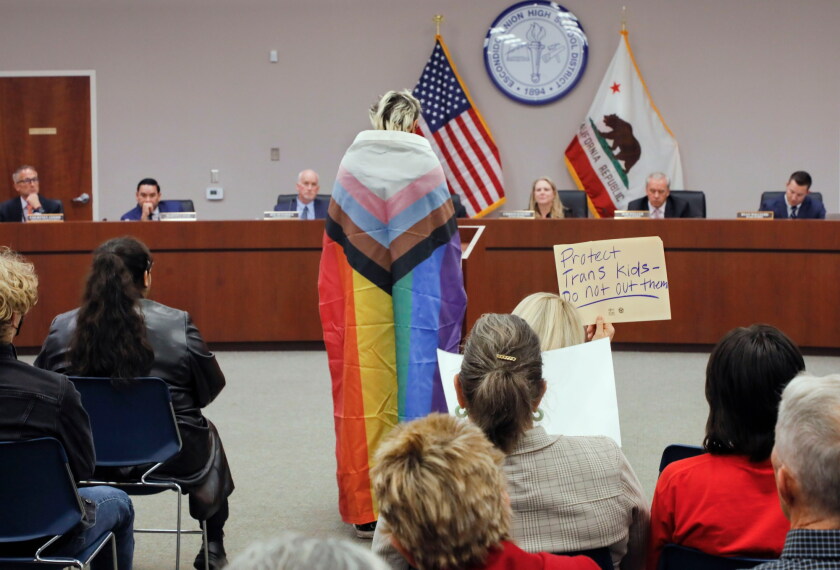
Teacher’s aide Amelia Mester, wrapped in a Pride flag, urges Escondido Union High School District not to have employees notify parents if they believe a student may be transgender in November 2025. A policy on the issue in the city’s elementary school district is the subject of a federal class-action lawsuit in which a judge just sided against the district.
Teacher’s aide Amelia Mester, wrapped in a Pride flag, urges Escondido Union High School District not to have employees notify parents if they believe a student may be transgender. A policy on the issue in the city’s elementary school district is the subject of a federal class-action lawsuit in which a judge just ruled against the district.
Charlie Neuman for The San Diego Union-Tribune/TNS
Law & Courts Federal Appeals Court Upholds 8th Grader's Expulsion Over Gun Comments in Class
Shortly after a nearby mass school shooting, a student allegedly discussed bringing a gun to school.
3 min read
Photo of stone columns.
E+
Law & Courts Trump's Education Policies Spurred 72 Lawsuits in 2025. How Many Is He Winning?
The legal challenges show which policies have had a big impact and how 2026 could go.
5 min read
President Donald Trump holds up an executive order after signing it at an indoor Presidential Inauguration parade event in Washington, Jan. 20, 2025.
President Donald Trump holds up an executive order after signing it at an indoor presidential inauguration parade event in Washington on Jan. 20, 2025. Trump's executive actions prompted legal challenges virtually from the moment he took office, and education-related policies were not immune.
Matt Rourke/AP
