Federal

NCLB Seen as Largely Ineffective, PDK-Gallup Poll Finds

By Laura Greifner — August 29, 2006 3 min read
  • Save to favorites
  • Print

Almost 70 percent of American adults who say they are familiar with the federal No Child Left Behind Act believe it has had no effect or is actually hurting public schools, according to a nationwide survey released last week.

The 38th Annual Phi Delta Kappa/Gallup Poll of the Public’s Attitudes Toward the Public Schools surveyed 1,007 adults on issues such as how public schools are evaluated, how school improvement should occur, and the state of current reform efforts.

“The views expressed in this year’s PDK/Gallup poll should serve as a wake-up call to our nation’s policymakers as they begin the process of reauthorizing NCLB in 2007,” William Bushaw, the executive director of Bloomington, Ind.-based PDK International, said in a statement.

Links to the 38th Annual Phi Delta Kappa/Gallup Poll, as well as further resources on the survey, are available from Phi Delta Kappa.

More American adults reported being knowledgeable about the No Child Left Behind law than in previous PDK-Gallup surveys, but many expressed an unfavorable view of it. Forty-five percent of those polled said they knew either “a great deal” or “a fair amount” about the federal law, up from 40 percent last year and 31 percent two years ago.

However, of that group, 31 percent said the law was hurting the performance of public schools in their communities, and 37 percent said it had made no difference. Twenty-nine percent said it was helping their local public schools.

The poll has a margin of error of 3 to 4 percentage points.

Under the 4½-year-old law, states must test students annually in reading and mathematics in grades 3-8 and once during high school. Sixty-nine percent of the poll respondents said a single test in each of those subjects would not provide a fair picture of whether a school needs improvement, and 81 percent said they believed testing requirements should include assessments of students’ knowledge in subjects beyond reading and math.

The No Child Left Behind law also requires states to begin giving science tests at certain grade levels in the 2007-08 school year.

‘Consider the Source’

Some organizations questioned the results of the poll and suggested that PDK, a professional educators’ organization that they believe is ideologically aligned with teachers’ unions, was trying to preserve the status quo through the wording of its survey questions.

“Consider the source of the poll,” said Kati Haycock, the director of the Washington-based research and advocacy group Education Trust, which has been supportive of the NCLB law. “These guys are not exactly an unbiased source.”

One question, for instance, asked respondents whether they favored or opposed allowing parents to choose to have their children attend private schools at public expense. Of those surveyed, 36 percent favored the idea, while 60 percent opposed it.

The Milton and Rose D. Friedman Foundation, an Indianapolis-based foundation that advocates vouchers and other school choice programs, and the Washington-based Cato Institute, a think tank that promotes a free-market philosophy, argue that the wording misleads poll interpreters into thinking that the public opposes school choice.

The Friedman Foundation commissioned its own poll last year, asking respondents instead if they favored or opposed allowing students and parents to choose any type of school at public expense. With that wording, 60 percent of the 1,000 adults surveyed favored allowing the students to choose, while only 33 percent opposed it.

Lowell C. Rose, the executive director emeritus of PDK and a co-author of the survey, countered that Gallup has the final say in the wording of the poll questions, ensuring that they are free of bias.

The PDK-Gallup poll showed an overall positive view of the nation’s public schools. When asked how educators should attempt to improve education, 71 percent of respondents preferred improvements in the existing public school system, rather than establishing an alternative system.

“The fact that the public’s support of its local schools is unaffected by the criticism directed at public schools in general should send a clear message … that change proposals should be built on the assumption that people like the schools they have,” Mr. Rose said in a statement.
A version of this article appeared in the August 30, 2006 edition of Education Week as NCLB Seen as Largely Ineffective, PDK-Gallup Poll Finds

Events

This content is provided by our sponsor. It is not written by and does not necessarily reflect the views of Education Week's editorial staff.
Sponsor
Artificial Intelligence Webinar
Managing AI in Schools: Practical Strategies for Districts
How should districts govern AI in schools? Learn practical strategies for policies, safety, transparency, as well as responsible adoption.
Content provided by Lightspeed Systems
This content is provided by our sponsor. It is not written by and does not necessarily reflect the views of Education Week's editorial staff.
Sponsor
Reading & Literacy Webinar
Unlocking Success for Struggling Adolescent Readers
The Science of Reading transformed K-3 literacy. Now it's time to extend that focus to students in grades 6 through 12.
Content provided by STARI
Jobs Virtual Career Fair for Teachers and K-12 Staff
Find teaching jobs and K-12 education jubs at the EdWeek Top School Jobs virtual career fair.

EdWeek Top School Jobs

Teacher Jobs
Search over ten thousand teaching jobs nationwide — elementary, middle, high school and more.
View Jobs
Principal Jobs
Find hundreds of jobs for principals, assistant principals, and other school leadership roles.
View Jobs
Administrator Jobs
Over a thousand district-level jobs: superintendents, directors, more.
View Jobs
Support Staff Jobs
Search thousands of jobs, from paraprofessionals to counselors and more.
View Jobs

Read Next

Federal Ed. Dept. Wants to Revamp Assistance Program It Calls 'Duplicative,' 'Confusing'
The department's Comprehensive Centers have already been through a year of shakeups.
3 min read
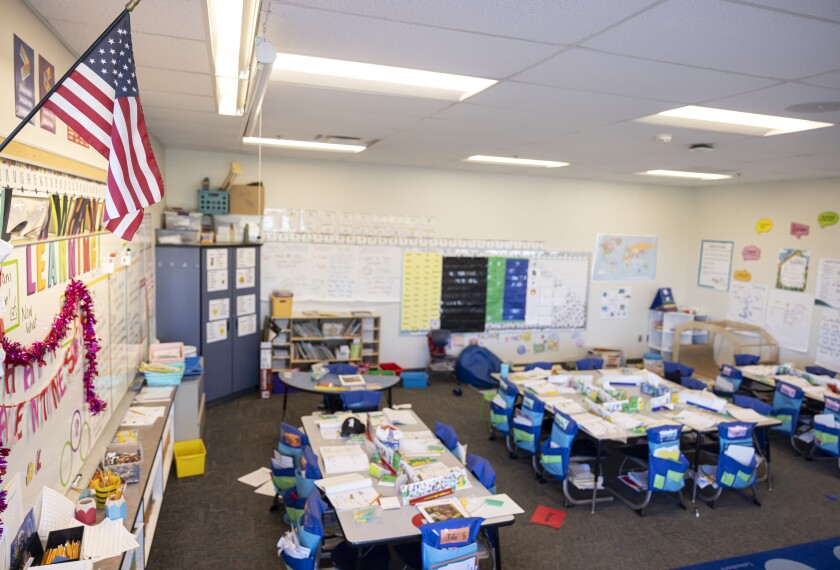
A first grade classroom at a school in Colorado Springs, on Feb. 12, 2026.
A 1st grade classroom at a school in Colorado Springs, Colo., on Feb. 12, 2026. The U.S. Department of Education released a proposal to rework a decades-old program charged with helping states and school districts problem-solve and deploy new initiatives, calling the current structure “duplicative” and “confusing.”
Kevin Mohatt for Education Week
Federal Will the Ed. Dept. Act on Recommendations to Overhaul Its Research Arm?
An adviser's report called for more coherence and sped-up research awards at the Institute of Education Sciences.
6 min read
The U.S. Department of Education building is pictured on Oct. 24, 2025, in Washington, D.C.
The U.S. Department of Education building in Washington is pictured on Oct. 24, 2025. A new report from a department adviser calls for major overhauls to the agency's research arm to facilitate timely research and easier-to-use guides for educators and state leaders.
Maansi Srivastava for Education Week
Federal Trump Talks Up AI in State of the Union, But Not Much Else About Education
The president didn't mention two of his cornerstone education policies from the past year.
4 min read
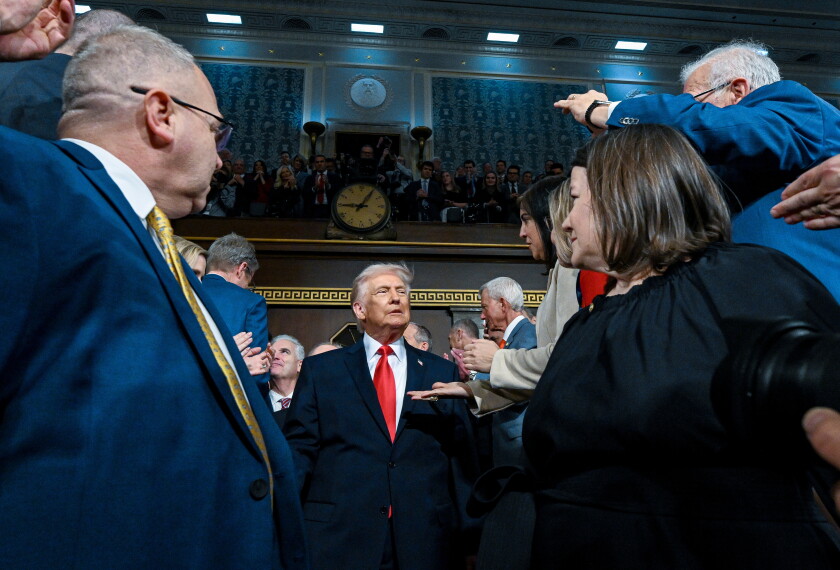
President Donald Trump enters to deliver the State of the Union address to a joint session of Congress in the House chamber at the U.S. Capitol in Washington, Tuesday, Feb. 24, 2026.
President Donald Trump enters to deliver the State of the Union address to a joint session of Congress in the House chamber at the U.S. Capitol in Washington, Tuesday, Feb. 24, 2026. The president devoted little time in the speech to discussing his education policies.
Kenny Holston/The New York Times via AP, Pool
Federal Education Department Will Send More of Its Programs to Other Agencies
Education grants for school safety, community schools, and family engagement will shift to Health and Human Services.
4 min read
Various school representatives and parent liaisons attend a family and community engagement think tank discussion at Lowery Conference Center on March 13, 2024 in Denver. One of the goals of the meeting was to discuss how schools can better integrate new students and families into the district. Denver Public Schools has six community hubs across the district that have serviced 3,000 new students since October 2023. Each community hub has different resources for families and students catering to what the community needs.
A program that helps state education departments and schools improve family engagement policies is among those the Trump administration will transfer from the U.S. Department of Education to the U.S. Department of Health and Human Services. In this photo, school representatives and parent liaisons attend a family and community engagement discussion on March 13, 2024, in Denver to discuss how schools can better integrate new students and families into the district.
Rebecca Slezak For Education Week