Law & Courts

N.J. Panel Recommends Expanding Number of ‘Special Needs’ Districts

By Catherine Gewertz — June 21, 2005 4 min read
  • Save to favorites
  • Print

An advisory panel to the New Jersey board of education has recommended that poor rural school districts be considered for designation as “special needs” districts, a move that could obligate the state to provide for those rural systems intensive support similar to what it gives its poorest urban districts.

The June 15 recommendation by the state board’s legal committee represents a significant development in an eight-year legal effort by a group of poor, rural districts. They have argued that they need intensive state help—including more money—similar to that received by 31 urban districts as a result of the ongoing Abbott v. Burke litigation. Decisions in that case require New Jersey to fund its poorest urban districts at the levels of its wealthiest districts, spend billions on school facilities, and provide extra services such as full-day preschool to offset the effects of poverty.

Frederick A. Jacob, a Millville, N.J., lawyer representing the rural districts in the case, known as Bacon v. New Jersey State Department of Education, said the recommendation is important because it makes clear that smaller rural districts can be as educationally needy as big-city districts. “It’s now decided once and for all that poverty is poverty,” he said in an interview. “It’s poverty that creates educational issues, not urban-ness.”

An administrative law judge decided in December 2002 that only five of the original 17 plaintiff rural districts deserve the special-needs designation. But in February 2003, state Commissioner of Education William L. Librera accepted only one of the five as an Abbott district, bringing the total to 31. Some of the rural districts appealed to the state board of education.

The board’s legal committee concluded that all 17 of the original rural districts in the complaint—and possibly even more poor districts not named in the action—deserve special-needs designation. The panel considered many indicators of financial need, such as the communities’ income levels and tax burdens, and educational need, such as their large class sizes, limited academic programming, and high truancy rates.

“We can only conclude that the students of these districts are not being afforded a thorough and efficient education” as required by state law, the panel said. “… The conditions under which these students live mirror those of the students in the Abbott districts, which in some cases are only blocks away.”

The panel said the state must devote additional resources to the poor, rural districts, but stopped short of specifying what level of aid or specific programs should be provided. Instead, it proposes that the commissioner undertake individual assessments of each district’s needs and report back to the board of education in December.

Attorneys in the case said the state board was scheduled to consider the legal committee’s report in July.

No Quick Fix

Despite the committee’s strong conclusions, no change in the Abbott designations could occur quickly. Changes would have to be approved by the board of education, and could be taken to the state court system by the districts on appeal.

State officials declined to comment on the legal committee’s report, saying it would be inappropriate to do so before it had been considered by the board. But David G. Sciarra, the lead attorney for the plaintiffs in the Abbott case, said the recommendation in Bacon “opens the door to the next big set of challenges, which is how to expand the Abbott remedies to other districts statewide.”

The panel’s recommendation comes as the state is actively trying to revise the criteria by which it designates Abbott districts.

Mr. Librera last week submitted to the legislature a proposal that would require a stricter showing of financial need by districts in order to be eligible. He made the same recommendation in 2003, but it was not adopted by the legislature. A legislative analysis at that time found that 13 districts would lose their designation as Abbott districts, but Mr. Librera said that analysis overlooked the indicators of educational adequacy that must be examined under his revised criteria. Considering both financial and educational factors, he said, could remove three to eight districts from the current Abbott list.

He said in an interview last week that Abbott designations are not meant to exist “in perpetuity,” and that some districts’ financial health and educational attainment has changed sufficiently to warrant their removal. Abbott remedies, he said, should not be the only mechanism through which the state assists districts in particular need.

“We continue to think of ourselves as the laboratory in the country for this kind of decision,” Mr. Librera said, “including the struggles that go along with it, how you deal with criteria, how you deal with [districts’] progress, how you deal with changes in this.”

Related Tags:

Events

This content is provided by our sponsor. It is not written by and does not necessarily reflect the views of Education Week's editorial staff.
Sponsor
Reading & Literacy Webinar
Unlocking Success for Struggling Adolescent Readers
The Science of Reading transformed K-3 literacy. Now it's time to extend that focus to students in grades 6 through 12.
Content provided by STARI
Jobs Virtual Career Fair for Teachers and K-12 Staff
Find teaching jobs and K-12 education jubs at the EdWeek Top School Jobs virtual career fair.
This content is provided by our sponsor. It is not written by and does not necessarily reflect the views of Education Week's editorial staff.
Sponsor
Artificial Intelligence Webinar
MTSS + AI in Action: Reimagining Student Support
See how one district is using AI to strengthen MTSS, reduce workload, and improve student support.
Content provided by Panorama Education

EdWeek Top School Jobs

Teacher Jobs
Search over ten thousand teaching jobs nationwide — elementary, middle, high school and more.
View Jobs
Principal Jobs
Find hundreds of jobs for principals, assistant principals, and other school leadership roles.
View Jobs
Administrator Jobs
Over a thousand district-level jobs: superintendents, directors, more.
View Jobs
Support Staff Jobs
Search thousands of jobs, from paraprofessionals to counselors and more.
View Jobs

Read Next

Law & Courts Supreme Court’s Gender Identity Ruling Leaves Schools Seeking Clarity
Advocates say they would welcome more from the Supreme Court on gender-notification policies.
7 min read
The Supreme Court is photographed, Friday, Feb. 27, 2026, in Washington.
The Supreme Court is photographed, Friday, Feb. 27, 2026, in Washington. The high court recently ruled that California policies that sometimes limit or discourage schools from disclosing information to parents about children’s gender transitions and expressions at school likely violate parents’ constitutional rights
Rahmat Gul/AP
Law & Courts Supreme Court Backs Parents in School Gender Disclosure Fight
The Supreme Court restored an injunction blocking California policies on student gender transitions
8 min read
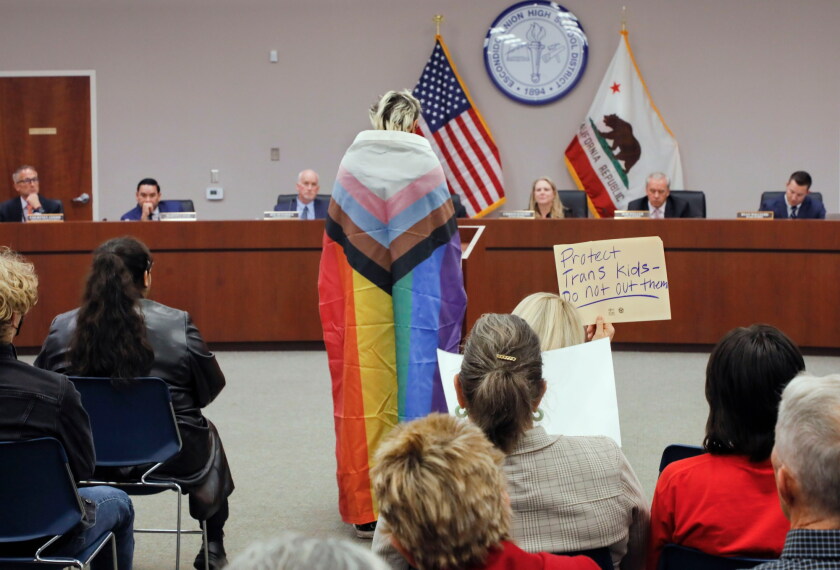
Teacher’s aide Amelia Mester, wrapped in a Pride flag, urges Escondido Union High School District not to have employees notify parents if they believe a student may be transgender in November 2025. A policy on the issue in the city’s elementary school district is the subject of a federal class-action lawsuit in which a judge just sided against the district.
Teacher’s aide Amelia Mester, wrapped in a Pride flag, urges Escondido Union High School District not to have employees notify parents if they believe a student may be transgender at a meeting in November 2025. Two parents and two teachers from the district sued in 2023, challenging California state guidance concerning student gender transitions and parental notification. The U.S. Supreme Court has now reinstated a lower-court decision overturning those state policies.
Charlie Neuman for The San Diego Union-Tribune/TNS
Law & Courts Appeals Court Allows Louisiana Ten Commandments Displays to Proceed
The court said it was premature to rule on the constitutionality of La. Ten Commandments displays.
3 min read
Students work under Ten Commandments and Bill of Rights posters on display in a classroom at Lehman High School in Kyle, Texas, Thursday, Oct. 16, 2025.
Students work under Ten Commandments and Bill of Rights posters on display in a classroom at Lehman High School in Kyle, Texas, Oct. 16, 2025. A federal appeals court has lifted a lower-court injunction blocking a Louisiana law that requires Ten Commandments displays, clearing the way for the law to take effect.
Eric Gay/AP
Law & Courts Supreme Court Strikes Trump Tariffs in Case Brought by Educational Toy Companies
Two educational toy companies were among the leading challengers to the president's tariff policies
3 min read
Members of the Supreme Court sit for a new group portrait following the addition of Associate Justice Ketanji Brown Jackson, at the Supreme Court building in Washington, Oct. 7, 2022. Bottom row, from left, Associate Justice Sonia Sotomayor, Associate Justice Clarence Thomas, Chief Justice of the United States John Roberts, Associate Justice Samuel Alito, and Associate Justice Elena Kagan. Top row, from left, Associate Justice Amy Coney Barrett, Associate Justice Neil Gorsuch, Associate Justice Brett Kavanaugh, and Associate Justice Ketanji Brown Jackson.
Members of the U.S. Supreme Court sit for a new group portrait following the addition of Justice Ketanji Brown Jackson, at the court building in Washington, Oct. 7, 2022. On Feb. 20, 2026, the court ruled 6-3 to strike down President Donald Trump's broad tariff policies, ruling that they were not authorized by the federal statute that he cited for them.
J. Scott Applewhite/AP
