Louisiana, situated at the crowded shipping intersection of the Mississippi River and the Gulf of Mexico, is home to some of the world’s industrial giants.
Here in East Baton Rouge, corporate residents include the Georgia-Pacific Corp., the Kaiser Aluminum Corp., and the Exxon Corp., whose chemical plant and oil refinery dominate the riverfront.
Exxon is doing well these days. The company tallied worldwide earnings of $6.5 billion in 1995, up 27 percent over 1994, according to its annual report. In East Baton Rouge, the company provides paychecks for 4,000 people, helps finance arts programs, and sponsors other community events.
But the wealth produced by sprawling plants like Exxon’s often fails to pay dividends in local school budgets.
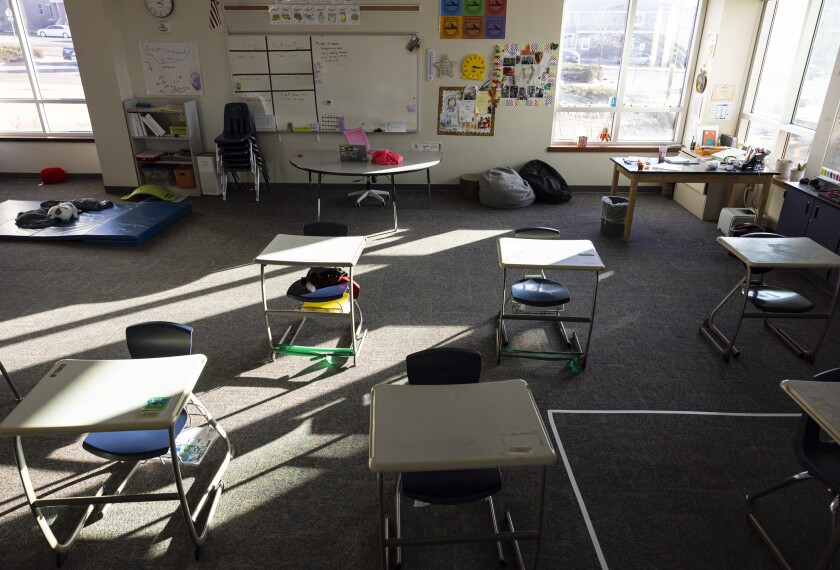
The East Baton Rouge Parish schools face a lot of maintenance bills: $5 million for safety-code violations, $27 million to replace roofs, and $22.5 million for heating and air conditioning. The 55,000-student system says it can afford about $5 million in maintenance this year.
Businesses like Exxon and the Dow Chemical Co., a major presence in neighboring Iberville Parish, give millions of dollars in time and equipment to Louisiana schools. But their gifts pale in comparison with the gold mine of tax breaks they get at schools’ expense, some Louisianans complain.
“For a state with an abundance of natural resources, why are we 48, 49, and 50 in every category of education?” said state Sen. J. Lomax Jordan Jr., a Republican from Lafayette Parish. “Could it be the half a century worth of history of these guys saying, ‘Please, give us a handout?’”
The state routinely gives manufacturers a 10-year property-tax exemption for investing in new equipment or expansions, regardless of whether new jobs are created.
In 1995, the board in charge of the program, a panel appointed by the governor, approved 647 applications. Records show that about 5,500 new jobs and 33,000 temporary positions were attributed to the program. But the cost was $2.9 billion in property removed from local tax rolls.
Those exemptions, along with earlier tax breaks, cost Louisiana schools $151 million in 1995 alone, according to estimates from the Louisiana Coalition for Tax Justice, a Baton Rouge-based watchdog group. East Baton Rouge lost $27 million--about what is needed to repair the school system’s decrepit roofs. Based on state and county data, about $6.3 million of those breaks went to the Exxon plant.
Legislative efforts to revamp the program failed last year after running headlong into the state’s powerful business lobby, though tax incentives could come up in a special legislative session this summer.
Difficult Calculations
But judging whether companies like Exxon are shortchanging local schools isn’t easy. City officials find it hard to calculate the value of additional jobs as weighed against the cost of tax breaks, and school officials are hard-pressed to criticize a corporate citizen that volunteers help and pays for specific educational programs.
Exxon spent nearly $300,000 over three years on the “Chemicals, Health, the Environment, and Me” program to train science teachers at Louisiana State University in Baton Rouge.
And its Exxon Science Education Committee oversees 10 “ambassador schools” in neighborhoods near the local plant. The schools get tutors, plant tours, grants, and surplus office equipment. The company estimates that employees volunteer about 3,000 hours a year in local schools.
“If I’m big enough, I should expect to be actively involved,” said Dave Gardner, a spokesman for the Exxon plant. “That’s what you expect from a leader.”
Dow Chemical spent $440,000 in southeast Louisiana on its “Hands On Science” program. It has a $25,000 fund for project grants and contributed $125,000 to an East Baton Rouge scholarship trust fund.
“Schools are winners as a result of these programs,” said Babs Babin, the local government-affairs manager for Dow, which employs about 2,300 people in Louisiana and posted worldwide record sales of $20 billion in 1995.
Local tax records show, however, that despite the helping hand they extend schools, corporations are being well-compensated for their presence.
In 1995, Dow paid about $7.5 million in property taxes and $5 million in sales taxes to the three Louisiana parishes where it has operations. Thanks to the state’s exemption program, the company saved about $9 million.
Based on the exemptions on the books in 1995, Exxon would realize an estimated $150 million in tax relief over 10 years from the state tax break, about 42 percent of which would have gone to the East Baton Rouge schools, at existing rates.
Exxon paid $14 million in 1995 property taxes, mostly to East Baton Rouge. The schools’ share was $5.8 million--about 10 percent of all property taxes that went to the parish’s schools in 1995.
Bum Rap?
Across Louisiana, the scores of other corporations that get tax breaks read like a Who’s Who of industry--AT&T Corp., General Motors Corp., International Paper Co., and Shell Oil Co.
Business officials say that the tax savings they reap from the state’s program get a bum rap. They say the discounts are vital to their operations.
“We are an international corporation, and we have a lot of options,” Mr. Gardner of Exxon said. “Where we choose to invest our money is not locked into a given site.”
“The people who want to give the money to education are a little shortsighted,” added Ms. Babin of Dow. “We pay millions in sales taxes. No one talks about that.”
The Louisiana Association of Business and Industry points out that parishes with the biggest tax exemptions granted by the state remain among Louisiana’s richest localities and pay the highest teacher salaries. And because of statewide property-tax exemptions on houses worth less than $75,000 here, businesses pay up to 90 percent of all property taxes.
“We’re spending a hell of a lot of money on education, and it’s not going to the right place,” argued Don Allison, a tax expert and lobbyist for the business and industry association. “We don’t look at an education tax any differently from another tax.”
Unheated Bathrooms
But such arguments seem far removed at East Baton Rouge’s Eden Park Elementary School, which faces problems such as unheated bathrooms.
“We cover the pipes when we expect a freeze,” said Pamela N. Millican, the school’s principal.
On a walk across the school’s cement courtyard, she points to flaking paint, rusting beams, and leaking overhangs that tell the story of a maintenance budget that can’t fix everything.
How would she improve the facility?
“I’d bomb it and start over,” she said. “You can’t just educate with a textbook. You educate with a facility.”
The modest help that has arrived in the schools here came after pleas to local businesses. Waiting for the strapped school district to remove dangerous playground equipment took more than a year. Meanwhile, Eden Park was able to get an air conditioner for the cafeteria soon after talks with the Belle of Baton Rouge Casino.
East Baton Rouge’s South Boulevard Elementary School received a $250,000 facelift in 1995 from TCI Communications Inc., the nation’s largest cable television company.
The project stands out because with 304 employees, TCI is a relatively small presence here. And because it is not a manufacturer, TCI cannot get the 10-year tax discounts.
“The corporate world is just as interested in the education for young people as we are,” said Principal Kathleen S. Craig of South Boulevard Elementary. “You just have to sit down and have a dialogue.”
But some observers wonder why schools should have to ask for such basic items. Eden Park Elementary has $36,000 in fire- and safety-code violations. Its shortcomings are not lost on its students.
“I’d like to have a computer,” said Keara Antwine, a 5th grader. “I’ve never worked on one at school.”
Major improvements are rare. The last school bond in East Baton Rouge passed in 1969. Five bond issues have failed since. The city’s powerful chamber of commerce opposed the most recent bond measure in 1994.
Dollars for Quality
Until recently, the East Baton Rouge district was under one of the nation’s longest-running federal desegregation orders. Eden Park will get new computers next year as part of the agreement to end the court order. And a new superintendent and new school board members are restoring confidence in a school leadership that had been known for conflict.
In January, voters extended three school taxes. The approval will not mean new money, but it at least signals some support for schools.
“It says our system is finally on the right track after a long time,” Superintendent Gary Mathews said. “All of the groups were behind it.”
Deborah Franklin, the TCI employee in charge of school programs, lost her job recently in a reorganization. Now teaching special education at Brookstown Elementary School here, she still feels strongly about corporate participation.
“People should demand participation from corporations,” she said. “If they want top quality, they have to put top dollar into the product.”
Sen. Jordan said people should take a closer look at what lost revenue is costing schools.
“If they want to do something about education, they have a real opportunity,” Sen. Jordan, a lawyer, said. “I challenge all of these corporate executives to look beyond their dividends to talk about the real live people who are their neighbors in Louisiana.”