Students in the New York City public schools have been waiting for financial relief for 11 years, and it’s time for the state courts to force the state to solve the problem, lawyers representing the city’s schoolchildren argued last week.
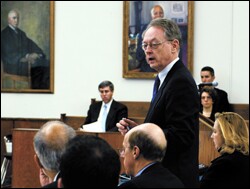
“The kids have waited many, many years,” Michael A. Rebell, the litigation director of the Campaign for Fiscal Equity, told a panel of three jurists appointed to advise the trial judge in the state’s long-running school finance case. “We ask you to be very specific to make sure this time there is no more delay.”
In final arguments before the three-member panel, the state responded that the advocacy group and the city are asking the court to take power away from state lawmakers.
“The argument … made is a policy argument,” Richard Rifkin, a deputy attorney general for the state, said during a Nov. 1 session here formally closing the latest chapter in Campaign for Fiscal Equity v. State of New York.“These are issues for the legislature.”
But backing up the case made by the Campaign for Fiscal Equity, a lawyer for the city asked the panel to impose fines of “unprecedented magnitude” if the governor and the legislature fail to give the city adequate funding.
“Put a hammer over their heads,” said Michael A. Cardoza, the corporation counsel for the city. “We’ve got to come up with a hammer, because a hammer will produce results.”
Latest Installment
The Campaign for Fiscal Equity lawsuit, commonly called the CFE case, has bounced through the state courts since the New York City-based advocacy group filed it in 1993.
Last year, the New York Court of Appeals—the state’s highest court—found that the state doesn’t provide enough money for the city to give all students the “sound, basic education” that case law says the state constitution guarantees. (“Court Orders New York City Funding Shift,” July 9, 2003.)
When the state missed a court-imposed deadline of July 30 to provide a remedy, the trial-court judge overseeing the case convened three distinguished jurists as special masters to advise him on what legal authority he has to impose a solution on the state.
After last week’s arguments, Mr. Rebell told reporters he’s optimistic that the panel’s report, due at the end of the month, will set the stage for a final resolution to the case.
“Hopefully, the court is going to come out with a very clear road map,” he said. The state’s argument, he added, is one “they’ve been making for a decade, and it’s been rejected by the court of appeals.”
Throughout a series of hearings in October, the masters allowed lawyers from the city to participate, even though the city is not a party to the case. The panel’s report is due Nov. 30.
In last week’s closing arguments, Mr. Rebell suggested the panel could tell state leaders how much money the state needs to give New York City.
Studies submitted by the CFE and the state estimate that the cost of remedying the constitutional violations is between $4.3 billion and $5.6 billion, to be paid to the city over the next five years. The plaintiffs are also asking for $8.9 billion for construction, while the state suggests that the current school finance system will address the city’s capital costs.
If the state failed to appropriate within 90 days of an order by the judge an amount that the trial court considered necessary to address the city’s school operating and construction costs, the court could find the legislature and governor in contempt of court. The penalty could be a significant fine—as much as $1 million a day. That money could be used to aid New York City schools, Mr. Rebell said.
Just the threat of fines might spur the legislature to act, he said.
“If you come up with a figure, that is going to galvanize the legislature, especially with a coercive penalty behind it,” Mr. Rebell said. The legislature might act before a new deadline that the court could impose, he added.
One of the appointees, John D. Feerick, remarked that policymakers in other states had responded quickly to court action intended to spur their work.
“That suggests to me a very good precedent for our own state,” said Mr. Feerick, a former dean of the Fordham University law school.
A Few Hints
Members of the panel offered a few hints of what they will recommend to Justice Leland DeGrasse of the state supreme court based in Manhattan, which is a trial court. They listened to Mr. Rebell’s proposal without much comment. But when Mr. Rifkin suggested that the courts shouldn’t strong-arm the legislature and the governor into a solution, they reacted skeptically.
“The courts can allow a constitutional violation to exist and do nothing about it?” asked E. Leo Milonas, a former state judge who is one of the special masters.
“Can you impose a contempt order on a government of which you are a part?” Mr. Rifkin asked in response. “If you impose that order, you’re absolutely ensuring an appeal.”
“That’s the way you make new law,” retorted William C. Thompson, a former state appeals court judge and the other of the three masters, “and we’re not afraid to do what we have to do.”
At another point, Mr. Milonas said that the state constitution vests the legislature with the power to appropriate money, and that a judge might overstep his authority if he specified how much the legislature should spend on New York City schools.
“How can we impose on the state legislature how much it should appropriate when the constitution gives it that power?” Mr. Milonas asked Mr. Cardoza.
“If you don’t do it, the constitutional remedy won’t be ameliorated,” Mr. Cardoza responded.
Besides debating money, the lawyers argued over how the state would monitor how it is spent. Gov. George E. Pataki, a Republican, has proposed creating a state office of educational accountability to see that schools were spending money from the lawsuit efficiently.
While the CFE and the city acknowledge that schools should be held accountable for spending wisely, they argued that the current state education department is the best entity for the job.
The proposed office “is not necessary at all,” said Mr. Cardoza. “It will create a further blurring of the lines.”
Whatever the panelists recommend and whatever Justice DeGrasse decides, the CFE and the city are hoping they’re near the end of their legal odyssey.
“It would be a crime if we end up going back to the court of appeals,” Mr. Cardoza told the panel, “and then we start three years after that trying to enforce a remedy.”


