Law & Courts

Kan. Lawmakers Agree on Spending Plan

By David J. Hoff — July 12, 2005 4 min read
  • Save to favorites
  • Print

Kansas lawmakers appropriated $148 million last week in K-12 spending to comply with an order from the state supreme court in a long-running school finance case.

After almost two weeks of debate in a special session, Democrats and moderate Republicans passed a supplemental-spending bill to essentially double the increase the legislature previously appropriated for the 2005-06 school year.

The bill appears to meet the Kansas Supreme Court’s order last month for an increase in school spending by $143 million above what had been approved for the coming school year during the legislature’s regular session. Gov. Kathleen Sebelius, a Democrat, issued a statement shortly after the legislature passed the bill on July 6 supporting the bill.

“We hopefully have averted this first deadline, and … then we determine where we go from here,” said Sen. Jean Schodorf, the Republican from Wichita who is the chairwoman of the Senate education committee.

The court heard arguments July 8 by the state attorney general and plaintiffs in the finance case over whether the legislature had fully complied with the order to increase spending and ensure school financing is equitably distributed throughout the state.

Authority Questioned
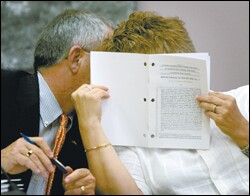
Rep. Kathie Decker, the chairwoman of the House education committee, confers behind a school finance bill with Rep. Michael O'Neal during the special session.

The Kansas legislature acted after many lawmakers publicly questioned the court’s authority to order them to appropriate funds. During the special session, the House and the Senate considered several amendments to the state constitution that would have curtailed the court’s authority to issue such orders in the future. None of them won a two-thirds majority in both chambers. If one had passed, voters would have had to approve it before it became part of the constitution.

On June 3, the supreme court said that the $2.4 billion the legislature had approved for schools in 2005-06 was not enough to provide a “suitable” education, which the Kansas Constitution guarantees all students in the state. The order was the remedy in the finance case, filed in 1999 by students and school districts.

The court ordered the legislature to appropriate an additional $143 million for the new school year. It also said it might order lawmakers to give schools an additional $568 million for the 2006-07 school year.

To respond to the order, the legislature would use $79 million that flowed into the state’s coffers in May and June. It also relied on updated estimates that projected tax revenues would increase by $79 million more than what was expected when lawmakers passed their fiscal 2006 budget.

The plaintiffs’ lawyer said late last week he and his clients were reviewing the legislature’s bill and hadn’t decided whether to object to some of its provisions.

Although the legislators proclaimed that their bill would provide an additional $148 million for schools, $27 million of that is state financing to offset property-tax relief in some poor districts, said Alan L. Rupe, the Wichita lawyer representing the plaintiffs. “That is moving money from one account to another,” he said. “It is not new money.” He said the legislators “arguably could be short” of meeting the court’s order.

But Mr. Rupe said the plaintiffs might tell the court that they were satisfied with the legislature’s work.

“It’s the best effort that we saw during the [special] session,” he said.

Even if the court approves the legislature’s work, Ms. Schodorf and other lawmakers said the state would struggle to appropriate an additional $568 million for the 2006-07 school year. The state’s general-fund budget is about $7 billion. “That is a huge amount of money for a state the size of Kansas,” Ms. Schodorf said. “This next one is going to be very difficult.”

“If that is enforced next year, that will bankrupt the state of Kansas,” said Sen. Kay O’Connor, a conservative Republican, who predicted the legislature would need to increase taxes by 25 percent to raise the money.

The court based its request for the additional increase on a 2001 study by school finance experts hired by the legislature. It did say it would review any new study conducted for the legislature before lawmakers meet in their next session, scheduled for January. The court left open the possibility of lowering that figure.

As part of the funding bill, the legislature also commissioned a study by its staff to determine how much the state needs to spend to provide a suitable education as required by the constitution. Ms. Schodorf said she expects the study to provide a figure similar to the 2001 study cited by the court.

Ms. O’Connor opposed last week’s bill because it didn’t include a constitutional amendment that would declare that the court may not order the legislature to appropriate money.

“Our federal and state constitutions were designed to limit the accumulation of power to avoid the subsequent abuse of that power,” said John Dayton, a professor of education at the University of Georgia and a school finance expert. “Shifting more power to one branch of government while limiting the ability of another branch of government to act as an effective check and balance on that branch of government in the future could have serious long-term consequences.”

Related Tags:

Events

This content is provided by our sponsor. It is not written by and does not necessarily reflect the views of Education Week's editorial staff.
Sponsor
Special Education Webinar
Bridging the Math Gap: What’s New in Dyscalculia Identification, Instruction & State Action
Discover the latest dyscalculia research insights, state-level policy trends, and classroom strategies to make math more accessible for all.
Content provided by TouchMath
This content is provided by our sponsor. It is not written by and does not necessarily reflect the views of Education Week's editorial staff.
Sponsor
School Climate & Safety Webinar
Belonging as a Leadership Strategy for Today’s Schools
Belonging isn’t a slogan—it’s a leadership strategy. Learn what research shows actually works to improve attendance, culture, and learning.
Content provided by Harmony Academy
This content is provided by our sponsor. It is not written by and does not necessarily reflect the views of Education Week's editorial staff.
Sponsor
School & District Management Webinar
Too Many Initiatives, Not Enough Alignment: A Change Management Playbook for Leaders
Learn how leadership teams can increase alignment and evaluate every program, practice, and purchase against a clear strategic plan.
Content provided by Otus

EdWeek Top School Jobs

Teacher Jobs
Search over ten thousand teaching jobs nationwide — elementary, middle, high school and more.
View Jobs
Principal Jobs
Find hundreds of jobs for principals, assistant principals, and other school leadership roles.
View Jobs
Administrator Jobs
Over a thousand district-level jobs: superintendents, directors, more.
View Jobs
Support Staff Jobs
Search thousands of jobs, from paraprofessionals to counselors and more.
View Jobs

Read Next

Law & Courts California Sues Ed. Dept. in Clash Over Gender Disclosures to Parents
California challenges U.S. Department of Education findings on state policies over gender disclosure.
4 min read
California Attorney General Rob Bonta speaks to reporters as Arizona Attorney General Kris Mayes, left, and Oregon Attorney General Dan Rayfield, right, listen outside the Supreme Court on Wednesday, Nov. 5, 2025, in Washington. (AP Photo/Mark Schiefelbein)
California Attorney General Rob Bonta speaks to reporters outside the U.S. Supreme Court in Washington on Nov. 5, 2025, with Arizona Attorney General Kris Mayes and Oregon Attorney General Dan Rayfield behind him. Bonta this week sued the U.S. Department of Education, asking a court to block the agency's finding that the state is violating FERPA by <ins data-user-label="Matt Stone" data-time="02/13/2026 4:22:45 PM" data-user-id="00000185-c5a3-d6ff-a38d-d7a32f6d0001" data-target-id="">not requiring schools to disclose</ins> students’ gender transitions <ins data-user-label="Matt Stone" data-time="02/13/2026 4:22:45 PM" data-user-id="00000185-c5a3-d6ff-a38d-d7a32f6d0001" data-target-id="">to</ins> parents.
Mark Schiefelbein/AP
Law & Courts Oklahoma Board Rejects Jewish Charter as Supreme Court Fight Looms
Oklahoma's charter school board rejected the Jewish school as members said their hands were tied.
4 min read
Ben Gamla Charter Schools founder and former U.S. Rep. Peter Deutsch, right, speaks with Brett Farley, executive director of the Catholic Conference of Oklahoma, left, before a Jan. 12 meeting of the Statewide Charter School Board in Oklahoma City. Both are founding board members of an Oklahoma Jewish Charter School.
Ben Gamla Charter Schools founder and former U.S. Rep. Peter Deutsch, right, speaks with Brett Farley, executive director of the Catholic Conference of Oklahoma, before a Jan. 12, 2026, meeting of the Statewide Charter School Board in Oklahoma City. The board rejected the proposed Jewish charter school on Feb. 9, 2026.
Nuria Martinez-Keel/Oklahoma Voice
Law & Courts Religious Charter Schools Push New Cases Toward Supreme Court
Advocates seeking to establish publicly funded religious schools in three states.
9 min read
The U.S. Supreme Court is seen, Wednesday, Jan. 14, 2026, in Washington.
The U.S. Supreme Court is seen on Wednesday, Jan. 14, 2026, in Washington. Religious charter advocates are betting a full Supreme Court will side with their efforts to establish religious charter schools.
Rahmat Gul/AP
Law & Courts Educators Sue Over ICE Activity on School Grounds and Nearby
The challenge targets the Trump administration's revocation of a policy that limited immigration enforcement at schools.
5 min read
A sign reading "Protect Neighbors" is posted near a bus stop as a school bus passes on Friday, Jan. 30, 2026, in Minneapolis.
A sign reading "Protect Neighbors" is posted near a bus stop in Minneapolis on Jan. 30, 2026. A lawsuit from two Minnesota school districts and the state's teachers' union says immigration agents have detained people and staged enforcement actions at or near schools, school bus stops, and daycare centers.
Kerem Yücel /Minnesota Public Radio via AP
