Sometimes, it seems that Arizona lawmakers can’t win.
For the second time in a year, a court has rejected their efforts to fix the state’s system of paying for school construction, which the state supreme court ruled unconstitutional in 1994.
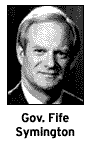
And things probably won’t get any easier. Gov. Fife Symington, a leader in the school finance debate, is on trial for 21 felony counts of fiscal misconduct. A conviction would force him from office.
Meanwhile, the clock is ticking for the GOP-controlled legislature. If a solution to the finance issue acceptable to the courts is not in place by June 30, 1998, state aid to schools will be frozen. (“Ariz. Governor Signs Finance Bill; Legal Challenge Likely,” March 12, 1997.)
“I see the possibility of a new funding plan,” said Henry Kenski, an associate professor of political communication at the University of Arizona in Tucson. “The question is, who’ll be in a position to influence such a plan?”
Arizona joins a handful of states, including Vermont, New Jersey, and North Carolina, where judges this year have called for higher K-12 spending or sought greater parity in education quality.
Familiar Territory
Gov. Symington, a Republican, has twice backed his legislature’s attempts to fix the finance system since the 1994 ruling. And both times, a judge has found those remedies lacking.
|
Earlier this year, the governor asked the courts to rule on this year’s changes, the most important of which was the $32.5 million Assistance to Build Classrooms program, or ABC, for poor districts.
Funding from ABC was designed to reduce the per-pupil funding gap for construction between rich and poor districts to 4-to-1. The gap is 650-to-1 in some areas.
But to reach the 4-1 ratio, poor districts must also issue bonds.

|
Even with the new money, the finance system still failed to ensure “a general and uniform education system” as called for in the state constitution, Judge Rebecca A. Albrecht wrote in a five-page decision Aug. 20. Reaching the 4-1 ratio by issuing bonds was not a viable option for all districts, she added. The decision had a familiar ring.
Last year, the legislature added a $100 million grant-and-loan fund for school repair and construction and a 10-year plan to provide poor and fast-growing districts $30 million a year in state facilities aid. But last November, Judge Albrecht ruled that the plans failed to fix an unconstitutional system.
“It’s obvious that legislators are piling money into a system that doesn’t work,” said Patricia Likens, the spokeswoman for state schools Superintendent Lisa Graham Keegan. “As amazing as it sounds, there are some who don’t think that there’s a problem.”
Mr. Symington, who has often criticized the courts for interfering in state business, vowed to appeal the finance decision.
“We feel that Judge Albrecht ruled incorrectly,” said Mr. Symington’s spokesman, Doug Cole. “The legislature has worked very hard in concert with this office to resolve this issue, and we believe we have.”
Between now and June, a lot could happen to redirect Arizona’s school finance odyssey.
Under one scenario, Gov. Symington would be acquitted of the criminal counts he faces, and the status quo maintained until all appeals are exhausted in the school finance case.
If, however, Mr. Symington is convicted and forced from office, Secretary of State Jane Dee Hull will take over. Ms. Hull, a Republican, is seen as more sympathetic to the schools’ cause, and could call a special session this year to resolve the issue.
“I think the governor has been the biggest roadblock on this,” said Timothy M. Hogan, the executive director of the Arizona Center for Law in the Public Interest, which represented the districts that filed the original lawsuit. “The secretary of state is generally regarded as more supportive.”
But Ms. Hull would face a gubernatorial election in 1998, if she opted to run, and raising taxes for schools could be political suicide.
“On one hand, she’s a moderate conservative who might be bolder than the governor,” Mr. Kenski said of the school aid issue. “But she also has to get elected. This is not an easy call.”
Superintendent Keegan, also a member of the gop, has her own proposal. She wants a statewide vote on a half-cent sales-tax increase to equalize per-pupil funding for school construction. The tax would replace secondary property taxes now used to pay off school construction bonds.
She has pledged to leave office if such an initiative failed. The House voted 40-19 earlier this year to put the issue to voters, but the plan died in the Senate.
Ms. Keegan “hopes that the legislature comes together and works on this initiative,” Ms. Likens said. “It’s an idea that will work.”


