Federal

John McCain Backed School Choice, Native Education

By Andrew Ujifusa — September 04, 2018 3 min read
John McCain, the long-time GOP senator from Arizona who spoke in favor of school choice over two presidential campaigns, died last month at 81.
  • Save to favorites
  • Print

A supporter of both school choice and federal funding for public schools, John McCain’s legacy in K-12 education also includes his backing for a landmark education law that became a signature accomplishment for his one-time rival for the presidency.

The longtime Republican senator from Arizona also supported merit pay for high-performing teachers, once telling an audience during a presidential campaign debate, “I don’t see why a good teacher should be paid less money than a bad senator.” The remark drew laughter from the crowd.

McCain died from cancer on Aug. 25 at the age of 81.

First elected to Congress in 1982 after surviving years of imprisonment and torture during the Vietnam War as a U.S. Navy pilot, McCain did not make education policy one of his signature issues while on Capitol Hill. And while he defended the No Child Left Behind Act, signed by President George W. Bush in 2002, McCain also said in subsequent years that the law needed to be revisited.

In addition to his broader support for choice, McCain pushed for additional education options for Native American children.

And, last year, he spoke out in favor of the Deferred Action for Childhood Arrivals program, which granted certain legal protections for children brought to the United States illegally. President Donald Trump has tried to rescind the program.

‘The Most Important Thing’

During two unsuccessful presidential campaigns in 2000 and 2008, McCain touted school choice as a way for parents to ensure their children escape struggling schools.

He called it “the most important thing” the nation could do with respect to education, and criticized opponents of this view who sought to curry favor with the teachers’ unions instead.

“When a public system fails, repeatedly, to meet these minimal objectives, parents ask only for a choice in the education of their children,” McCain said.

Just as McCain sometimes deviated from mainstream Republican Party thought, he did not always cast his support for choice in traditional terms.

In his first presidential bid, McCain drew a contrast between his support for choice and that of his rival Bush’s view. While Bush sought to pay for vouchers by gutting federal education aid, according to McCain, he would help pay for a $5.4 billion voucher program by “by eliminating corporate welfare doled out to the oil and gas industry, ethanol giants, and sugar barons.”

McCain’s backing for choice extended to children attending Bureau of Indian Education schools, which he said represented a broken promise to Native American children.

He worked with Sen. James Lankford, R-Okla., on legislation that would create education savings accounts for parents to pay for tutoring and other education services for children at those schools.

“We have no greater responsibility to our next generation than to help them prepare to compete in an increasingly competitive workforce, and this bill would provide Native American students the best opportunity to succeed in the classroom and beyond,” McCain said in a statement last year when he re-introduced the Native American Education Opportunity Act last year.

Fixed, Not Scrapped

McCain also threw his weight behind online education programs and alternative certification programs to train teachers. He once backed a plan to help schools recruit teachers from the ranks of college students who were in the top 25 percent of their graduating class.

McCain’s views evolved on the No Child Left Behind Act, which had the fervent backing of the Bush administration and was also shepherded through Congress by one of McCain’s friends on Capitol Hill, Democratic Sen. Edward M. Kennedy of Massachusetts.

In general, he remained a supporter of the law. But he also said at one point that the law should be changed to give English-language learners and students with disabilities more leeway with respect to academic progress.

“It was a great first beginning in my view. It had its flaws ... and we need to fix a lot of the problems. We need to sit down and reauthorize it,” McCain said of NCLB in his final 2008 presidential debate with Barack Obama.

McCain also tussled with Obama over a 2008 campaign ad in which the GOP nominee accused Obama of backing Illinois legislation to provide sex education to kindergarteners. Analysts questioned the accuracy of McCain’s attack.

During the NCLB era, he also criticized the federal bureaucracy for making it too difficult for parents to use tutoring money provided for under the law.
Related Tags:

A version of this article appeared in the September 05, 2018 edition of Education Week as John McCain Backed School Choice, Native Education

Events

This content is provided by our sponsor. It is not written by and does not necessarily reflect the views of Education Week's editorial staff.
Sponsor
Artificial Intelligence Webinar
Managing AI in Schools: Practical Strategies for Districts
How should districts govern AI in schools? Learn practical strategies for policies, safety, transparency, and responsible adoption.
Content provided by Lightspeed Systems
This content is provided by our sponsor. It is not written by and does not necessarily reflect the views of Education Week's editorial staff.
Sponsor
Student Absenteeism Webinar
Removing Transportation and Attendance Barriers for Homeless Youth
Join us to see how districts around the country are supporting vulnerable students, including those covered under the McKinney–Vento Act.
Content provided by HopSkipDrive
This content is provided by our sponsor. It is not written by and does not necessarily reflect the views of Education Week's editorial staff.
Sponsor
Reading & Literacy Webinar
Two Jobs, One Classroom: Strengthening Decoding While Teaching Grade-Level Text
Discover practical, research-informed practices that drive real reading growth without sacrificing grade-level learning.
Content provided by EPS Learning

EdWeek Top School Jobs

Teacher Jobs
Search over ten thousand teaching jobs nationwide — elementary, middle, high school and more.
View Jobs
Principal Jobs
Find hundreds of jobs for principals, assistant principals, and other school leadership roles.
View Jobs
Administrator Jobs
Over a thousand district-level jobs: superintendents, directors, more.
View Jobs
Support Staff Jobs
Search thousands of jobs, from paraprofessionals to counselors and more.
View Jobs

Read Next

Federal Ed. Dept. Wants to Revamp Assistance Program It Calls 'Duplicative,' 'Confusing'
The department's Comprehensive Centers have already been through a year of shakeups.
3 min read
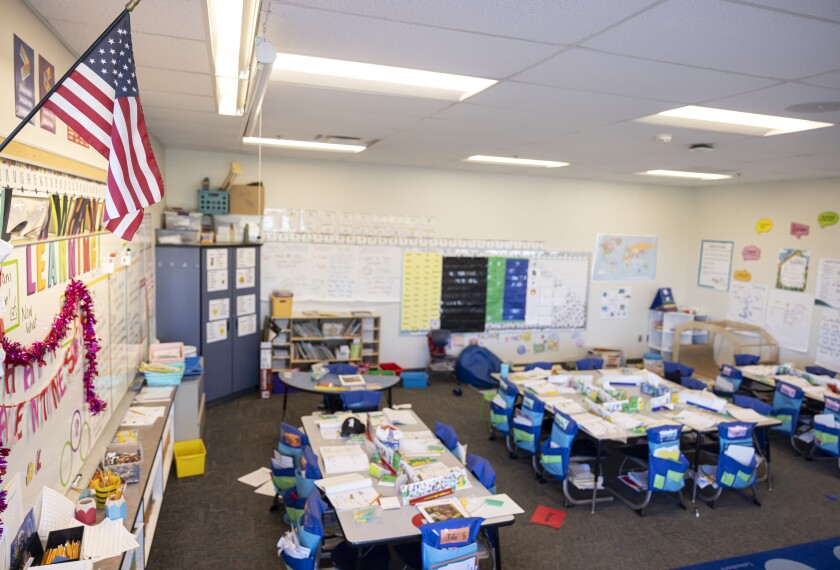
A first grade classroom at a school in Colorado Springs, on Feb. 12, 2026.
A 1st grade classroom at a school in Colorado Springs, Colo., on Feb. 12, 2026. The U.S. Department of Education released a proposal to rework a decades-old program charged with helping states and school districts problem-solve and deploy new initiatives, calling the current structure “duplicative” and “confusing.”
Kevin Mohatt for Education Week
Federal Will the Ed. Dept. Act on Recommendations to Overhaul Its Research Arm?
An adviser's report called for more coherence and sped-up research awards at the Institute of Education Sciences.
6 min read
The U.S. Department of Education building is pictured on Oct. 24, 2025, in Washington, D.C.
The U.S. Department of Education building in Washington is pictured on Oct. 24, 2025. A new report from a department adviser calls for major overhauls to the agency's research arm to facilitate timely research and easier-to-use guides for educators and state leaders.
Maansi Srivastava for Education Week
Federal Trump Talks Up AI in State of the Union, But Not Much Else About Education
The president didn't mention two of his cornerstone education policies from the past year.
4 min read
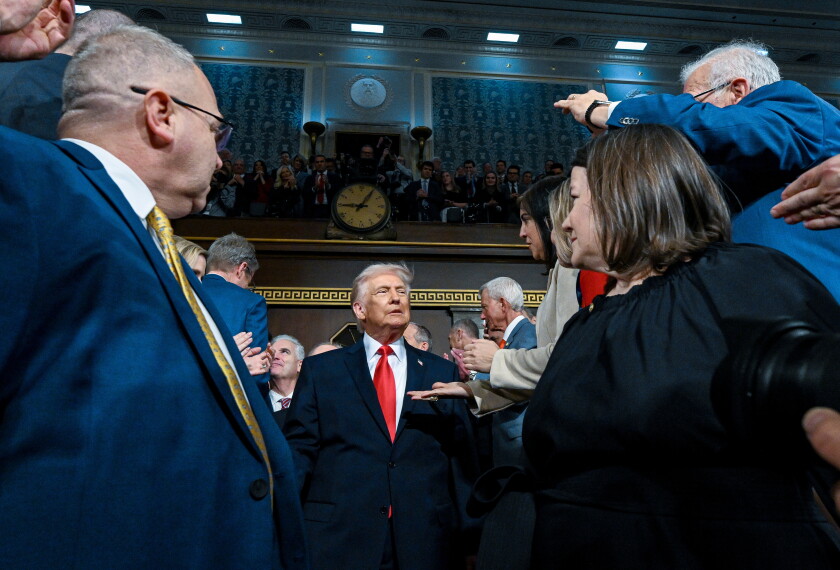
President Donald Trump enters to deliver the State of the Union address to a joint session of Congress in the House chamber at the U.S. Capitol in Washington, Tuesday, Feb. 24, 2026.
President Donald Trump enters to deliver the State of the Union address to a joint session of Congress in the House chamber at the U.S. Capitol in Washington, Tuesday, Feb. 24, 2026. The president devoted little time in the speech to discussing his education policies.
Kenny Holston/The New York Times via AP, Pool
Federal Education Department Will Send More of Its Programs to Other Agencies
Education grants for school safety, community schools, and family engagement will shift to Health and Human Services.
4 min read
Various school representatives and parent liaisons attend a family and community engagement think tank discussion at Lowery Conference Center on March 13, 2024 in Denver. One of the goals of the meeting was to discuss how schools can better integrate new students and families into the district. Denver Public Schools has six community hubs across the district that have serviced 3,000 new students since October 2023. Each community hub has different resources for families and students catering to what the community needs.
A program that helps state education departments and schools improve family engagement policies is among those the Trump administration will transfer from the U.S. Department of Education to the U.S. Department of Health and Human Services. In this photo, school representatives and parent liaisons attend a family and community engagement discussion on March 13, 2024, in Denver to discuss how schools can better integrate new students and families into the district.
Rebecca Slezak For Education Week