Amid the devastation inflicted by a tsunami the day after Christmas, a school reopened in Galle last week, a small but vital sign that the community in Sri Lanka is determined to seek recovery and normalcy.
Read the related stories:
The Sudarma School is about 100 meters from the beachfront in the southern fort-city that was hit head-on by the giant wave on Dec. 26, according to Martin Dawes, a regional spokesman for the United Nations Children’s Fund, who visited there last week, making a delivery of school supply kits.
Only a day before school reopened, he said, local authorities were trying to get an accurate number of the dead and missing. They were talking to parents who had brought in photographs of children. Officials were estimating that as many as 350 children may have died, out of the school’s 1,200 students.
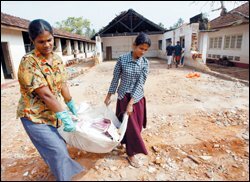
Workers were rushing to spread disinfectant on walls, floors, and furniture in one of the school’s two buildings, Mr. Dawes said. The other, badly damaged, would have to be torn down.
• Children account for more than one-third of the 153,000 people estimated killed in South Asia as a result of the Dec. 26, 2004, tsunami, according to UNICEF.
• Children represented 39 percent of the overall population in the eight hardest-hit countries: India, Indonesia, Malaysia, Maldives, Myanmar, Sri Lanka, Somalia, and Thailand.
• The agency estimates that 1.5 million surviving children—many of whom have been orphaned or separated from their families—have a critical need for basic care and support.
• In Aceh, Indonesia, officials report that 1,500 teachers were killed and more than 500 schools were destroyed or damaged—over 50 percent of the total in the province.
• Sri Lankan authorities report that 112 schools were damaged or destroyed in that country; another 244 are occupied by refugees.
These statistics, the best available at the time this issue went to press, were compiled by the Basic Education Coalition and updated by Education Week.
While the crew worked, displaced men, women, and children wandered about the school, Mr. Dawes continued, a complication to preparations for classes. He doubted that school administrators would turn them out.
“People are traumatized—it makes no sense to kick them out,” Mr. Dawes said. “We’re quite prepared to bring in tents to set up alternative schools outside of a school” occupied by displaced persons.
The scene was similar to reports from tsunami-afflicted communities across South Asia. Hundreds of schools reopened in one shape or form, some jury-rigged in tents, others in buildings that were hurriedly cleaned up or that had escaped unscathed, according to governments, aid agencies, and news organizations.
Hundreds of other schools, however, were destroyed, or were too damaged to reopen, according to UNICEF and government sources in Sri Lanka, Indonesia, and the Maldives.
Schools in Ampara, Sri Lanka, did not open because of a lack of teachers, Mr. Dawes said in a telephone interview from his office in Colombo, the island country’s capital. “They may be dead or bereaved, or have got enough to deal with their family,” he said.
Relief efforts by international groups in Indonesia’s Aceh province, where a long-running civil war has given way to an uneasy truce between the government and rebel forces, were being restricted by the Indonesian government.
Some islands of the Maldives may no longer be habitable because of contaminated drinking water, Cream Wright, the chief of the education section of UNICEF’s programme division, said in Washington last week.
‘A Place to Organize’
The urgency to restart schools is a conviction that is shared by local communities, their governments, and the international relief and aid organizations that are working in the tsunami zones. Schools, they say, are critical both to short-term relief and long-term recovery.
Experts say schools are a vital resource for delivering health and safety services in the aftermath of a disaster.
“School is a place to organize, to protect children, a place for other groups to organize—just getting more shelter in light of predators [who might target children for sexual exploitation or abuse] moving into those areas,” said Stephen F. Moseley, the president of the Academy for Education and Development, a Washington-based nonprofit group that runs programs in education, research, and training around the world, often funded by grants as well as government contracts.
Mark Engman, the senior representative for government and intergovernment relations of the Christian Children’s Fund, headquartered in Richmond, Va., which carries out education initiatives in many of the affected countries, said many children have little to do during the cleanup operations.
“Schools represent normalcy; you can get back to normal life, when you see in a lot of countries a lot of despair,” he said.
Mr. Engman said his group was setting up “child-centered places” in Sri Lanka, Indonesia, and India that could be developed into schools. The children’s fund is also helping train teachers to look for signals of distress in their students.
Schools, moreover, help protect people who are vulnerable to being caught up in illegal human trafficking for labor or sex during crises.
And not just for the children, experts note, but for parents who might be lured to abandon their responsibilities.
“Schooling becomes an expression of hope for parents to energize themselves and take responsibility for their children,” Mr. Moseley said.