Federal

Fuller’s Work Touches Off Controversy

By Debra Viadero — October 19, 2004 2 min read
  • Save to favorites
  • Print

A University of California, Berkeley, researcher set off a political firestorm this month when he released an analysis casting doubt on the Bush administration’s contention that academic achievement is rising across the nation.

The U.S. Department of Education quickly enlisted 12 scholars and advocates to denounce the findings. The study was also disowned by Policy Analysis for California Education, or PACE, the respected think tank on whose letterhead it had been circulated. And the Education Trust, a Washington research and advocacy group, rushed to respond with the release of its own report offering a very different take on state test-score trends. (“Report: States See Test-Score Gains,” this issue.)

U.S. Secretary of Education Rod Paige also suggested in a statement that, with a presidential election near, the release of the Berkeley scholar’s study might be “politically motivated.”

Bruce Fuller, the lead author of the study and a professor of education and public policy, said the intense reactions surprised him.

He said the study was not meant to criticize the No Child Left Behind Act, the centerpiece of President Bush’s education agenda. “All we’re trying to say is that the evidence is too thin to claim No Child Left Behind is boosting test scores,” he said.

Internal Squabble

His report is a compilation of statistics showing trends in reading-test scores since the 1990s for 3rd and 4th graders in 15 states. Mr. Fuller said the figures showed that “no consistent pattern of gains in children’s reading skills can be detected since passage of the No Child Left Behind reforms,” which President Bush signed into law in January 2002. In 11 of the states studied, the analysis says, scores had either flattened out or declined.

Mr. Fuller released the data in tandem with a Commentary he wrote on the findings in Education Week. (“Are Test Scores Really Rising?” Oct. 13, 2004.) Because of an error, he said, the release of his analysis went out on letterhead for the California policy group, which Mr. Fuller co-directs.

That manner of release drew a protest from Michael W. Kirst, another PACE co-director, who said that Mr. Fuller had overstepped the state-based think tank’s mission of providing independent analysis of the impact of education policy in California.

Federal officials were more concerned about the findings themselves. They said test scores for some of the states cited in the report had climbed even though Mr. Fuller claimed otherwise.
Events

This content is provided by our sponsor. It is not written by and does not necessarily reflect the views of Education Week's editorial staff.
Sponsor
Artificial Intelligence Webinar
Managing AI in Schools: Practical Strategies for Districts
How should districts govern AI in schools? Learn practical strategies for policies, safety, transparency, and responsible adoption.
Content provided by Lightspeed Systems
This content is provided by our sponsor. It is not written by and does not necessarily reflect the views of Education Week's editorial staff.
Sponsor
Reading & Literacy Webinar
Two Jobs, One Classroom: Strengthening Decoding While Teaching Grade-Level Text
Discover practical, research-informed practices that drive real reading growth without sacrificing grade-level learning.
Content provided by EPS Learning
Jobs Virtual Career Fair for Teachers and K-12 Staff
Find teaching jobs and K-12 education jubs at the EdWeek Top School Jobs virtual career fair.

EdWeek Top School Jobs

Teacher Jobs
Search over ten thousand teaching jobs nationwide — elementary, middle, high school and more.
View Jobs
Principal Jobs
Find hundreds of jobs for principals, assistant principals, and other school leadership roles.
View Jobs
Administrator Jobs
Over a thousand district-level jobs: superintendents, directors, more.
View Jobs
Support Staff Jobs
Search thousands of jobs, from paraprofessionals to counselors and more.
View Jobs

Read Next

Federal Ed. Dept. Wants to Revamp Assistance Program It Calls 'Duplicative,' 'Confusing'
The department's Comprehensive Centers have already been through a year of shakeups.
3 min read
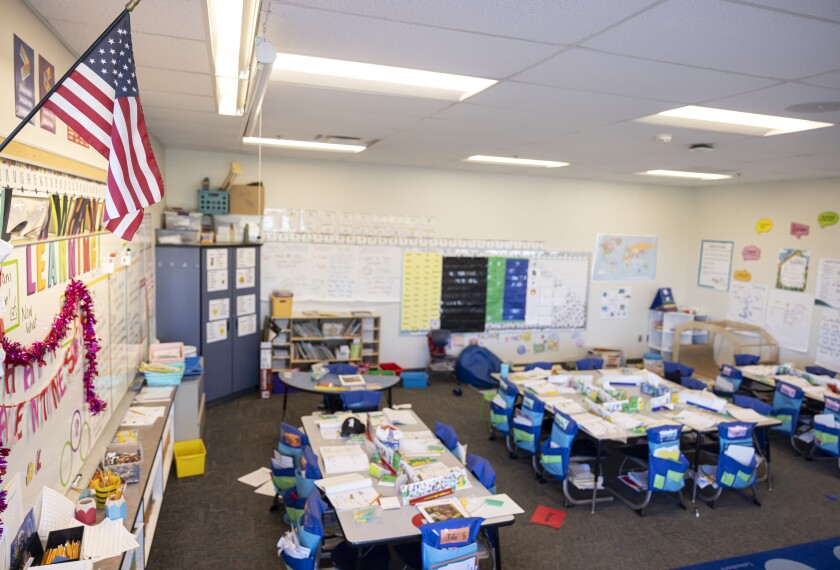
A first grade classroom at a school in Colorado Springs, on Feb. 12, 2026.
A 1st grade classroom at a school in Colorado Springs, Colo., on Feb. 12, 2026. The U.S. Department of Education released a proposal to rework a decades-old program charged with helping states and school districts problem-solve and deploy new initiatives, calling the current structure “duplicative” and “confusing.”
Kevin Mohatt for Education Week
Federal Will the Ed. Dept. Act on Recommendations to Overhaul Its Research Arm?
An adviser's report called for more coherence and sped-up research awards at the Institute of Education Sciences.
6 min read
The U.S. Department of Education building is pictured on Oct. 24, 2025, in Washington, D.C.
The U.S. Department of Education building in Washington is pictured on Oct. 24, 2025. A new report from a department adviser calls for major overhauls to the agency's research arm to facilitate timely research and easier-to-use guides for educators and state leaders.
Maansi Srivastava for Education Week
Federal Trump Talks Up AI in State of the Union, But Not Much Else About Education
The president didn't mention two of his cornerstone education policies from the past year.
4 min read
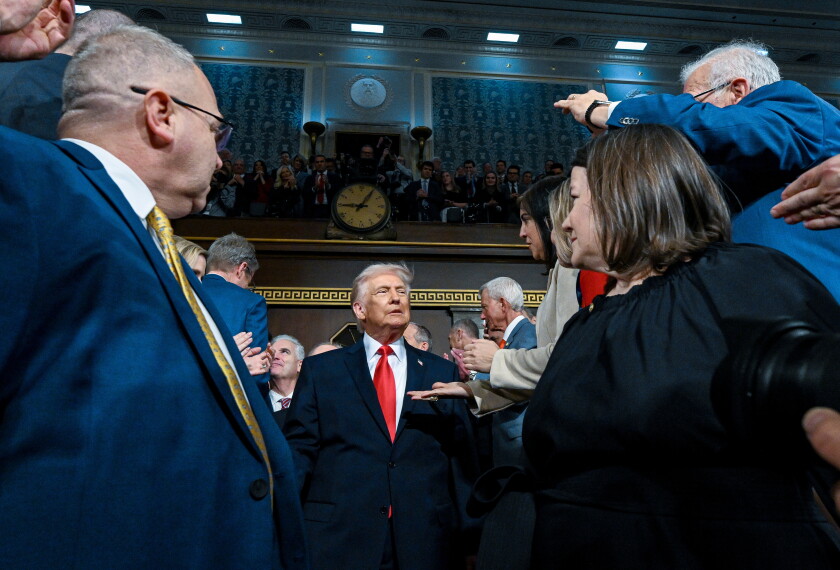
President Donald Trump enters to deliver the State of the Union address to a joint session of Congress in the House chamber at the U.S. Capitol in Washington, Tuesday, Feb. 24, 2026.
President Donald Trump enters to deliver the State of the Union address to a joint session of Congress in the House chamber at the U.S. Capitol in Washington, Tuesday, Feb. 24, 2026. The president devoted little time in the speech to discussing his education policies.
Kenny Holston/The New York Times via AP, Pool
Federal Education Department Will Send More of Its Programs to Other Agencies
Education grants for school safety, community schools, and family engagement will shift to Health and Human Services.
4 min read
Various school representatives and parent liaisons attend a family and community engagement think tank discussion at Lowery Conference Center on March 13, 2024 in Denver. One of the goals of the meeting was to discuss how schools can better integrate new students and families into the district. Denver Public Schools has six community hubs across the district that have serviced 3,000 new students since October 2023. Each community hub has different resources for families and students catering to what the community needs.
A program that helps state education departments and schools improve family engagement policies is among those the Trump administration will transfer from the U.S. Department of Education to the U.S. Department of Health and Human Services. In this photo, school representatives and parent liaisons attend a family and community engagement discussion on March 13, 2024, in Denver to discuss how schools can better integrate new students and families into the district.
Rebecca Slezak For Education Week