Law & Courts

Educational Toymakers Sued Over Trump Tariffs. How Is the Supreme Court Leaning?

By Mark Walsh — November 05, 2025 3 min read
People arrive to attend oral arguments at the Supreme Court on Wednesday, Nov. 5, 2025, in Washington.
  • Save to favorites
  • Print

A majority of U.S. Supreme Court justices voiced skepticism on Wednesday about the legality of President Donald Trump’s sweeping tariffs, which are being challenged by two educational toy companies and others who say the measures will raise costs for school districts.

During more than two hours of arguments in Learning Resources Inc. v. Trump, Chief Justice John G. Roberts Jr. said the tariffs were an “imposition of taxes on Americans, and that has always been the core power of Congress.”

Justice Neil M. Gorsuch warned of “a one-way ratchet toward the gradual but continual accretion of power in the executive branch and away from the people’s elected representatives” in Congress.

Justice Amy Coney Barrett asked tough questions of both sides, while more liberal members Sonia Sotomayor, Elena Kagan, and Ketanji Brown Jackson also appeared sympathetic to the challengers.

The lead challengers to Trump’s tariffs are Learning Resources Inc. and hand2mind Inc., both based in Vernon Hills, Ill., a Chicago suburb. They sell hands-on learning toys focused on STEM learning, computer coding, social emotional learning, reading, and mathematics.

Most of their products were manufactured in China until the president imposed some of his highest tariffs on that country. The companies have shifted some of their production to Vietnam and India, although those countries have also seen higher Trump tariffs.

“Mr. Trump … raised the tax rate on our company to the point it was asphyxiating,” Rick Woldenberg, the CEO of both education companies, told Education Week recently. Woldenberg and several of his adult children who work for the companies were in attendance at court.

Trump has increased baseline and nation-specific tariffs on imported goods based on two conditions he has declared “emergencies.”

One involves the flow of fentanyl and other lethal opioids into the United States from countries such as Canada, Mexico, and China. Portions of the increased tariffs on those nations are meant to pressure them to better combat the problem.

The other emergency cited by the president is the existence of longstanding trade imbalances between the United States and many of its trading partners.

“President Trump has declared that these emergencies are country-killing and not sustainable, that they threaten the bedrock of our national and economic security, and that fixing them will make America strong, financially viable, and a respected country again,” U.S. Solicitor General D. John Sauer told the justices during the Nov. 5 arguments.

Argument at times a civics lesson

Woldenberg and other challengers argue that Trump’s use of a 1977 federal law, the International Emergency Economic Powers Act (IEEPA), exceeds his powers because the statute does not mention tariffs.

“Tariffs are taxes,” Neal K. Katyal, a Washington lawyer representing small-business owners challenging the tariff policies. “They take money from Americans’ pockets and deposit them in the U.S. Treasury. Our founders gave that taxing power to Congress alone. Yet, here, the president bypassed Congress and imposed one of the largest tax increases in our lifetimes.”

Katyal and a lawyer representing a group of 12 states, also challenging the tariffs, faced pushback from conservative Justices Clarence Thomas, Samuel A. Alito Jr., and Brett M. Kavanaugh.

“I know you dispute the fact that this is a real emergency,” Alito told Katyal. “Maybe it’s not. But isn’t it the very nature of an emergency provision that it’s going to be more open-ended?”

Kavanaugh expressed concern that restricting the president’s ability to impose tariffs would take away from his “suite of tools” to deal with economic emergencies.

At times, though, the argument sounded like a civics lesson dealing with the underpinnings of the American Revolution and the constitutional separation of powers.

“Tariffs are constitutionally special because our founders feared revenue-raising measures, unlike embargoes on foreign countries’ exports,” Katyal said.

“You know, there was no Boston embargo party, but there was certainly a Boston Tea Party,” he said.

Gorsuch said the key context here was “the constitutional assignment of the taxing power to Congress, the power to reach into the pockets of the American people is just different, and it’s been different since the founding.”

A decision in the case is expected by next June.

Events

This content is provided by our sponsor. It is not written by and does not necessarily reflect the views of Education Week's editorial staff.
Sponsor
Artificial Intelligence Webinar
Managing AI in Schools: Practical Strategies for Districts
How should districts govern AI in schools? Learn practical strategies for policies, safety, transparency, and responsible adoption.
Content provided by Lightspeed Systems
This content is provided by our sponsor. It is not written by and does not necessarily reflect the views of Education Week's editorial staff.
Sponsor
Student Absenteeism Webinar
Turning Attendance Data Into Family Action
This California district cut chronic absenteeism in half. Learn how they used insight and early action to reach families and change outcomes.
Content provided by SchoolStatus
This content is provided by our sponsor. It is not written by and does not necessarily reflect the views of Education Week's editorial staff.
Sponsor
College & Workforce Readiness Webinar
Climb: A New Framework for Career Readiness in the Age of AI
Discover practical strategies to redefine career readiness in K–12 and move beyond credentials to develop true capability and character.
Content provided by Pearson

EdWeek Top School Jobs

Teacher Jobs
Search over ten thousand teaching jobs nationwide — elementary, middle, high school and more.
View Jobs
Principal Jobs
Find hundreds of jobs for principals, assistant principals, and other school leadership roles.
View Jobs
Administrator Jobs
Over a thousand district-level jobs: superintendents, directors, more.
View Jobs
Support Staff Jobs
Search thousands of jobs, from paraprofessionals to counselors and more.
View Jobs

Read Next

Law & Courts Appeals Court Halts Ruling Letting Teachers Disclose Students' Gender Identity
A federal appeals court has temporarily paused enforcement of the ruling but has not yet decided whether to grant a longer-term stay.
Kristen Taketa, The San Diego Union-Tribune
3 min read
Students carrying pride and transgender flags leave Great Oak High School in Temecula, Calif., on Sept. 22, 2023, after walking out of the school in protest of the Temecula school district policy requiring parents to be notified if their child identifies as transgender.
Anjali Sharif-Paul/The Orange County Register via AP
Law & Courts Schools Can’t Bar Teachers From Telling Parents If Kids Are Transgender, Judge Rules
The injunction bans any public school employee from misleading parents about their child’s gender presentation at school.
Kristen Taketa, The San Diego Union-Tribune
5 min read
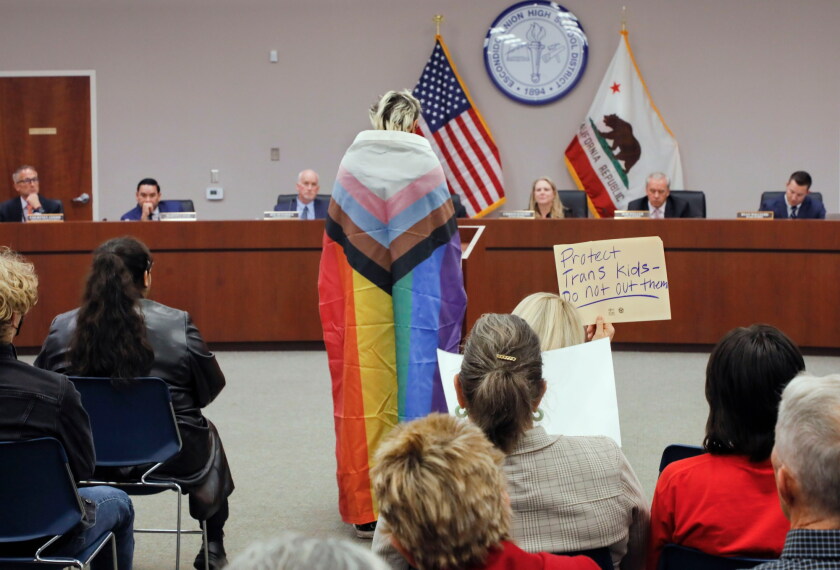
Teacher’s aide Amelia Mester, wrapped in a Pride flag, urges Escondido Union High School District not to have employees notify parents if they believe a student may be transgender in November 2025. A policy on the issue in the city’s elementary school district is the subject of a federal class-action lawsuit in which a judge just sided against the district.
Teacher’s aide Amelia Mester, wrapped in a Pride flag, urges Escondido Union High School District not to have employees notify parents if they believe a student may be transgender. A policy on the issue in the city’s elementary school district is the subject of a federal class-action lawsuit in which a judge just ruled against the district.
Charlie Neuman for The San Diego Union-Tribune/TNS
Law & Courts Federal Appeals Court Upholds 8th Grader's Expulsion Over Gun Comments in Class
Shortly after a nearby mass school shooting, a student allegedly discussed bringing a gun to school.
3 min read
Photo of stone columns.
E+
Law & Courts Trump's Education Policies Spurred 72 Lawsuits in 2025. How Many Is He Winning?
The legal challenges show which policies have had a big impact and how 2026 could go.
5 min read
President Donald Trump holds up an executive order after signing it at an indoor Presidential Inauguration parade event in Washington, Jan. 20, 2025.
President Donald Trump holds up an executive order after signing it at an indoor presidential inauguration parade event in Washington on Jan. 20, 2025. Trump's executive actions prompted legal challenges virtually from the moment he took office, and education-related policies were not immune.
Matt Rourke/AP