The recession tearing into the U.S. economy is not only straining the public coffers that support K-12 schooling, it’s also taking a toll on education philanthropy.
From family foundations to corporate philanthropies, charitable giving to K-12 education appears to be facing a downturn. Although no national figures are available, many philanthropies—including notable education contributors such as the Eli and Edythe Broad Foundation and the Jack Kent Cooke Foundation—expect to decrease their giving levels this year.
Most grantmakers are expected to meet their current grant commitments, which often span multiple years, but observers and foundation officials say the outlook for education is likely to worsen before it improves.
The Denver-based Donnell-Kay Foundation saw its endowment drop by about one-fifth, to $26 million, from January to early November of 2008. And that was before the stock market plunged lower in recent months.
Nearly two-thirds surveyed by a national consulting firm say they’ll scale back contributions this year.
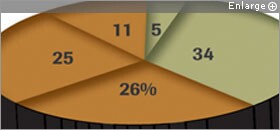
Note: Slices total more than 100 percent because of rounding.
SOURCE: Dini Partners
As a result, the private family foundation, whose mission is to improve public education and drive “systemic school reform,” is scaling back its grantmaking, as well as in-house work with its own staff and consultants. The foundation’s budget is down by about $350,000, to $1.25 million for the fiscal year that began Feb. 1.
“It’s a pretty typical story,” said Tony Lewis, the executive director. “We have less money to spend.”
Some organizations that rely on private giving for part or all of their budgets are already feeling the pinch.
“What’s been a challenge is some of the local and regional corporate giving is down,” said Craig S. Evans, the executive director of the nonprofit Foundation for Orange County Public Schools, in Florida, which raises money to work with the 166,000-student Orlando-based district. The organization’s budget has dropped from about $1.1 million in the last fiscal year to $920,000 this year, he said.
Mr. Evans said he’s heard from some foundations that they are redirecting their grantmaking to help “people who have lost their jobs, people who are hungry, people who are in housing trouble.”
Mixed Picture
Not every philanthropy will give less this year. Some have said they will provide about the same levels of support, at least for 2009, even if their assets have shrunk. And at least a few have said their grantmaking levels will rise.
Notably, the Seattle-based Bill & Melinda Gates Foundation, the largest single donor to K-12 education, has said its overall payout of grants would climb by 10 percent in 2009, though that growth was lower than planned. The foundation has provided some $2 billion this decade for efforts intended to improve high schools. (The foundation provides support for Education Week’s annual Diplomas Count report.)
But philanthropic organizations themselves are facing the impact of tough times. The assets of many foundations dropped by nearly one-third last year, The Chronicle of Philanthropy reported recently.
Meanwhile, President Barack Obama has drawn criticism, even from some leading congressional Democrats, for a proposal that would reduce the tax benefit of charitable giving by wealthy individuals starting in 2011. Critics argue that such a move would further squeeze private donations.
At the same time, some analysts say the stock market tumble will have a much bigger impact on the decisions of high-wealth donors.
When it comes to K-12 public education, philanthropic dollars are a tiny fraction of overall funding. Though no precise numbers are available, the Foundation Center, based in New York City, estimates total grant awards for elementary and secondary education, including for private schools, by foundations in 2006 at $1.36 billion.
By contrast, in 2006-07, public schools spent more than $500 billion from all sources, according to federal data.
Even so, philanthropy can play an important role.
“Funders think about how to use their money to leverage change or to fill in the gaps,” said Christine T. Tebben, executive director of Grantmakers for Education, a national network based in Portland, Ore.
She said the recession is “the center of the conversation” for her nearly 250 members right now.
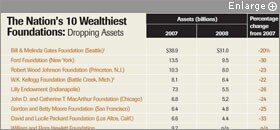
Notes: Figures are for the fiscal years ending Dec. 31. Many figures in this table are estimated.
n/a = Not available
1 Figures are for the Bill & Melinda Gates Foundation and the Bill & Melinda Gates Foundation Trust.
2 Figures are for the W.K. Kellogg Foundation and the W.K. Kellogg Foundation Trust.
SOURCE: The Chronicle of Philanthropy
Ms. Tebben said she is generally seeing a contraction in education giving in 2009 by foundations. Her group aims to release a study later this year with details.
“The uncertainty [of the economy] is as hard as the reality,” Ms. Tebben said.
Although not separating out plans for education, several recent surveys suggest giving by many philanthropies is going down.
A January report by Dini Partners, a Houston-based consulting firm, found that 62 percent of 54 major donors it surveyed across the nation expected their giving levels to decline in 2009. Of 73 foundations that recently provided information to The Chronicle of Philanthropy, 39 said they expected their donations to decline this year.
Frederick M. Hess, the director of education policy studies at the American Enterprise Institute, a Washington think tank, said it’s too soon to know the “full damage” of the recession on education philanthropy, since many foundations calculate the value of their endowments over several years when setting giving levels.
“It’s likely it’ll get substantially uglier before we get out the other side,” said Mr. Hess, who has studied philanthropy in education.
Hit Across the Board
The recession, which officially began in December 2007, is hitting foundations large and small.
“Our endowment is down, just like everybody else’s,” said Joshua S. Wyner, the executive vice president of the Jack Kent Cooke Foundation, based in Lansdowne, Va.
In the fiscal year that ends May 31, his foundation is providing $11 million in grants for work in K-12 and higher education, including to charter school networks. Also, it’s giving $17 million in direct student support and scholarships for high-achieving, lower-income students to attend high school, college, and graduate school.
“Our first priority is to maintain every commitment that we’ve made until now,” Mr. Wyner said.
He expects the foundation’s giving level will decline in the coming fiscal year, but said he doesn’t know how much yet.
The Los Angeles-based Broad Foundation, one of the largest private K-12 funders in the country, will lower its new grant commitments in education in 2009, said Erica S. Lepping, a spokeswoman for the foundation.
The foundation, which backs efforts such as improving urban school leadership and helping high-quality charter schools, committed nearly $80 million for new education grants last year. (Broad is providing support for the Education Week series “A Nation at Risk: 25 Years Later.”)
At the Donnell-Kay Foundation, Mr. Lewis said current and likely future budget cuts will lower the size of new grants and limit some policy work the philanthropy is doing through its staff and consultants.
Recent grant recipients include the 75,000-student Denver public school system; the Colorado Children’s Campaign, a research and advocacy group in Denver; and Envision Schools Colorado, a new charter school operator.
Responses Vary
Philanthropies are showing a range of responses to the economic crisis, said Stephanie M. Saroki, the senior director of K-12 programs at the Washington-based Philanthropy Roundtable, an association of foundation officials and individual donors.
“One response is to take a really hard look at your giving, and thinking about how those grants align with your mission,” she said.
And some foundation officials see potential to collaborate with the U.S. Department of Education, especially given a new, $5 billion pot of discretionary funding included as part of the recently enacted federal stimulus package, and Secretary of Education Arne Duncan’s close work with philanthropies when he led the Chicago school system.
Ms. Saroki said she worries, though, that the tight fiscal times may reduce the willingness of foundations to back the next generation of entrepreneurial ventures in education. She argues that nonprofits such as New York City-based Teach For America have proved to be especially powerful investments.
Jay P. Greene, an education researcher at the University of Arkansas at Fayetteville who has studied K-12 philanthropy, said many universities, think tanks, and other nonprofits working to influence the shape of education will surely face a difficult period.
Robin J. Lake, the associate director of the Center for Reinventing Public Education, at the University of Washington in Bothell, said, “It’s going to be a lot harder for us to find money to support our most forward-thinking and creative work.” The center conducts research and policy analysis on charter schools, urban district reform, and other K-12 topics.
Beyond Public Schools
Some private schools and organizations that support them are already finding it harder, meanwhile, to raise money.
James B. Field, the president of the Minnesota Independent School Forum, based in St. Paul, said that at a recent meeting with the heads of 15 private schools, each reported that fundraising levels were down.
To make matters worse, Mr. Field said, many schools with endowments have seen the value of those assets drop significantly.
The Denver-based StreetSchool Network (formerly called the National Association of Street Schools), a national network of “second chance” Christian schools for struggling students, is facing more difficult times. Most of the schools charge nominal tuition on a sliding scale, so as not to price out a largely low-income clientele.
Tom Tillapaugh, the network’s president, said his organization and member schools, which rely heavily on private donations, are seeing a decline in charitable support.
“We have several schools that are hurting really bad,” he said, “and if something doesn’t change, they might have to close.”


