Law & Courts

Court Seeks Justice Dept.’s Views in Case Over N.Y. Teacher Test

By Mark Walsh — December 05, 2007 3 min read
  • Save to favorites
  • Print

The U.S. Supreme Court is asking the Bush administration for its views on a long-running lawsuit that contends a teacher-certification exam used by New York state has a disparate impact on black and Latino teachers in the New York City school system.

The court on Dec. 3 asked the U.S. solicitor general for his views about the issues raised in Board of Education of New York City v. Gulino (Case No. 07-270), a sign that the justices are interested in the case. The solicitor general typically takes several months to respond to such an invitation.

The case raises several provocative questions. Who is the employer of public school teachers in New York state: the state, because it sets minimum licensure requirements, or the school district, which does the actual hiring? And is the state’s test a licensing exam akin to those administered to doctors and lawyers, or is it an employment test, which federal law says must pass muster as being job-related and properly validated?

A group of black and Latino teachers in New York City filed a class action against the state and the school system in 1996. The plaintiffs alleged that two tests used by the state had a racially disparate impact on African-American and Latino test-takers, and that those who failed to pass the test were demoted to substitute-teacher status, for which they were received less pay and reduced benefits. The teachers often had worked for many years with temporary licenses while trying to achieve full certification.

11 Years of Litigation

New York state used the National Teachers’ Examination Core Battery until 1994, when a state-developed exam called the Liberal Arts & Sciences Test, or LAST, replaced it. The lawsuit maintained that the test had a racially disparate impact that amounted to employment discrimination under Title VII of the Civil Rights Act of 1964.

Between 1993 and 1999, according to court documents, the average passing rate for white test-takers on the two tests ranged from 91 percent to 94 percent. The average for black test-takers in that period ranged from 51 percent to 62 percent; for Latinos, the average ranged from 47 percent to 55 percent.

The suit led to a five-month trial in 2002-03 before U.S. District Judge Constance Baker Motley, a noted civil rights lawyer before joining the bench. In late 2003, Judge Motley ruled that both the state and the school district were subject to Title VII liability for the test. But she ruled for the defendants, holding that the LAST was job-related because its inclusion of an essay portion was relevant to a teacher’s ability to communicate in writing. Judge Motley died in 2005.

On appeal, a three-judge panel of the U.S. Court of Appeals for the 2nd Circuit, in New York City, ruled unanimously last year to send the case back to the district court. The appeals court dismissed the state as a defendant, ruling that only the school district could face liability as an employer under Title VII. And it said the judge had erred in applying court precedents to the question of whether the LAST was a properly validated employment test. It ordered the district court to reconsider that issue.

The 1.1 million-student New York City school district appealed to the Supreme Court. The district is “in the awkward position of being on its own to defend a licensing examination that it neither designs, administers, grades, nor validates,” the school system said in its appeal.

The New York state education department filed a brief that also urges the justices to take up the case. The brief says most other federal appeals courts to address the issues had ruled that Title VII’s disparate-impact analysis should not be applied to state licensing requirements.

“A core rationale for demanding uniform minimum teacher-licensing requirements is to break [the] cycle” of poor and minority students’ “being poorly educated by underqualified teachers,” the state’s brief says.

In a brief urging the high court not to review the case, lawyers for the New York City teachers said the challenged tests “were used as de facto civil service examinations for public school personnel—not licensing tests—and courts routinely apply Title VII to civil service or state exams, the passage of which … is required exclusively for public employment.”

Events

This content is provided by our sponsor. It is not written by and does not necessarily reflect the views of Education Week's editorial staff.
Sponsor
Artificial Intelligence Webinar
Managing AI in Schools: Practical Strategies for Districts
How should districts govern AI in schools? Learn practical strategies for policies, safety, transparency, as well as responsible adoption.
Content provided by Lightspeed Systems
This content is provided by our sponsor. It is not written by and does not necessarily reflect the views of Education Week's editorial staff.
Sponsor
Reading & Literacy Webinar
Unlocking Success for Struggling Adolescent Readers
The Science of Reading transformed K-3 literacy. Now it's time to extend that focus to students in grades 6 through 12.
Content provided by STARI
Jobs Virtual Career Fair for Teachers and K-12 Staff
Find teaching jobs and K-12 education jubs at the EdWeek Top School Jobs virtual career fair.

EdWeek Top School Jobs

Teacher Jobs
Search over ten thousand teaching jobs nationwide — elementary, middle, high school and more.
View Jobs
Principal Jobs
Find hundreds of jobs for principals, assistant principals, and other school leadership roles.
View Jobs
Administrator Jobs
Over a thousand district-level jobs: superintendents, directors, more.
View Jobs
Support Staff Jobs
Search thousands of jobs, from paraprofessionals to counselors and more.
View Jobs

Read Next

Law & Courts Appeals Court Halts Ruling Letting Teachers Disclose Students' Gender Identity
A federal appeals court has temporarily paused enforcement of the ruling but has not yet decided whether to grant a longer-term stay.
Kristen Taketa, The San Diego Union-Tribune
3 min read
Students carrying pride and transgender flags leave Great Oak High School in Temecula, Calif., on Sept. 22, 2023, after walking out of the school in protest of the Temecula school district policy requiring parents to be notified if their child identifies as transgender.
Anjali Sharif-Paul/The Orange County Register via AP
Law & Courts Schools Can’t Bar Teachers From Telling Parents If Kids Are Transgender, Judge Rules
The injunction bans any public school employee from misleading parents about their child’s gender presentation at school.
Kristen Taketa, The San Diego Union-Tribune
5 min read
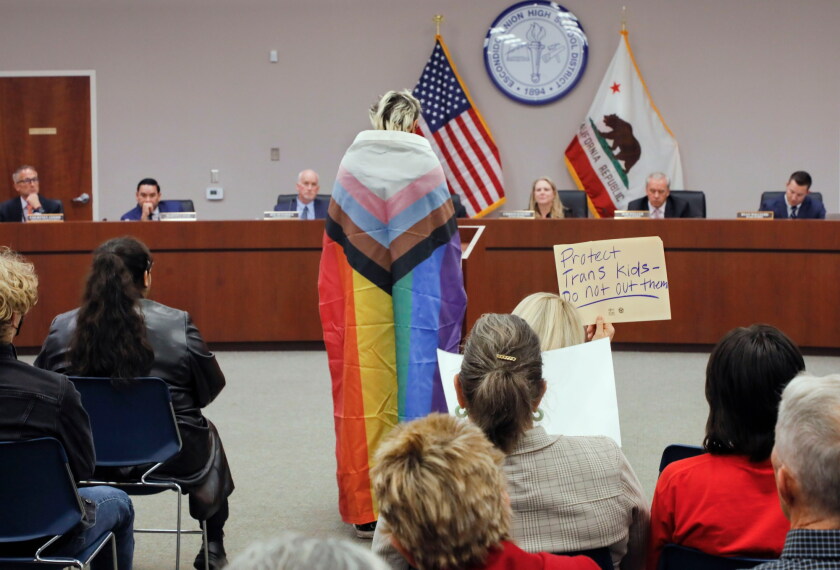
Teacher’s aide Amelia Mester, wrapped in a Pride flag, urges Escondido Union High School District not to have employees notify parents if they believe a student may be transgender in November 2025. A policy on the issue in the city’s elementary school district is the subject of a federal class-action lawsuit in which a judge just sided against the district.
Teacher’s aide Amelia Mester, wrapped in a Pride flag, urges Escondido Union High School District not to have employees notify parents if they believe a student may be transgender. A policy on the issue in the city’s elementary school district is the subject of a federal class-action lawsuit in which a judge just ruled against the district.
Charlie Neuman for The San Diego Union-Tribune/TNS
Law & Courts Federal Appeals Court Upholds 8th Grader's Expulsion Over Gun Comments in Class
Shortly after a nearby mass school shooting, a student allegedly discussed bringing a gun to school.
3 min read
Photo of stone columns.
E+
Law & Courts Trump's Education Policies Spurred 72 Lawsuits in 2025. How Many Is He Winning?
The legal challenges show which policies have had a big impact and how 2026 could go.
5 min read
President Donald Trump holds up an executive order after signing it at an indoor Presidential Inauguration parade event in Washington, Jan. 20, 2025.
President Donald Trump holds up an executive order after signing it at an indoor presidential inauguration parade event in Washington on Jan. 20, 2025. Trump's executive actions prompted legal challenges virtually from the moment he took office, and education-related policies were not immune.
Matt Rourke/AP
