Federal

Court Revives NEA Suit Against NCLB

By Mark Walsh — January 08, 2008 3 min read
  • Save to favorites
  • Print

A federal appeals court has revived a major legal challenge to the No Child Left Behind Act based on arguments that the law imposes financial obligations on states and school districts without providing enough funding to cover the costs.

The Jan. 7 ruling by a panel of the U.S. Court of Appeals for the 6th Circuit, in Cincinnati, is a victory for the National Education Association and its allies in the suit, which was dismissed in a federal district court in 2005.

A panel of the court ruled 2-1 that the states were not on clear notice of their potential financial obligations when they agreed to accept federal funding under the NCLB law, as legal rulings based on the spending clause in Article I of the U.S. Constitution require.

Central to the case was a provision in the NCLB law that says, “Nothing in this act shall be construed to … mandate a state or any subdivision thereof to spend any funds or incur any costs not paid for under this act.”

The language was first added to several federal education statutes in 1994, including to that year’s reauthorization of the Elementary and Secondary Education Act, of which the NCLB law is the latest version.

In an opinion by U.S. Circuit Judge R. Guy Cole Jr., the appeals court said that because of the unfunded-mandate language, “a state official could plausibly contend that she understood … that her state need not comply with NCLB requirements for which federal funding falls short.”

Writing in dissent, Judge David W. McKeague said the more logical purpose of the unfunded-mandates language was to bar federal education officials from piling additional requirements on states and school districts.

The 6th Circuit covers Kentucky, Michigan, Ohio, and Tennessee.

‘Bolt of Lightning’

The ruling returned the case to a federal district judge in Detroit. What happens next is unclear because the NEA, which filed the suit on behalf of nine school districts in Michigan, Texas, and Vermont, appears to have gotten essentially what it wanted in the suit: a declaration that the NCLB law was restricted by the unfunded-mandates provision.

The ruling means that “as a condition of participation in the No Child Left Behind Act, a school district or state cannot be compelled to use its own resources to carry out that mandate,” Robert H. Chanin, the general counsel of the NEA and the architect of the lawsuit, said in an interview.

Mr. Chanin said he believes states and school districts would be on solid legal ground in refusing to use their own funds to pay for NCLB obligations that were not covered by their allocations of federal aid. The law requires schools to test students annually in grades 3-8 and at least once in high school in reading and mathematics. Schools that do not make adequate yearly progress in student achievement face consequences, such as having to provide after-school tutoring.

“Hundreds of school districts and all of the states now know that at least one court of appeals has said to them, ‘You are right; you don’t have to do anything you are not getting the money to do.’”

Connecticut Attorney General Richard Blumenthal, who filed a friend-of-the-court brief on the NEA’s side in the 6th Circuit, issued a statement calling the decision “a bolt of legal lightning igniting new, powerful momentum to our No Child Left Behind case and congressional reform.”

The state has its own suit challenging the federal education law, also based largely on the grounds that it imposes unfunded mandates. Connecticut’s case is pending in a federal district court.

The ruling came one day before the sixth anniversary of when President Bush signed the No Child Left Behind Act into law. Secretary of Education Margaret Spellings joined Mr. Bush on Monday at an elementary school in Chicago to recognize the anniversary.

Later in the day, Secretary Spellings issued a statement that said the federal government was exploring all its legal options in the wake of the court ruling.

“This decision could undermine efforts to improve the education of our nation’s children, in particular those students most in need,” Ms. Spellings said. “No Child Left Behind is not an unfunded mandate but rather a compact between the states and the federal government, which asks that in exchange for federal dollars, results be demonstrated.”
Events

This content is provided by our sponsor. It is not written by and does not necessarily reflect the views of Education Week's editorial staff.
Sponsor
Artificial Intelligence Webinar
Managing AI in Schools: Practical Strategies for Districts
How should districts govern AI in schools? Learn practical strategies for policies, safety, transparency, as well as responsible adoption.
Content provided by Lightspeed Systems
This content is provided by our sponsor. It is not written by and does not necessarily reflect the views of Education Week's editorial staff.
Sponsor
Reading & Literacy Webinar
Unlocking Success for Struggling Adolescent Readers
The Science of Reading transformed K-3 literacy. Now it's time to extend that focus to students in grades 6 through 12.
Content provided by STARI
Jobs Virtual Career Fair for Teachers and K-12 Staff
Find teaching jobs and K-12 education jubs at the EdWeek Top School Jobs virtual career fair.

EdWeek Top School Jobs

Teacher Jobs
Search over ten thousand teaching jobs nationwide — elementary, middle, high school and more.
View Jobs
Principal Jobs
Find hundreds of jobs for principals, assistant principals, and other school leadership roles.
View Jobs
Administrator Jobs
Over a thousand district-level jobs: superintendents, directors, more.
View Jobs
Support Staff Jobs
Search thousands of jobs, from paraprofessionals to counselors and more.
View Jobs

Read Next

Federal Ed. Dept. Wants to Revamp Assistance Program It Calls 'Duplicative,' 'Confusing'
The department's Comprehensive Centers have already been through a year of shakeups.
3 min read
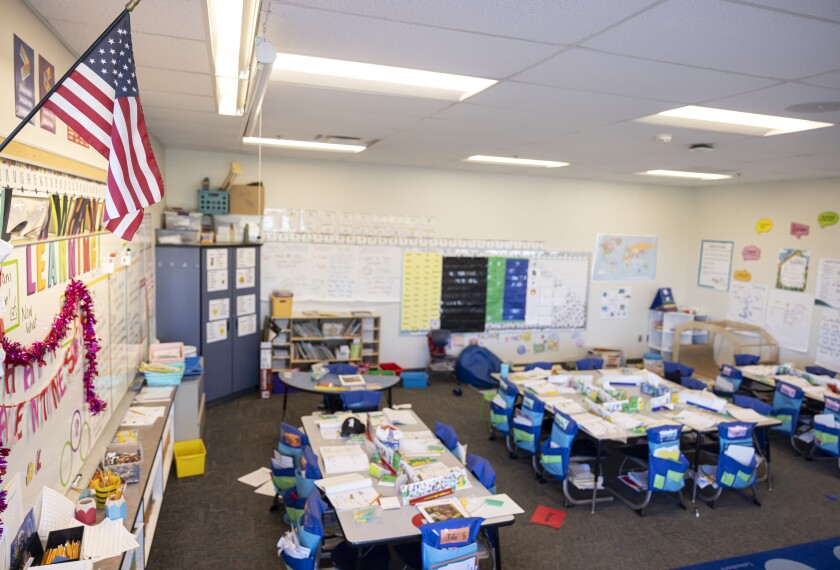
A first grade classroom at a school in Colorado Springs, on Feb. 12, 2026.
A 1st grade classroom at a school in Colorado Springs, Colo., on Feb. 12, 2026. The U.S. Department of Education released a proposal to rework a decades-old program charged with helping states and school districts problem-solve and deploy new initiatives, calling the current structure “duplicative” and “confusing.”
Kevin Mohatt for Education Week
Federal Will the Ed. Dept. Act on Recommendations to Overhaul Its Research Arm?
An adviser's report called for more coherence and sped-up research awards at the Institute of Education Sciences.
6 min read
The U.S. Department of Education building is pictured on Oct. 24, 2025, in Washington, D.C.
The U.S. Department of Education building in Washington is pictured on Oct. 24, 2025. A new report from a department adviser calls for major overhauls to the agency's research arm to facilitate timely research and easier-to-use guides for educators and state leaders.
Maansi Srivastava for Education Week
Federal Trump Talks Up AI in State of the Union, But Not Much Else About Education
The president didn't mention two of his cornerstone education policies from the past year.
4 min read
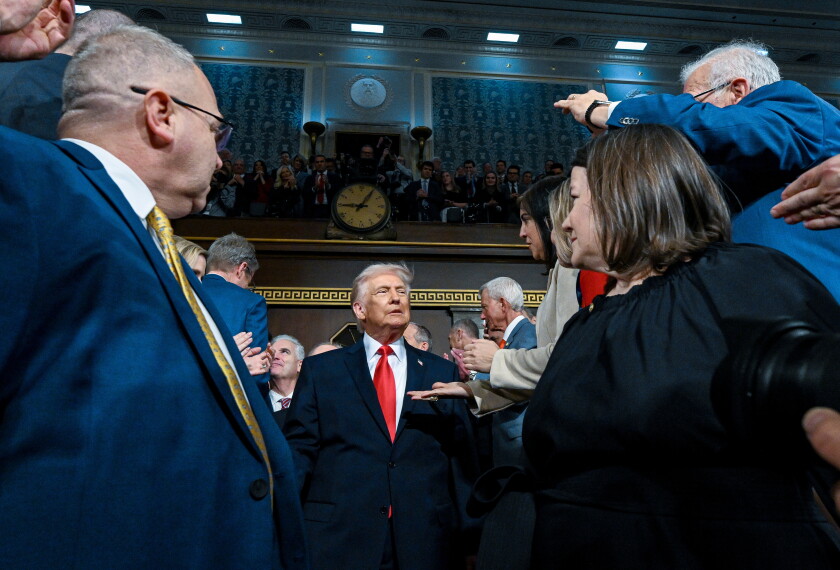
President Donald Trump enters to deliver the State of the Union address to a joint session of Congress in the House chamber at the U.S. Capitol in Washington, Tuesday, Feb. 24, 2026.
President Donald Trump enters to deliver the State of the Union address to a joint session of Congress in the House chamber at the U.S. Capitol in Washington, Tuesday, Feb. 24, 2026. The president devoted little time in the speech to discussing his education policies.
Kenny Holston/The New York Times via AP, Pool
Federal Education Department Will Send More of Its Programs to Other Agencies
Education grants for school safety, community schools, and family engagement will shift to Health and Human Services.
4 min read
Various school representatives and parent liaisons attend a family and community engagement think tank discussion at Lowery Conference Center on March 13, 2024 in Denver. One of the goals of the meeting was to discuss how schools can better integrate new students and families into the district. Denver Public Schools has six community hubs across the district that have serviced 3,000 new students since October 2023. Each community hub has different resources for families and students catering to what the community needs.
A program that helps state education departments and schools improve family engagement policies is among those the Trump administration will transfer from the U.S. Department of Education to the U.S. Department of Health and Human Services. In this photo, school representatives and parent liaisons attend a family and community engagement discussion on March 13, 2024, in Denver to discuss how schools can better integrate new students and families into the district.
Rebecca Slezak For Education Week