School Choice & Charters

Bishops Seek Means To Maintain High Quality

By Bess Keller — November 19, 1997 3 min read
  • Save to favorites
  • Print

Keeping Roman Catholic schools faithful to both religion and high academic quality in the next century will require better salaries for teachers and tax dollars in the hands of parents choosing schools.

That prescription comes in a report made to the National Conference of Catholic Bishops, which met here last week.

The report chronicles a seven-year effort to meet goals set by the bishops’ education committee. The goals include: maintaining the Catholic identity of the schools; increasing the availability of a parochial education, especially to Catholic and poor parents; finding new private money and directing public money to Catholic schools, through vouchers or other means; and bettering the salaries and benefits of parochial school teachers and administrators.

Roman Catholic school leaders said improvements during the past seven years have been uneven.

“We’ve made tremendous progress in the formation of future leaders” for Catholic elementary and secondary schools, said Monsignor Thomas J. McDade, the bishops’ secretary for education.

With growing enrollments and a shrinking workforce of nuns and other religious, Catholic schools have had to rely more and more on lay teachers and principals, who may be less prepared than their predecessors to take up the spiritual dimension of their jobs, said Leonard DeFiore, the president of the National Catholic Educational Association, based in Washington. Principals who are able to minister to spiritual needs are crucial to providing “a uniquely Catholic school environment,” he said.

Inner-City Salvation

Mr. DeFiore also pointed to progress--if not success--in making taxpayer money available for Catholic school tuition. An organization created in 1994 under the bishops’ auspices helps Catholic school parents lobby at the state and federal levels for support, while a majority of members of Congress favor “some form of vouchers,” according to Mr. DeFiore. He said he is optimistic that the next Congress or the next president will produce more school choice for parents.

Concerns raised by the U.S. Catholic Conference, however, helped defeat a voucher bill that the House voted on this month. (“Voucher Bill Fails on Bipartisan Vote in House,” Nov. 12, 1997.)

And state-financed voucher plans that include religious schools are under challenge in Ohio and Wisconsin state courts.

The Catholic leaders argue that vouchers would help keep open inner-city parochial schools, which serve a larger proportion of poor, minority, and non-Catholic students than their suburban counterparts. Overall, almost 25 percent of those enrolled in Catholic schools are members of minority groups.

“We still have the tremendous financial burden of keeping these inner-city schools open, and the dioceses don’t have the resources to do that indefinitely,” Mr. DeFiore said. While well-off suburban parishes can raise tuition or combine forces to meet school needs, inner-city schools often have to rely on the diocese for support, he said.

Both Mr. DeFiore and Monsignor McDay conceded that salaries and benefits for Catholic school staff members are inadequate. “That’s one area where we haven’t made as much progress as we’d like, and it’s a difficult area,” because higher salaries often mean higher tuitions, Mr. DeFiore said. He said salaries for most teachers in Catholic K-8 schools are between $20,000 and $30,000 a year, while the average figure for public school teachers exceeds $37,000.

“The whole issue of salaries and benefits is not something we can deal with on a national level,” Monsignor McDay said. But, he added, the report intentionally frames the matter as one of justice to spur discussion in each diocese and parish.

Related Tags:

Events

This content is provided by our sponsor. It is not written by and does not necessarily reflect the views of Education Week's editorial staff.
Sponsor
College & Workforce Readiness Webinar
The Road to Opportunity: Making CTE Accessible for All
The most valuable CTE happens off campus. For too many students, transportation is the barrier that keeps opportunity out of reach.
Content provided by HopSkipDrive
This content is provided by our sponsor. It is not written by and does not necessarily reflect the views of Education Week's editorial staff.
Sponsor
Recruitment & Retention Webinar
New Hire, No Laptop, No Login: Preventing Day-One Disruption
What happens before day one matters. Discover how districts are improving the new hire experience.
Content provided by Frontline Education
Teaching Profession K-12 Essentials Forum Supporting the New K-12 Workforce: What Teachers Need to Stay at School
 Join this free virtual event to discover what teachers say they need to feel supported to stay in classrooms for the long haul.

EdWeek Top School Jobs

Teacher Jobs
Search over ten thousand teaching jobs nationwide — elementary, middle, high school and more.
View Jobs
Principal Jobs
Find hundreds of jobs for principals, assistant principals, and other school leadership roles.
View Jobs
Administrator Jobs
Over a thousand district-level jobs: superintendents, directors, more.
View Jobs
Support Staff Jobs
Search thousands of jobs, from paraprofessionals to counselors and more.
View Jobs

Read Next

School Choice & Charters Another Democratic-Leaning State Will Pass on the Federal School Choice Program
Thirty-one states are on track to participate in the first federal tax-credit scholarship program.
4 min read
Gov. Tina Kotek speaks at a meeting of the Oregon Prosperity Council in Portland on Jan. 22 . In a new poll of Portland metro area voters, only a third of respondents said they have a positive opinion of Kotek.
Gov. Tina Kotek of Oregon speaks at a meeting of the Oregon Prosperity Council in Portland on Jan. 22. 2026. Kotek said Friday she wouldn't opt Oregon in to a new federal tax credit program that, starting next year, will bankroll scholarships for K-12 students that can cover private school tuition, home-school expenses in some states, and certain expenses for public school students.
Mark Graves/The Oregonian via TNS
School Choice & Charters How Can Public Schools Participate in Trump's Federal Choice Program?
The Trump administration has confirmed public schools can receive federal scholarship funds. Here's how.
Graduation cap and dollars. Scholarship or student loan concept.
Getty
School Choice & Charters Could More States Try to Keep Islamic Schools Out of Their Choice Programs?
A state asserted it could exclude certain schools from its new private school choice program.
10 min read
HOUSTON, TEXAS - MAY 9: Students walk down a hallway outside classrooms at Houston Quran Academy in Houston, Friday, May 9, 2025. (Kirk Sides/Houston Chronicle via Getty Images)
Students walk down a hallway outside classrooms at Houston Quran Academy in Houston on May 9, 2025. Texas initially excluded Islamic schools from its new private school choice program, leading some to wonder if other states might limit the kinds of private schools eligible for state school choice funding.
Kirk Sides/Houston Chronicle via Getty
School Choice & Charters A Large Democratic-Led State Says Yes to Trump’s School Choice Program
Thirty-one states are on track to participate in the first major federal foray into private school choice.
5 min read
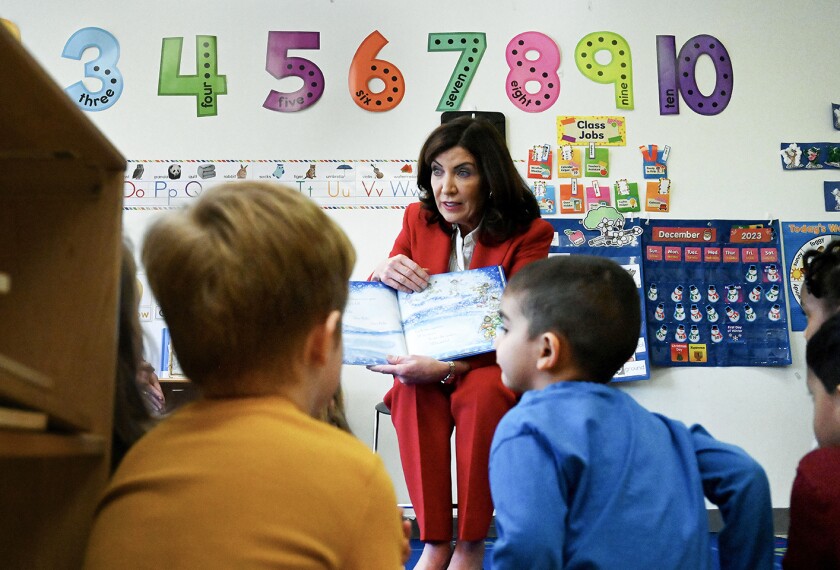
New York Gov. Kathy Hochul reads "Snowflakes Fall" to daycare children at the Department of Labor on Dec. 20, 2023, in Albany, N.Y. Hochul on Jan. 3, 2024, said she will push for schools to reemphasize phonics in literacy education programs, a potential overhaul that comes as many states revamp curriculums amid low reading scores.
New York Gov. Kathy Hochul reads "Snowflakes Fall" to children on Dec. 20, 2023, in Albany, N.Y. Hochul became the latest Democratic governor to say she'll opt her state in to the federal tax-credit scholarship program that takes effect next year, and will direct federal taxpayer funds to private school scholarships.
Will Waldron/The Albany Times Union via AP