
School & District Management

Survey Shows Nearly All States Can Track Data on Students

Survey finds better use by policymakers
By Sarah D. Sparks — December 01, 2011 3 min read
  • Save to favorites
  • Print

Includes updates and/or revisions.

Nearly all states now have comprehensive data systems that allow them to track students’ academic careers over time, and state officials are starting to dig into using the mountains of information, according to the sixth annual national survey on the subject.

The Data Quality Campaign, a Washington-based nonprofit group that promotes data use in education, released the report last week. For the first time, the survey focused on governors’ perspectives on state longitudinal-data systems, as opposed to the systems’ technical capacity.

“Leadership is critical,” said Aimee R. Guidera, the executive director of the campaign, noting that in the past year, Idaho and Maryland “leapfrogged many states that had been building along slowly,” thanks to statewide data-use programs launched by Idaho schools Superintendent Tom Luna and Maryland Gov. Martin J. O’Malley.

“There’s been incredible progress this year in states’ ability to provide access to stakeholders, including teachers and principals and parents,” Ms. Guidera said, though she added that no state has enacted all of the DQC’s recommended state policies to support data use.

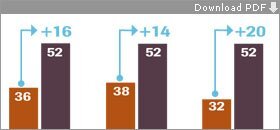
Essential Elements

Most states have made progress over the past six years in creating student-data systems with the elements that the Data Quality Campaign considers to be “essential.”
BRIC ARCHIVE

Note: The data include the 50 states plus the District of Columbia and Puerto Rico.
SOURCE: Data Quality Campaign

“We really think the next several years need to be spent on the toughest issues in [data use], around turf, trust, technical issues, and time,” she said in an interview. “This is much knottier and hard to solve, because it deals with changing behavior. It’s much easier to build a data system that collects information.”

Infrastructure Complete

The 2011 survey finds states have basically completed that first phase of developing data infrastructure.

This will be the last year that the DQC will track states’ progress in what it considers the 10 “essential elements” of student data systems because, as the report concludes, “without exception, every state in the country has robust longitudinal data that extend beyond test scores and could inform today’s toughest education decisions.”

Nearly all states now have a unique identification code for each student. They also have student-level enrollment, demographic, and program data, as well as high school graduation data, college-readiness-test results, and the ability to match P-12 and postsecondary student records. All or nearly all states also can track academic growth from year to year using students’ test scores, provide information on students who are not tested, and audit their data for quality and reliability.

However, only 41 states and territories track individual students’ transcript data. Those that cannot are: Alaska, Arizona, Colorado, Connecticut, Maine, Montana, New Jersey, Oklahoma, Pennsylvania, Rhode Island, and Vermont. Moreover, the District of Columbia and seven states—Alaska, Colorado, Connecticut, Montana, New Jersey, South Dakota, and Vermont—still cannot match teachers to their students. That data element is considered critical for developing test-based teacher-evaluation systems, the report notes.

The DQC found 39 states now regularly train active teachers and principals to understand and use longitudinal data to improve instruction. But fewer than a third as many states require preservice teachers to demonstrate data literacy in order to obtain certification or licensure, and only six states use data to provide feedback to teacher education programs.

“One of the lessons learned from 10 essential elements is to really push [education] leaders on quality,” said Paige Kowalski, the director of state policy initiatives for the DQC. “You can’t just check the box and move on. States may be providing access to data for teachers, but are they really providing timely, actionable, user-friendly data?”

During the next several weeks, the DQC intends to release four more in-depth studies of how states use longitudinal student data to inform education policy in four areas: teacher effectiveness, parent engagement, high school early-warning systems, and college and career readiness. The group will also hold a national data “summit” with U.S. Secretary of Education Arne Duncan in Washington on Jan. 18.

A version of this article appeared in the December 07, 2011 edition of Education Week as Milestone Reached: Most States Gather Data on Students

Events

This content is provided by our sponsor. It is not written by and does not necessarily reflect the views of Education Week's editorial staff.
Sponsor
Artificial Intelligence Webinar
Managing AI in Schools: Practical Strategies for Districts
How should districts govern AI in schools? Learn practical strategies for policies, safety, transparency, as well as responsible adoption.
Content provided by Lightspeed Systems
This content is provided by our sponsor. It is not written by and does not necessarily reflect the views of Education Week's editorial staff.
Sponsor
Reading & Literacy Webinar
Unlocking Success for Struggling Adolescent Readers
The Science of Reading transformed K-3 literacy. Now it's time to extend that focus to students in grades 6 through 12.
Content provided by STARI
Jobs Virtual Career Fair for Teachers and K-12 Staff
Find teaching jobs and K-12 education jubs at the EdWeek Top School Jobs virtual career fair.

EdWeek Top School Jobs

Teacher Jobs
Search over ten thousand teaching jobs nationwide — elementary, middle, high school and more.
View Jobs
Principal Jobs
Find hundreds of jobs for principals, assistant principals, and other school leadership roles.
View Jobs
Administrator Jobs
Over a thousand district-level jobs: superintendents, directors, more.
View Jobs
Support Staff Jobs
Search thousands of jobs, from paraprofessionals to counselors and more.
View Jobs

Read Next

School & District Management Q&A How a School District Handled 3 Straight Years of Campus Closures
Amid 11 closures, a superintendent shares her advice for leaders in similar situations.
8 min read
HOUSTON, TEXAS - AUGUST 20: Students walk through the hallway to their next class at Cypresswood Elementary in Aldine ISD in Houston, Wednesday, Aug. 20, 2025. Aldine ISD is one of the most improved school districts in the Houston area in 2025 TEA A-F ratings, increasing the district's overall score by 10 points in two years.
Elementary students walk to their next class in the Aldine Independent school district near Houston on Aug. 20, 2025. The district has decided to close 11 schools over the past three years due to a sharp enrollment drop.
Brett Coomer/Houston Chronicle via Getty Images
School & District Management Epstein and School Photos? How a Social Media Controversy Pulled in K-12 Districts
Districts have had to respond to a social-media fueled controversy about the sex offender and financier.
6 min read
A document that was included in the U.S. Department of Justice release of the Jeffrey Epstein files, photographed Tuesday, Feb. 10, 2026, shows a photo of Epstein on a inmate report from the Federal Bureau of Prisons .
A document included in the U.S. Department of Justice release of the Jeffrey Epstein files, shown in a Feb. 10, 2026, photograph. A social media-fueled controversy drawing a shaky connection between the sex offender and a major school photo company used by 50,000 schools has led to calls for school districts to reexamine their use of the company.
Jon Elswick/AP
School & District Management Many Assistant Principals Aren’t Seeking Promotion. Here’s Why
The assistant principalship isn’t just a stepping stone to the top job in a school.
6 min read
Image of a male and female silhouette standing near an illustrated ladder going.
Afry Harvy/iStock/Getty
School & District Management Los Angeles School Superintendent Placed on Paid Leave During Federal Probe
Alberto Carvalho's home and office were searched by the FBI last week.
3 min read
Los Angeles District Superintendent Alberto Carvalho, at podium, holds a news conference as SEIU Local 99 Executive Director Max Arias, left, and Los Angeles Mayor Karen Bass, right, listen, in Los Angeles City Hall, on March 24, 2023.
Los Angeles Unified School District Superintendent Alberto Carvalho holds a news conference at Los Angeles City Hall on March 24, 2023. The FBI searched the district leader's home and office last week, and LAUSD, the nation's second-largest school district, has placed him on paid leave.
Damian Dovarganes/AP
