Opinion
School & District Management Opinion

An Apology to Secretary Duncan

By Jennifer L. Jennings — May 06, 2013 1 min read
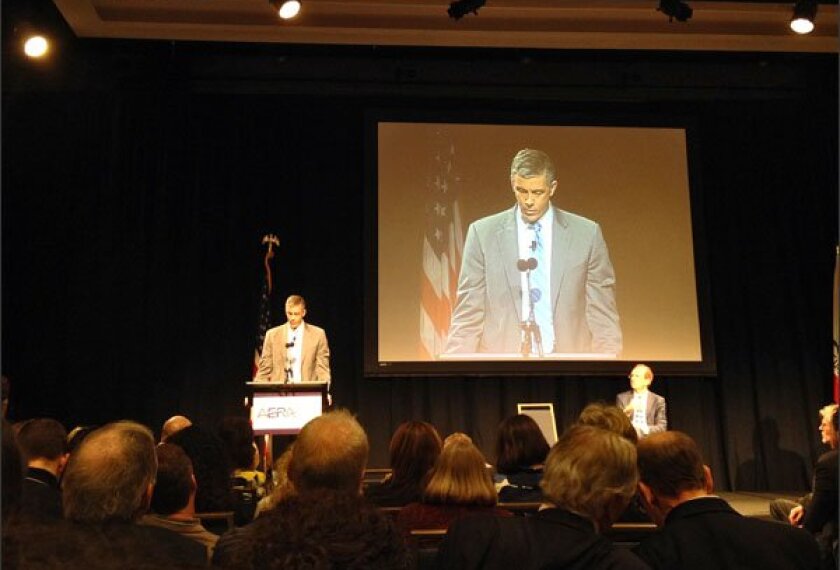
U.S. Secretary of Education Arne Duncan addresses the AERA's annual meeting on April 30.
  • Save to favorites
  • Print

Includes updates and/or revisions.

I agree with U.S. Secretary of Education Arne Duncan on just about nothing. I think Race to the Top is an evidence-free mess. I think the idea of a test worth teaching to is a willful misunderstanding of the science of testing. And I can’t agree with Duncan’s insistence that the cheating scandals that have garnered widespread attention in recent months are a parable about “rotten” school cultures and not a reflection on the incentives that we’ve forced upon teachers.

But as I sat on the floor of a packed ballroom in San Francisco at the annual meeting of the American Educational Research Association last month, I was embarrassed—no, humiliated—when some of my colleagues booed the secretary of education as he approached the microphone for his keynote speech. It is one thing to disagree with some of the Obama administration’s policies, to bring countervailing data to the table, and to engage in reasoned—and, one would hope, enlightened—conversation. It is another thing entirely to abdicate our most sacred responsibility as researchers—a commitment to ideas, to data, to truth, to real debate—at the altar of one-upmanship.

I was embarrassed—no, humiliated—when some of my colleagues booed the secretary of education when he approached the microphone for his keynote speech.”

What saddens me is that the educational policy debate has become an overwhelming chorus of boos, of shout-downs, and of bitter personal insults, rather than a real debate about ideas and data and first principles. Unfortunately, this mirrors the direction that most American political debates have leaned in recent years. It is toxic. It is unnecessary. And it is not befitting of a community of researchers who stand in front of students on most days of the week and call ourselves educators.

I have no senior standing, official office, or public mandate with which to offer this apology, but nonetheless: I’m sorry. I’m sorry that a faceless minority of the educational research community lacked the courage to meet you with ideas rather than with the heckling that is so easy to deploy when you are sitting among hundreds of others, none of whom will ever be called personally to account for their actions.

You had the grace, the guts, and the patience not to reciprocate.

If there is one lesson from this conference, Secretary Duncan, you showed America’s educational researchers that we can have a different debate—one in which we rely on ideas and open disagreement and reason, and not on schoolyard bravado.

A version of this article appeared in the May 15, 2013 edition of Education Week as An Apology to Secretary Duncan

Events

This content is provided by our sponsor. It is not written by and does not necessarily reflect the views of Education Week's editorial staff.
Sponsor
Artificial Intelligence Webinar
Managing AI in Schools: Practical Strategies for Districts
How should districts govern AI in schools? Learn practical strategies for policies, safety, transparency, and responsible adoption.
Content provided by Lightspeed Systems
This content is provided by our sponsor. It is not written by and does not necessarily reflect the views of Education Week's editorial staff.
Sponsor
Student Absenteeism Webinar
Removing Transportation and Attendance Barriers for Homeless Youth
Join us to see how districts around the country are supporting vulnerable students, including those covered under the McKinney–Vento Act.
Content provided by HopSkipDrive
This content is provided by our sponsor. It is not written by and does not necessarily reflect the views of Education Week's editorial staff.
Sponsor
Reading & Literacy Webinar
Two Jobs, One Classroom: Strengthening Decoding While Teaching Grade-Level Text
Discover practical, research-informed practices that drive real reading growth without sacrificing grade-level learning.
Content provided by EPS Learning

EdWeek Top School Jobs

Teacher Jobs
Search over ten thousand teaching jobs nationwide — elementary, middle, high school and more.
View Jobs
Principal Jobs
Find hundreds of jobs for principals, assistant principals, and other school leadership roles.
View Jobs
Administrator Jobs
Over a thousand district-level jobs: superintendents, directors, more.
View Jobs
Support Staff Jobs
Search thousands of jobs, from paraprofessionals to counselors and more.
View Jobs

Read Next

School & District Management LAUSD Superintendent Carvalho Breaks Silence on FBI Raid of His Home, Office
The leader of the nation's second-largest K-12 district denied wrongdoing and asked to return to his job.
Howard Blume, Richard Winton & Brittny Mejia, Los Angeles Times
4 min read
Alberto Carvalho, Superintendent, Los Angeles Unified School District, the nation's second-largest school district, comments on an external cyberattack on the LAUSD information systems during the Labor Day weekend, at a news conference at the Roybal Learning Center in Los Angeles Tuesday, Sept. 6, 2022. Despite the ransomware attack, schools in the nation's second-largest district opened as usual Tuesday morning.
Los Angeles Unified School District Superintendent Alberto Carvalho speaks at a news conference on Sept. 6, 2022. The FBI raided the superintendent's home and office last month, and he's been placed on leave.
Damian Dovarganes/AP
School & District Management Opinion My Surgeon Gave Me a Lesson in School Leadership
When a personal health issue forced me to get vulnerable with my staff, I learned a lot from my doctor.
Sarah Whaley
3 min read
Allowing for vulnerability while leading a team.
Vanessa Solis/Education Week via Canva
This content is provided by our sponsor. It is not written by and does not necessarily reflect the views of Education Week's editorial staff.
Sponsor
School & District Management Sponsor
From Balcony to Dance Floor: How District Leaders Rebuild Belonging in Times of Uncertainty
District leaders must balance strategy and connection to rebuild belonging, strengthen staff culture, and drive student success.
Content provided by National University
School & District Management Opinion School Leaders Must Protect Their Own Well-Being. Here Are the 3 Areas to Watch
Principals are under enormous stress. Don’t downplay it.
4 min read
Screen Shot 2026 03 08 at 9.29.05 AM
Canva
