With pigeons fluttering through the rafters and plaster crumbling from the walls, the future home of the Thurgood Marshall Academy charter school scarcely looks like a place to entertain the likes of a big-city mayor.
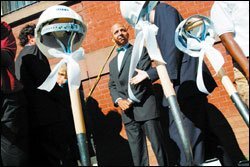
Yet District of Columbia Mayor Anthony A. Williams seemed happy to be there earlier this month, as he helped kick off a project to convert the long-vacant eyesore into a community-oriented campus for 350 high school students.
Mr. Williams is not alone among big-city mayors in extending a growing interest in public education to charter schools. In Indianapolis, Bart Peterson has taken full advantage of his status as the nation’s only mayor with authority to charter schools. And New York City Mayor Michael R. Bloomberg and Chicago’s Richard M. Daley, both of whom control their school systems, have recently launched initiatives to form more of the independently run but publicly financed schools.
Read the related story,
Still, Washington is unusual in the extent to which charter schools here are starting to be billed as a strategy for revitalizing residential neighborhoods and making the city more attractive to middle-class parents.
Mr. Williams, who has headed the nation’s capital since 1999, has set a goal of attracting 100,000 new residents to the city over the next decade—particularly middle-income families with children. And despite strong criticism from some backers of Washington’s regular public schools, he’s made it clear that he sees charter schools as an important tool for achieving that goal.
“Mayors realize you have to fix urban public schools if you’re going to have any sort of comprehensive urban renewal,” said Andrew J. Rotherham, the director of education policy at the Progressive Policy Institute, a Washington research organization aligned with the centrist Democratic Leadership Council. “You simply cannot do that without drawing the middle class back into the cities, and to do that you need to have good public schools for them to send their kids to.”
At this month’s groundbreaking ceremony for the Thurgood Marshall Academy, Mayor Williams ticked off a list of redevelopment projects planned for the neighborhood. But he said those investments would amount to little without good public education—including charter schools.
“It’s really education that’s going to take us over the goal line,” he said at the Oct. 5 ceremony at the 103-year-old former elementary school.
Giving Up?
With an estimated 16,000 charter students this year, Washington has among the nation’s highest proportion of public school students in charter schools—around one in five. While many charter schools serve high proportions of students from low-income families, a few have attracted sizable numbers of youngsters from more affluent households.

To build on that trend, Mayor Williams recently joined forces with a fellow Democrat, Sen. Mary L. Landrieu of Louisiana, on an initiative to support charter schools in neighborhoods identified as having strong potential for attracting and retaining middle-class residents. As the top-ranking Democrat on the Senate subcommittee in charge of appropriations for the capital city, the senator has taken a strong interest in its schools.
Financed with $5 million earmarked by Congress, the City Build Charter School Initiative is slated to provide $1 million this year to each of five charter schools to help meet their facilities’ needs. The schools are to be located in one of 12 neighborhoods that scholars at the Brookings Institution, a Washington think tank, have identified as promising targets for investment designed to fuel community renewal.
The notion of creating charter schools that appeal to middle- income families is not universally applauded. Among the idea’s strongest critics are the very sorts of residents that the City Build initiative is aiming to please.
“We’re only creating more options for people who already have a lot of options,” said Regina Arlotto, a middle-class mother of three who is the president of Save Our Schools, a group of parents with children in the city’s regular public schools. “There is a socioeconomic problem here, where the public schools are going to end up being warehouses for the poorest of the poor.”
Last month, the group filed a federal lawsuit to end what it calls “the aggressive promotion of charter schools by the officials charged with running the D.C. public school system.”
Calling the city’s 62,000-student public school system “notoriously dysfunctional,” the suit names the city school board as a defendant, as well as the District of Columbia Council and the mayor, who appoints four of the school board’s nine members. Also named is the separate District of Columbia Public Charter School Board, whose sole function is to authorize and oversee charter schools.
Mentioning the City Build initiative by name, the suit says it “has no funds to build new public school facilities or improve the existing crumbling public schools, and is devoted solely to providing further incentives to D.C. residents to abandon the public schools.”
Supporters of the City Build initiative reject the charge that promoting charter schools—or attempting to broaden their appeal—will undermine regular public schools.
“What parents want is for their kids to be in schools where the same values are shared by the other parents,” Sen. Landrieu said. “Charter schools are not a threat to the public education system. They are like a window to let fresh air in, to make the public education system stronger, not weaker.”
The federal money for the City Build program came from the political horse-trading that led to the enactment this year of a voucher plan for Washington. Reflecting a “three-sector approach” championed by Mayor Williams, that law designated $13 million for charter schools and $13 million for the city’s regular public schools, in addition to $13 million for tuition vouchers for low-income children to attend private schools in the city.
Officials in the District of Columbia’s state education office are reviewing the 19 applications they received this fall for the City Build grants.
This year, the money is expected to go to schools that have already gotten off the ground, said Rebecca Sibilia, the management officer at the state education office who is overseeing the program. For example, the Thurgood Marshall Academy, which has been operating since 2001 in a church annex, is among the applicants.
But in the future, Ms. Sibilia said, the hope is that the grants will become a factor in shaping the very missions of new charter schools, as well as influencing where they locate. Although charter schools are open to children citywide, supporters say the idea is to provide convenient, free alternatives to families who for whatever reason lack confidence in the district-run schools available to them.
“If this indeed does end up being a continuing program, this will become an incentive grant for schools to think about what they’re giving to the neighborhood, rather than finding the first location that they can,” Ms. Sibilia said.
Among those hoping for some of the City Build money is the Capital City Public Charter School. Located in a renovated church in one of the 12 targeted neighborhoods, the school was founded in 2000 by a group of middle-class parents and now serves 240 students in prekindergarten through grade 8. Roughly 54 percent of those youngsters qualify for free or reduced-price lunches.
“We already did what they want us to do,” Anne Herr said with a laugh, referring to the school’s decision to locate in one of the targeted neighborhoods.
Ms. Herr, a mother of three who was an analyst at the U.S. Department of State before taking over as the school’s executive director last month, said she grew interested in co-founding the school after growing disenchanted with her children’s district-run public school, which was located across town from her home. She said Capital City appeals to parents like herself who want an alternative to the area’s high-priced private schools.
“We were bothered at some deep level that people feel that it’s only private schools that are great schools,” Ms. Herr said. “We wanted it to be true that public schools can be great schools, too.”
‘A Class Issue’
As the City Build initiative rolls out, Sen. Landrieu says that Capital City is “exactly the kind of school we’re looking for.” Another one, she says, is the Two Rivers Charter School, which started up this fall in the Capitol Hill neighborhood and is modeled loosely on Capital City.
Two Rivers has had a difficult birth, partly because of strong opposition from Save Our Schools, which was started by a group of parents with children in three district-run public schools known as the Capitol Hill Cluster. Ms. Arlotto, the Save Our Schools president, says the cluster lost enrollment this year, and she believes the decline was a direct result of charter schools, particularly Two Rivers.
Located in a renovated wing of a district-run middle school, Two Rivers has attracted a mix of low-income and middle-class families. Of the 152 students from preschool through 3rd grade, a third qualify for subsidized lunches.
Besides that socioeconomic diversity, the school has enrolled a larger percentage of white youngsters—32 percent—than most schools in the city. The school’s racial makeup is cited in the Save Our Schools lawsuit as evidence that the school is discriminating against African-Americans, who make up 53 percent of the school’s enrollment.
Leaders of Two Rivers dismiss that contention, saying that the school took all comers as long as space was available, and that it held a lottery for slots in oversubscribed grades. As for the results, said Principal Jessica Wodatch, “I think it’s beautifully diverse.”
Parent Darlene Boyd, who has twin boys in Two Rivers’ preschool program, said that the presence of other middle-class families like her own was a major draw, but that she doesn’t buy charges that the school is discriminating against blacks. She said that she and her husband, both of whom are African-American, had been considering moving to the suburbs before the school opened.
“Honestly, it’s not a race issue, it’s a class issue,” Ms. Boyd said. “We’re black, and I want my children to go to school with people like us, kids who have lots of books and are exposed to things like us.”


