Voucher programs and tax-credit scholarships—school choice options available in many places that allow parents to apply public resources to help enroll their children in private schools—can be a wild card for school districts, particularly in terms of fiscal planning.
Modern-day voucher programs launched in the United States in 1990 with a districtwide program in Milwaukee and have gained significant steam in the past several years, with more than 40 states considering legislation to create such programs since 2011. Still, they remain contentious and often restricted. Most voucher and other tax-credit scholarship programs, for example, are not accessible for the general student population but limited to specific subgroups such as children with disabilities, low-income students, and, in some cases, those in rural areas.
Voucher advocates maintain that the programs actually provide savings for school districts, since the amount of money allocated for each voucher is typically less than the per-pupil funding amount, making it less expensive to educate more students. Critics, however, question that philosophy, saying that many of those students receiving vouchers would have gone to private schools regardless, essentially turning the scholarships into rebates for private school students.
Selected School Choice Options
Vouchers:
State-funded scholarships given to eligible participants (typically children from low-income families, students in low-performing schools, and those with special needs) to be used toward private school tuition. Private schools that accept voucher students must comply with standards set by the state legislature, such as giving students state or national tests or requiring all teachers and administrators to have college degrees or certifications, for example. Thirteen states and the District of Columbia have voucher programs.

Tax-Credit Scholarships:
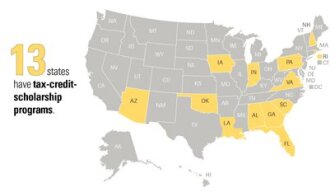
Programs that allow individuals and corporations to direct a portion of their state taxes to certain organizations that then provide money to K-12 students in the form of scholarships. Such scholarships may be used at private schools or public schools outside the district, depending on the state’s program. Thirteen states have tax-credit-scholarship programs.
Personal Tax Credits:
Programs that allow parents to receive a tax credit for education costs such as private school tuition, textbooks, online education, tutoring, and supplies. Six states have personal-tax-credit programs.
Education Savings Accounts:
Government-authorized accounts set up for eligible students that provide money for education-related expenses such as textbooks, tutoring, private school tuition, or, in some cases, college. (What the funds can be used for depends on the parameters of each program.) There is one education savings account program, in Arizona.

District Focus:
- Milwaukee’s voucher program started with 300 students in 1990 and had grown to 25,000 students in 2012. The state-backed program expanded to Racine, Wis., during the 2011-12 school year, when 250 students were allowed to participate. The cap was expanded to 500 students in 2012-13, and the cap has been lifted for subsequent years.
- The District of Columbia’s voucher program is the first and only voucher program authorized by Congress. Since the program’s inception in 2004, the number of students participating has fluctuated between 1,000 and 2,000.
- In addition to a statewide program in Ohio, Cleveland has a separate voucher program, established by the state in 1995 for students in the metropolitan area. About 6,000 participated in the 2012-13 school year.
- The 61,000-student Douglas County school district in Colorado approved a pilot voucher program in the 2011-12 school year to provide students with up to $4,600 in per-pupil funds to go toward private school tuition. But the program has been held up in legal battles since its inception and has not been implemented.


