
Few family rituals have as fixed a place in the American household, and in the popular imagination, as board games, those impromptu or regularly scheduled contests played by parents and children on kitchen tables and living room floors.
Now, a growing body of research is revealing the potential benefits of using board games in the classroom to strengthen the mathematics skills of children, particularly those from disadvantaged backgrounds.
A new study offers one of the most detailed explorations of that topic yet. Published by a pair of scholars, it concludes that exposing youngsters from low-income backgrounds to a simple board game that involves counting produced large and lasting gains in their understanding of numbers.
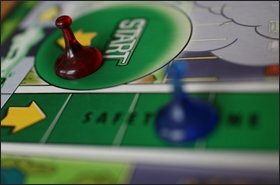
The researchers, Robert S. Siegler and Geetha B. Ramani, designed an activity resembling the popular board game Chutes and Ladders, in which they had 124 pupils count and move pieces along numbered squares. All the preschoolers tested were from families that participated in the federal Head Start program, which serves children from impoverished backgrounds.
Students played that board game four times, for 15 to 20 minutes per sitting, over a two-week period. At the end of the study, their knowledge of math in four different areas of number sense had increased greatly, the researchers found. The experiment has shown the same results among other young students they’ve tested.
Those results, and related research, offer an unconventional strategy for developing crucial math skills among young, disadvantaged students, including minority children, scholars say. As it now stands, those pupils’ performance in math traditionally lags behind that of their better-off and white peers.
Many children from poor families have limited exposure to board games and simple math-related activities at home. Spending even a small amount of time on fun, basic board games could spark an early interest in math and produce an academic payoff later, some researchers say.
“Young people learn a great deal about the world through play, and games are one source of play,” said Mr. Siegler, a professor of cognitive psychology at Carnegie Mellon University in Pittsburgh. And when it comes to learning math, he added, “the games that build understanding of numerical magnitudes are crucial.”
A Great Race
Researchers have been exploring the benefits of board games and other informal entries into math for decades. But while scholars have broadly examined the effect of strategies that blend games with other activities, such as songs and computer programs, Mr. Siegler and Ms. Ramani, an assistant professor of human development at the University of Maryland, sought to quantify the effect of board games in particular.
In their study, published in the March-April issue of the journal Child Development, they created a board game called The Great Race. The children, all from the Pittsburgh area, took turns using a spinner, then moving miniature figures—a bear or a rabbit—one or two paces along a board marked with 10 steps.
Those who played that basic game showed significant gains in four different measures of their number sense, based on tests designed by the two researchers. Those gains remained just as strong when the preschoolers were tested nine weeks later, after their last game-playing session. By contrast, the children who played a game that asked them to move along colored spaces, rather than numbered ones, did not improve on any of those numerical measures.
Students from relatively privileged backgrounds tend to be exposed to math at home not only through simple family games and activities, but also through parents’ subtle use of math-related language, said Sharon A. Griffin, a professor of education at Clark University in Worcester, Mass., who has studied board games.
“The quantitative world is [presented] through language—bigger, smaller, taller, shorter,” Ms. Griffin said. “There’s explicit talk, using numbers, that doesn’t seem to happen in lower-income homes” as often, she said.
In the late 1980s, Ms. Griffin developed Number Worlds , a program that uses specially designed board and card games and other activities to promote math understanding among struggling pupils in early grades. Today, the program is sold commercially through SRA/McGraw-Hill.
She sees a growing focus among educators and researchers nowadays on board games. One “powerful boost” in that interest, Ms. Griffin believes, has come from emerging neuroscience research on how numbers are represented in the brain, and what that means for students learning math.
Ann McPartland, a teacher at Jacob Hiatt Magnet School in the 23,000-student Worcester district, has noticed that the basic counting ability of her prekindergartners varies greatly, and she sees a link to their families’ economic circumstances.
For Practice, and Play
The teacher began using board games, card games, and other simple counting activities designed by Number Worlds about seven years ago, in an attempt to close those gaps. One of her favorite counting games is not played on a board, but rather on a vinyl sheet with numbered spaces that she spreads out across her classroom floor.
Her students stand in the spaces, numbered one through 10. She has them walk forward while counting aloud, then backward, counting in reverse order. When a student stands on a particular space, the teacher will ask the class how many steps he or she must take to reach a different number.
“I’m hoping they can reach the point where they understand that six spaces, plus four, equals 10,” explained Ms. McPartland, who’s been teaching for 25 years. A large percentage of her pupils, she estimates, come from impoverished backgrounds.
Games “are relevant to children,” she said. “It’s something tangible for children. They can see and touch [them].”
Many commercial publishers of math materials use board games and card games, involving dice and other materials, in their curricula. Everyday Mathematics, taught to an estimated 3 million elementary students in 185,000 classrooms nationwide, incorporates board and other games into its print materials and computer-based programs.
Games offer math teachers a way of practicing and reinforcing arithmetic and other math skills, as well as supplementing a sole diet of drills and practice-problems, said Andy Isaacs, the director of the third edition of Everyday Mathematics. Not only do games engage students, they also present the opportunity to present “high level” math concepts in a colorful and simple way, said Mr. Isaacs, who is also a senior research associate in the physical sciences division at the University of Chicago.
Despite those benefits, some teachers and parents are reluctant to use board games and similar activities, he noted. Those critics tend to regard them as activities that cut into time spent on practicing problems, when in fact games should be used as another form of math practice.
“The idea that something could be simultaneously fun and worthwhile academically just doesn’t add up for them,” Mr. Isaacs said of the skeptics.
Research on the link between board games and math learning has implications not just for educators, but also for parents, said Douglas H. Clements, a professor of learning and instruction at the State University of New York at Buffalo.
Turning off the television and engaging children in a simple game just a few times a week can greatly improve their comfort in math, said Mr. Clements, who has designed a curriculum based in board games, puzzles, computer software, and other activities to build youngsters’ number skills.
He said he doesn’t doubt the educational value of some television programs and online activities, but emphasizes the value of other, simple options.
“There’s a huge amount of math in these board games and card games that is not on television and video games,” Mr. Clements said. “Even if you played once or twice a week, it would probably have a real effect on kids.”
Coverage of mathematics, science, and technology education is supported by a grant from the Ewing Marion Kauffman Foundation at www.kauffman.org.


