A power vacuum enveloped the District of Columbia schools last week after a federal appeals court ruled that the board of trustees appointed to oversee the district doesn’t have the authority it thought it did.
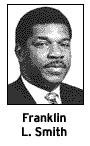
The three-judge panel said the financial-control board created by Congress to run the troubled city government has “extraordinary” power but was out of line in 1996 when it shifted oversight from the elected school board to the appointed board and fired Superintendent Franklin L. Smith.
The Jan. 6 ruling by the U.S. Court of Appeals for the District of Columbia Circuit stated clearly that the appointed board of trustees could serve only as advisers to the control board.
What remained unclear last week was who will lead the public schools from now on.
|
Since the financial-control board is unlikely to return authority to the elected school board, the decision puts pressure on the five-member control board to take a more active role in running the 77,000-student system. Under that scenario, the school system’s chief executive officer, Julius W. Becton Jr., would report only to the control board. (“Superintendent Under Fire in Beleaguered D.C. ,” Sept. 4, 1996.)
The court decision did not void past decisions by the appointed board of trustees. Judge Laurence H. Silberman wrote, “We see no benefit in plunging the District’s school system into further chaos by invalidating actions taken by the board of trustees over the past year.”
The order, which stemmed from a lawsuit filed by 11 current and former school board members, goes into effect in 30 days if no one requests a rehearing.
School Board Pleased
Members of the elected school board said the ruling will allow them to have more say in policy.
“I pledge that the elected board will have an expanded advisory capacity, and the court ruling certainly puts us on firmer ground,” said Wilma R. Harvey, the board’s newly elected president and longest-serving member. “We’re standing up for our rights to serve as elected officials.”
But Bruce K. MacLaury, the chairman of the appointed board of trustees, said he interpreted the ruling to mean that the elected board would remain on the sidelines.
“There’s no sense in having two groups of advisers,” he said. “We’ve assembled a top-notch administrative team and started to get the message across that accountability is the name of the game.”
When the financial-control board declared the school district to be in a state of emergency in November 1996, it berated the school board and superintendent for failing even the most basic requirements of their jobs, such as accounting for the total number of students and teachers in the district.
To replace that leadership, the control board created a complex chain of command, with Mr. Becton, a former U.S. Army general, serving as a member of the new board of trustees and reporting to the control board.
Mr. Smith, who now lives in Virginia Beach, Va., and is a vice president for Light Span Partnership Inc., an educational software company based in San Diego, said he would not seek to regain his old job.
“My dismissal is behind me, but I’m really pleased about the court decision, not just for me but for the people of D.C. who were slighted by the actions of the control board,” he said.
Several elected school board members--including former President Don Reeves, who until Ms. Harvey’s election last week also served on the appointed board--have complained that the new administration has shut them out. School board member Jay Silberman said the elected board would have steered the appointed board away from unpopular decisions last year to close 11 schools and delay the school year three weeks for roof repairs.2
“We’ve been dealing with an unresponsive administration that doesn’t account to anyone,” Mr. Silberman said. “My hope is that the court decision will open the door to more cooperation.”
Openness Questioned
Delabian L. Rice-Thurston, the president of an advocacy group that sued the district in 1991 over fire-code violations, echoed Mr. Silberman’s concerns. She noted that the elected board holds regularly scheduled public meetings each month, while the appointed board calls for public meetings as needed and gives only a few days’ notice.
Mr. MacLaury said the trustees have invited elected board members to their meetings and listened to their suggestions.
He also said the trustees, who are not paid, have held a public meeting once a month on average. “We’ll ask for serious input when we need it,” he said.


