

Special coverage of district and high school reform and its impact on student opportunities for success is supported in part by a grant from the Carnegie Corporation of New York.
Tom Horn points down at several rows of winter vegetables in planter boxes.
“We already harvested three and a half tons of food for the community from this garden,” says the principal of Al Kennedy, an alternative public high school in Cottage Grove, Ore., 130 miles south of Portland. He gestures to the neglected soccer field beyond. “But pretty soon, the garden will extend all the way out there.”
That emphasis on beyond-the-classroom learning appears to be working. The attendance rate at the 100-student high school, formerly called Al Kennedy Alternative School but now referred to by students and staff members as the Kennedy School of Sustainability, has jumped from 23 percent in fall 2006, when Mr. Horn took over, to about 90 percent. The dropout rate is now at 12.5 percent, down from 20 percent in 2004-05.
A longer version of this story appeared on Education Week Teacher. Read “Flattening the School Walls.”
Test scores, though still below par, are on the rise. The once-stigmatized alternative high school now has a 180-student waiting list. And for the first time ever, students from Kennedy are going to college.
Krista Parent, the superintendent of Oregon’s 2,900-student South Lane school district and the 2007 National Superintendent of the Year, says she envisioned transforming Kennedy from an alternative school for students who had “blown out of the regular system” to an option for “kids who need more real-world, relevant kinds of opportunities.” Under Mr. Horn and the teacher team he assembled, she noted, the school has “far exceeded our expectations and our vision—and more quickly than I thought it could be done.”
Tough Beginnings
Mr. Horn recalls showing up on the first day of school only to be cursed out by students smoking cigarettes and what smelled like marijuana near the front door. In his first two months, several students overdosed on crystal methamphetamine and cocaine. He visited the trailer parks his students lived in and saw what he describes as “abject poverty.”
Once a thriving mill town with well-paid jobs that did not require a diploma, Cottage Grove is now economically downtrodden.
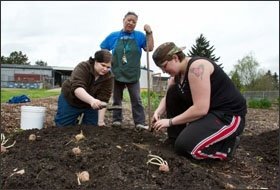
The principal determined that the students needed a curriculum to keep them engaged and in classes. Because of the rich natural resources of the surrounding area, as well as his own interest in green technology, he chose project-based learning and the theme of sustainability. He divided students into five cohorts, each of which completes projects related to a subtheme: agriculture, energy, forestry, architecture, or water.
All the projects are aimed at having “tangible, positive effects on the entire community,” he explained. “We’ve flattened the walls of the school.”
Since many Kennedy students had been demoralized in the traditional school system, Mr. Horn hoped getting kudos from community members might help restore students’ self-worth. And, he figured, the projects themselves, visible in the surrounding neighborhoods, could serve as a source of pride.
The cohort design, in which students remain with the same teacher all day, is, for a high school, perhaps Kennedy’s most unusual trait. The model gives teachers complete autonomy with their schedules.
“You never know when [students] will take off like fireworks and get excited about something,” said Vickie Costello, who teaches the water cohort. Having a static group “allows me to extend a lesson or end it and come back to it the next day and get them up and active. So many lessons lend themselves to being outside.”
As Mr. Horn says, “The model is a mixture of elementary school and a master’s cohort.”
The fluid schedule also lets teachers take students on day trips to Portland or extended trips of up to two weeks—for example, to go snow camping or explore the Oregon coast. All teachers at Kennedy, in addition to being certified to comply with highly-qualified-teacher regulations, are certified bus drivers.
The trips are closely tied to class themes. “Sometimes, we listen to a book on the CD player on the bus,” said Ms. Costello, who has been at Kennedy a year longer than Mr. Horn. “I ask questions, and we have a discussion about it.”
In addition to going on out-of-school study excursions, students spend one day a week doing field work for their thematic projects.
One group is farming tilapia, a breed of freshwater fish, as an energy-efficient protein source for the community. Another cohort is building Aleutian kayaks and taking them out to monitor the river’s water quality. Students are also doing beekeeping, pulling invasive species of plants from the riverbank, and working on sustainable-housing prototypes.
While the school has only five full-time teachers and four instructional aides, close to 60 community volunteers lend their hands and expertise to the various projects.
Funding for the projects comes mainly in the form of grants—$3 million from sources such as the University of Oregon and the U.S. Forest Service in the past six years.
Democratic Decisionmaking
The teachers at Kennedy have an extraordinary—even potentially overwhelming—amount of responsibility. In addition to the overnight trips and projects that require much out-of-school planning, they are working with a demanding population: According to Mr. Horn, 38 percent of Kennedy students are homeless, 14 percent are teenage parents, many have dealt with addiction issues, and all are at risk of dropping out. The school has a full-time counselor, but teachers need to be tuned into students’ mental-health and emotional needs, too.

All staff members are willing to go above and beyond the conventional teacher job description, Mr. Horn said. “There isn’t a weak link. It’s serendipitous.”
But the staff’s dedication is far from a matter of luck. Some former teachers self-selected out once Mr. Horn came onboard with his outsize ideas, and the principal himself screens new candidates for dedication to the model and the students.
“The passion that each teacher brings to their work as an educator at Kennedy comes from an understanding that learning should be a fascinating adventure,” he said. His teachers are all outdoor enthusiasts like him—skiers, surfers, and snowboarders.
Mr. Horn also fosters staff cohesion by using a democratic decisionmaking process. “Not a decision is made here that doesn’t involve everyone’s voice and opinion—which is really hard,” said Mr. Horn, who meets with his staff twice a week. “But when we solidify the notion of what we’re doing, there’s 100 percent commitment.”
Ms. Costello says the democratic process has been critical to her experience at Kennedy. “I can’t imagine working somewhere else without it,” she said. “It’s empowering and motivating. And it keeps evolving.”
One question that local school board members, who were initially skeptical of Kennedy’s project-based model, and school visitors have often asked is how the teachers address state standards within projects. Superintendent Parent said it’s an issue that she and Mr. Horn confer about regularly.
“One of the criticisms of the old alternative high school, and any alternative school, is that the standards have been watered down,” she said. “We had to fight that perception and make sure the rigor was present.”
Mr. Horn describes project-based learning as “working down Bloom’s Taxonomy instead of up,” referring to the hierarchy of cognitive skills many teachers use. With project-based learning, the students are given a task that requires higher-order thinking skills—often to create something—and they must learn and practice lower-level skills along the way.
Whether students realize it, the standards are embedded in the projects. The educators map out each project on a matrix, with the content subjects on the horizontal and phases of the project on the vertical. The state standards are embedded in the boxes. For instance, a student doing beekeeping might need to research and write a paper on bee behavior to address a language arts standard.
In most alternative schools, where students have fallen behind academically because of behavioral and social problems, the focus is remediation.
“We do this weird thing with setting benchmarks before we let students do something fun,” said Mr. Horn. But at Kennedy, teachers’ first concern is engagement—keeping students in school.
“You get kids hooked on personal interest,” said Ms. Costello. “You give them articles to read, and they don’t realize they’re doing language arts.”
In many cases, a student “comes to the realization they are lacking skills they need,” Mr. Horn said, and that acts as an intrinsic motivator.
Teachers address students’ individual academic needs as well. Students take a battery of assessments three times a year to determine their basic skill levels, and teachers set aside time for individual interventions based on the results. For math, some students take part in online digital lessons through Khan Academy, a provider of free video tutorials.
According to Ms. Costello, Kennedy is “more student-centric [than other schools.] Every student has an individualized plan—not just the special ed students. We look at their assessments and what they need.”
Marcus West, a 17-year-old who recently transferred to Kennedy, says he appreciates getting personalized attention. “The teachers actually work with me and show me things hands-on,” he said. “I’m getting help with the classes I need instead of just getting pushed toward the back.”

The school still has a way to go to meet state benchmarks and adequate yearly progress under the federal No Child Left Behind Act.
According to data from the Oregon education department, 52 percent of Kennedy students passed the state reading assessment for grades 10 and 11 in 2011. While that’s much higher than Kennedy’s 2008 passing rate of 9 percent, it’s well below the state average of 83 percent. The school’s writing scores have been up and down over the years and are currently at a 28 percent passing rate.
The area in which students “haven’t progressed as well in is math,” said Ms. Parent. “Math is so sequential. With pretty big gaps in these students’ education, that’s a little bit harder for us. We’ve got work to do in that area.”
But while Kennedy’s passing rate in grades 10 and 11 is low in math—36 percent—it’s double the rate from 2010 (the only one available for comparison).
Dana Beck, the program manager for Oregon gear up, a federally funded program that works to get low-income students into college, says Kennedy—the only alternative school the organization works with—is making “impressive” gains.
“I think there’s still room for growth and still room for them to adapt in their model to better meet testing requirements, but we’re seeing positive trends, and that’s a really good sign,” Ms. Beck said.
Ms. Costello is also optimistic about the growth she’s seen in the past six years. “Not only are test scores moving up, but interest in community college is increasing,” she said.
Between dual enrollment and postsecondary matriculation, according to Mr. Horn, as many as 40 percent of Kennedy students and recent graduates have enrolled in college in the past few trimesters.
Growth Models
As progressive as the approaches may seem, Mr. Horn roots his work in research and best practices. He’s a proponent of the 5 Dimensions of Teaching and Learning, an instructional framework developed by the University of Washington’s Center for Educational Leadership. He is also a devotee of the practice of “instructional rounds” based on the work of a group of professors at the Harvard Graduate School of Education—in which teachers observe their colleagues and compare their own practices with what they see.
Mr. Horn is emphatic that the work being done at his small school can be replicated in larger high schools, albeit with a bit of restructuring.
“You take the traditional high school and put Kennedy into that school,” he said. “That’s the replicability—it’s a school within a school.” The smaller school communities, which might be developed around themes to “build cohesion,” could be led by teacher leaders, he said.
The charter school movement has bred innovative models, he added, but districts should also consider bringing project-based learning to alternative and comprehensive high schools.
The big-picture project of spreading his model is on the horizon: Mr. Horn will be featured in an upcoming PBS documentary and is slated to give a ted Talk at a yearly conference of global thought leaders.
But the principal takes time with the more immediate issues as well—sitting down for a hot cup of tea with a defiant student or finding a way to build a weight room for his athletes. These day-to-day responsibilities seem to keep him grounded.
“It all sounds really wonderful, but it’s still growing,” he said of the model at his school. “We’re ironing out the difficulties.”


