Imagine a world that goes something like this: To succeed according to societal norms of success, you must learn to do some things that are impossible. Yes, that’s right, I said impossible. And yet, somehow, you attempt the challenge because, after all, it’s the only way to succeed according to societal norms. And we all know how important success is.
To earn an A in English class, you must verbally deconstruct the symbolism in Robert Frost’s poem “Mending Wall” while your house is on fire and collapsing around your ears. C’mon, ignore the flames and the ceiling caving in and speak up! I can’t he-e-a-a-r you! Did I mention that everyone else around you is safe and sound, curled up in blankies with hot cocoa, and never a thought of a burning house? They’re doing fine, so get with the program.
To earn a B in math class, you must explain in writing precisely how you came by all of your correct answers—Show your work!—while plunging off a 100-foot cliff without a parachute. C’mon, don’t let a little breeze past your ears distract you from the larger purpose here. Oh yes, and everyone else around you? They are sitting safely on porch swings, dangling their legs happily as you fall.
To earn a decent grade in science class, you must participate with others in a lab (and confront the Bunsen burner glaring at you), and must write the lab partners’ names in full on the report, while you’re struggling up the face of Mount Everest, breath heavy, legs burning, toes succumbing to frostbite. And all of your classmates? You guessed it—they’re lounging in a hot tub in the Caribbean.
Are you in a wheelchair? To graduate from high school, we expect you to climb the front steps on your own two feet ... 20 times. Without falling. And don’t come whining to us about needing a ramp or a railing! If we did that for you, we’d have to do it for everyone, and you can see how unreasonable that would be. Pleeaasse. Enough of the excuses already.
Are you blind? You must take a visual arts class and be able to capture on paper perspective, color, shading, shape, and emotional depth. You will do so first in pen and ink, then in watercolor, and finally through photography and film. No, of course we won’t allow you to create three-dimensional models or find an alternative approach to the assignment!
OK, stop. Is your stomach in knots yet? Do you feel as if you’ve landed in a dystopian universe where basic human needs and common-sense decency are no longer standards to live by?
What I know ... is that inside my son, there's a fire raging every time he's asked to do something on this alien planet called school."
Guess what? This scenario is precisely what we ask our students with Asperger’s syndrome (commonly referred to as a type of high-functioning autism) to do every single day of their lives in K-12 schools across the country. Hey, it’s a social world out there, and you’d better learn to play the game by the same rules as everyone else. Right?
I have watched my brilliant 16-year-old son write entire hard-rock albums to capture nuances of character and theme in a complex Shakespearean work, yet earn barely a B on an oral presentation about Edgar Allan Poe.
I have seen him get perfect answers in math, only to lose many points for not “showing” the work adequately. (In elementary school, the start of the math troubles, he was sent back from the math enrichment classroom because he kept showing up without a pencil.) I have seen him freak out over tests based exclusively on corrected homework—that somehow didn’t manage to stay with his notebook, thereby earning him that toxic zero. Never mind the points lost for the disastrous notebook itself. (And this for a kid who was solving square roots in his head at the age of 5. Nowadays? “I can’t do math,” he tells me. What I tell him is that he’s perfectly capable of doing “math"—he just doesn’t “do school” as well.)
I have watched my son get a D on a science lab because he couldn’t express enough details, had too many crossed-out errors in his lab report, and didn’t list the full names of his lab partners.
And on and on and on. And on. The moments make me cry. But they make my son despair, disengage, melt down, care too much, or stop caring entirely. And I think, this is what we do to children? To brilliant, kind, compassionate, gentle children? All in the name of success?
See related Commentary:
I Am a Twice-Exceptional Student
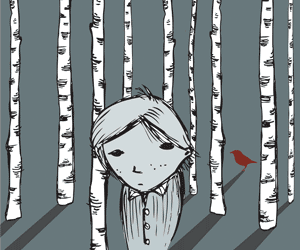
What I know—because parents know, trust me—is that inside my son, there’s a fire raging every time he’s asked to do something on this alien planet called school, that he’s falling off cliffs and climbing mountains every single moment of every single day of his educational programming. Not to mix too many metaphors, but sometimes all of this is happening inside him all at once. And it freaks him out. It. Freaks. Him. Out. But guess what—he’s learned to try to hide his freakouts because they just freak out everyone else. So he has learned to react as “normally” as he can, given the circumstances.
Remarkably, and precisely how I can’t begin to know, he has learned in his 10-plus years of schooling that he is supposed to ignore the flames, simply face up to the falling, keep on climbing even with no breath or energy to do so—if he is to succeed like everyone else around him. And he’s smart enough to know that no one else seems to have these fires raging and free-falls happening, and he can’t explain what this feels like. He can only take yet another low mark for “group participation,” “eye contact,” “presentation,” “neatness,” “organization,” and try not to fall apart at the seams. (And space is too limited to begin to address the traumas of lunchroom, recess, pep rallies, substitute teachers, bells, fire drills, field trips, and bus rides.)
We have asked our “Aspies” to try to “figure out” the way school functions for too long. What would it take for the rest of us to try to “figure out” the way kids with Asperger’s function? What would it take to put a few ramps and railings in place, to find alternative assessments, to speak gently to these gentle souls and ask them what the world feels like to them? It’s not that difficult, honestly. And the gifts we uncover might astound us.


