Twenty-six states and the District of Columbia are seeking flexibility under the No Child Left Behind Act in the second round of federal waivers. That means the vast majority of states are on pace to be free from many of the fundamental requirements of the decade-old federal accountability law.
Already, 11 states have won waivers after promising to implement specific policy changes backed by President Barack Obama’s administration, including tying teacher evaluations to student performance, adopting college- and career-readiness standards, and devising new accountability systems that factor in student growth. In exchange, states no longer need to aspire to 100 percent student proficiency in reading and math by the end of the 2013-14 school year or provide tutoring and public school choice for students if they fall short.
“The best ideas to meet the needs of individual students are going to come from the local level,” U.S. Secretary of Education Arne Duncan said in a statement Feb. 29, a day after second-round applications were due. “Like the first round of waiver applicants, these plans will protect children, raise the bar, and give states the freedom to implement reforms that improve student achievement.”
Those applying in this round are: Arkansas, Arizona, Connecticut, Delaware, Iowa, Idaho, Illinois, Kansas, Louisiana, Maryland, Michigan, Mississippi, Missouri, North Carolina, Nevada, New York, Ohio, Oregon, Rhode Island, South Carolina, South Dakota, Utah, Vermont, Virginia, Washington state, and Wisconsin, along with the District of Columbia.
States seeking second-round waivers will be notified of the U.S. Department of Education’s decisions later this spring, which would give them time to turn their plans into reality by the start of the next school year. Given that the department approved all 11 applications from the first round—after requiring changes to each state’s plan—it’s likely that a significant number of the 27 applications from the second round will be approved.
Several large states are still sitting out the waiver process; they include California,
Pennsylvania, and Texas. States still can apply in a third round, in September.
California officials continue to object to many of the waiver requirements as being costly and unworkable, such as redoing the statewide accountability system at a time when new standards and tests are being developed.
Twenty-six additional states plus the District of Columbia have applied for waivers under the No Child Left Behind Act, which would free them from many of the core tenets of the decade-old accountability law. Last month, the U.S. Department of Education awarded a first round of waivers to 11 states.
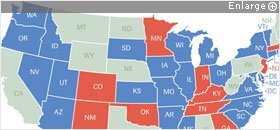
SOURCE: U.S. Department of Education
Instead, California wants to design its own waiver freeing it from several of the NCLB law’s biggest sanctions, including the requirements that struggling schools set aside money for supplemental education services, professional development, and transportation related to school choice. State schools Superintendent Tom Torlakson wants to have Title I funding for disadvantaged students made available for strategies more tailored to districts’ and schools’ individual needs.
California’s pursuit of more direct flexibility is “the only avenue we could see that could bring us some immediate relief from the aspects of No Child Left Behind that are harming our schools,” said Paul Hefner, a spokesman for the state department of education.
The California board of education, which has the final say on whether to seek a waiver, is expected to vote on the issue on March 7.
The federal Education Department has said there are only two options for states: following the law as it is, or applying through the formal waiver process. Federal officials wouldn’t comment on California’s plans.
Delivering on Pledges
With 11 states now freed from some parts of No Child Left Behind, the current version of the Elementary and Secondary Education Act, and 27 more applications in the pipeline, the Education Department has turned to an important part of the waiver process: holding states to their new accountability promises.
The department has issued implementation letters that vary slightly by state and convey some important messages.
Accountability for individual subgroups of students, such as members of racial and ethnic minorities and students learning English, was a significant point of contention for states, federal officials, and civil rights groups, and it will be a chief focus of monitoring for the department.
In implementation letters to most of the 11 first-round states, the department said it would make sure the states provide “transparency” around subgroup performance—especially in states that are using a new so-called “super-subgroup,” which typically lumps together smaller groups of students deemed at risk academically.
But the department also indicated it will be scrutinizing how Tennessee approves new “annual measurable objectives,” or AMOs, and how New Jersey and Georgia are implementing their new, not-yet-final grading systems.
While waiver states are no longer required to offer tutoring and choice as under the NCLB law, the department has made clear that under a section of the law that hasn’t been waived, districts have to allow students to stay in a public school of choice through that school’s highest grade. States still are encouraged, though not required, to provide transportation to those schools.
The department also emphasized that it wants states to continue to consult with stakeholders, notably teachers’ unions, as they implement their plans. If a state or a “significant number” of its school districts fail to implement the plan or file required reports, the department has reiterated that it will revoke a waiver.
Federal monitoring will begin before the start of the 2012-13 school year.
“We don’t think states overcommitted in their plans. And we think states should be held to their applications,” said Chris Minnich, the senior membership director for the Council of Chief State School Officers. “I think the states are welcoming this interaction.”


