
School & District Management

Study Finds U.S. Losing Its Postsecondary Edge

By Sarah D. Sparks — September 20, 2011 2 min read
  • Save to favorites
  • Print

The United States still leads the world in having a college-educated workforce, but it is the only country among the world’s leading economies whose incoming workers are less educated than those retiring, according to a new study by the Organization for Economic Cooperation and Development.

Released last week, the OECD’s “Education at a Glance 2011” report compares education systems in the Group of Twenty, or G-20, economies, which include 19 countries and the European Union.

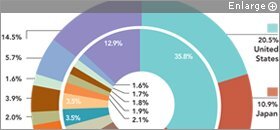
It finds that in 2009, Americans accounted for more than one in every four of the 225 million people with postsecondary degrees in the G-20 countries. But a closer look at the statistics reveals a deep generational divide among degree-holders: Americans make up more than a third of all postsecondary degree holders, ages 55 to 64, but only one-fifth of those ages 25 to 34.

“It’s not that the United States is doing worse; it’s that other countries are starting to do what the United States has been doing for a very long time,” said Andreas Schleicher, who heads the indicators and analysis division at the OECD’s Directorate for Education, in a briefing on the report. “There’s been a quite dramatic expansion of the pool of qualified people.”

A Piece of the Pie

Among the world’s leading economies, the United States accounts for 35.8 percent of all postsecondary degreeholders between the ages of 55 and 64 (inner ring). Among 25-to-34-year-old postsecondary degree-holders, the U.S. share accounts for 20.5% (outer ring).
BRIC ARCHIVE

SOURCE: Organization for Economic Cooperation and Development

China, in particular, has been gaining ground in education. Chinese between 25 and 34 held nearly triple the global share of postsecondary degrees, 18.3 percent, compared to its older workers, who represent only 6.9 percent of postsecondary degrees in their age group.

China on the Rise

Moreover, China’s educational edge is likely to grow. In 2009 China had 36.6 percent of the world’s students entering college, compared with the United States’ 12.9 percent share, and China accounted for 42.6 percent of the world’s students graduating high school, compared with 9.9 percent for American students.

Because of its well-educated older workers, the United States still ranks in the top five most-educated countries among the G-20, but it drops to 15th among those ages 25 to 34—a decline that could deeply affect the nation’s economic well-being, as prior research shows education has a greater effect on a person’s earnings than factors such as race or gender.

Educational attainment can play a role in a country’s politics and social fabric, too. The OECD study also found that 14-year-olds who scored higher on the International Civic and Citizenship Education Study were more likely to vote and to favor gender equality than those with lower civics education.

Mr. Schleicher said higher education in the United States is more expensive than that in other countries, and U.S. students feel a greater sense of risk in taking on student loans.

He added, however: “Tuition that U.S. students pay is still low in comparison to the benefits that you get.” After accounting for gender, age and income, adults with higher education reported they were “more satisfied with life, engaged in society and likely to report that they are in good health.”

Related Tags:

A version of this article appeared in the September 21, 2011 edition of Education Week as U.S. Educational Edge Seen to Be Shrinking

Events

Reading & Literacy K-12 Essentials Forum Supporting Struggling Readers in Middle and High School
Join this free virtual event to learn more about policy, data, research, and experiences around supporting older students who struggle to read.
School & District Management Webinar Squeeze More Learning Time Out of the School Day
Learn how to increase learning time for your students by identifying and minimizing classroom disruptions.
Recruitment & Retention Webinar EdRecruiter 2026 Survey Results: How School Districts are Finding and Keeping Talent
Discover the latest K-12 hiring trends from EdWeek’s nationwide survey of job seekers and district HR professionals.

EdWeek Top School Jobs

Teacher Jobs
Search over ten thousand teaching jobs nationwide — elementary, middle, high school and more.
View Jobs
Principal Jobs
Find hundreds of jobs for principals, assistant principals, and other school leadership roles.
View Jobs
Administrator Jobs
Over a thousand district-level jobs: superintendents, directors, more.
View Jobs
Support Staff Jobs
Search thousands of jobs, from paraprofessionals to counselors and more.
View Jobs

Read Next

School & District Management Opinion The 5‑Minute Clarity Reset: How a Small Pause Can Change a Big Decision
Stuck in a spin? This practice can help free an education leader to act.
5 min read
Screenshot 2025 11 18 at 7.49.33 AM
Canva
School & District Management Opinion Have Politics Hijacked Education Policy?
School boards should be held more accountable to student learning, says this scholar.
8 min read
The United States Capitol building as a bookcase filled with red, white, and blue policy books in a Washington DC landscape.
Luca D'Urbino for Education Week
School & District Management From Our Research Center Student Fear and Absences Surge as Immigration Enforcement Expands
While schools report widespread effects from immigration enforcement, not all are taking action.
5 min read
Three sisters, whose single mother fears being mistakenly detained by federal immigration agents because she is of Puerto Rican descent and speaks Spanish, walk into Funston Elementary School after being dropped off for the start of the school day, in Chicago's Logan Square neighborhood Oct. 15, 2025.
Three sisters, whose single mother fears being mistakenly detained by federal immigration agents because she is of Puerto Rican descent and speaks Spanish, walk into Funston Elementary School after being dropped off for the start of the school day, in Chicago's Logan Square neighborhood Oct. 15, 2025. Teachers in Chicago and elsewhere have expressed heightened anxiety from immigrant students as immigration enforcement efforts expand.
Rebecca Blackwell/AP
School & District Management The Wacky Thanksgiving Traditions Bringing School Communities Together
Principals encourage their students and staff to find new ways of giving back and showing gratitude.
4 min read
A photo illustration of an autumn heart wreath from dry colored leaves, cones, pumpkins, squash, black berries on beige background.
iStock/Getty
