
Late last year, Mayor Michael R. Bloomberg said that what the sprawling New York City school system needed was a hard-nosed business leader.
This month, three months after the mayor got a chance to try one out, he shifted gears, naming a political executive known for his diplomatic skills as the chancellor of the 1.1 million-student district.
Former publishing executive Cathleen P. Black’s removal from the top district post was almost as sudden as her ascension to it. (“Media Leader Tapped to Head N.Y.C. Schools,” Nov. 17, 2010.)
The announcement that the mayor was replacing Ms. Black with Deputy Mayor Dennis M. Walcott came days after a NY1/Marist College poll found only 17 percent of New Yorkers surveyed thought she was doing a good job.
Four deputy chancellors have left the district since Ms. Black’s appointment. Ms. Black was also criticized for remarks made at public meetings and staffers complained anonymously that she required intensive briefings on school policy. In an April 7 press conference, the mayor said that too much focus was being placed on her and not enough on the students. “I take full responsibility that this has not worked out as either of us hoped or expected,” he said.
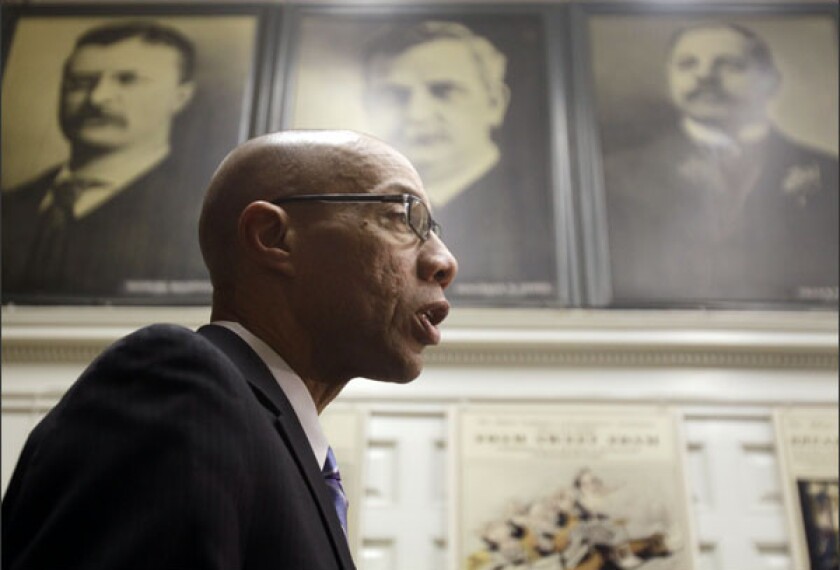
In naming Mr. Walcott as chancellor, Mr. Bloomberg has selected a person with deep ties to the mayor’s education agenda. Mr. Walcott, unlike Ms. Black, is a product of New York public schools, as are his children. His grandson is now enrolled.
A few hours after he was appointed, Mr. Walcott gave a speech at the city’s education headquarters, where he was greeted by rounds of applause. To underscore his connection to the district, the next day Mr. Walcott walked his grandson to school, news cameras in tow.

Mr. Walcott’s style is much different from Ms. Black’s and from that of Joel I. Klein, the former assistant U.S. attorney general who was Mr. Bloomberg’s first schools chancellor, and that shift in tone is needed at this stage of the mayor’s leadership, said Joseph P. Viteritti, a professor of public policy at Hunter College at the City University of New York. Mr. Bloomberg has about three years to go in his third four-year term.
“They’re not going to rewrite the agenda. They should fine-tune it, listen to the criticism, and reframe it in a positive way,” Mr. Viteritti, who has written on mayoral control of schools, said of Mr. Bloomberg and his new schools chief.
People complained of Mr. Klein’s “tin ear” during his eight years as chancellor, Mr. Viteritti said. In contrast, he said, Mr. Walcott “can take what he hears, tweak it, and move it forward in a way that’s much more successful.”
A native of Queens, Mr. Walcott, 59, has master’s degrees in education and in social work. His first job was as a kindergarten teacher, and after a year and a half in that role, founded a mentoring program. He also worked for various nonprofit organizations, including the Greater New York Fund/United Way and the Urban League, where he was president and chief executive officer.
In 2002, Mr. Bloomberg appointed Mr. Walcott to be deputy mayor, with schools a part of his portfolio along with community development.
Waiver Still Needed
Like Ms. Black, Mr. Walcott will need a waiver from the state department of education before he can officially start as chancellor. New York state law requires that school superintendents have educational leadership experience.
There is no sign that Mr. Walcott will have trouble getting a waiver.State Commissioner of Education David M. Steiner, who announced plans this month to leave his own post later this year, said that Mr. Walcott was an “outstanding partner” and that he looked forward to continuing to work with him. In contrast, Ms. Black’s state waiver was contingent on the district’s hiring a chief academic officer.
Ms. Black’s rise to the chancellorship followed leadership turnovers in Wake County, N.C., Pittsburgh, and San Diego that also placed noneducators in charge of large urban districts. In defending the selection of Ms. Black, who at the time was the chairman of the board of Hearst Magazines, Mr. Bloomberg said her lack of education experience, or as a public school parent, was immaterial.
“This is an organization, an agency of the city, that deals with 1.1 million customers, that has 135,000 employees, has a budget of $23 billion a year. This is a management job,” Mr. Bloomberg said in November on his radio program soon after he announced the appointment. “She’ll have plenty of educational experts to lean on to help her in formulating policy.”
In his letter requesting a state waiver for Mr. Walcott, Mr. Bloomberg struck a different note, touting the deputy mayor’s knowledge of the school system.
Richard D. Kahlenberg, a senior fellow at the Century Foundation, a policy-research organization with offices in New York and Washington, said that New York’s experience might cause some people to reconsider a mind-set that business leaders are the best choice to run school districts.
“There is this sense in the education reform community that we need noneducators to come in and clean up the mess educators have made,” he said. “Experience suggests that’s the wrong approach.”
Jeffrey Henig, a professor of political science and education at Teachers College, Columbia University, said that he was cautious about drawing broad conclusions from Ms. Black’s brief tenure. He said her situation does demonstrate though, that general management skills don’t always transfer to running a school district.
Mr. Bloomberg “thinks he’s done really good and important stuff,” Mr. Henig said, “but he’s also concerned about it losing its momentum or being reversed after the next mayoral election.”
Leonie Haimson, the executive director of the local parent-advocacy group Class Size Matters, said she was impressed that the new chancellor’s office had already reached out to her and other parent activists for a meeting. At that April 11 meeting, she said, Mr. Walcott told the group he would not deviate from the education agenda put in place during the mayor’s tenure.


