Nine states and the District of Columbia were chosen Tuesday to receive a combined $3.4 billion in the second round of the federal Race to the Top grant competition, a cash infusion that is intended to support bold new plans to turn around struggling schools, revamp teacher evaluation, and implement common academic standards, among other efforts.
The second-round winners, selected from a group of 19 finalists, were Florida, Georgia, Hawaii, Maryland, Massachusetts, New York, North Carolina, Ohio, and Rhode Island, in addition to the nation’s capital. They will receive from $75 million to $700 million through the competition.
Notably absent from the list were Colorado and Louisiana, which had high hopes of winning grants after aggressively changing elements of state education policy, and California, which had looked to the prospect of up to $700 million in new federal aid amid a continued fiscal crisis.
The new awardees join Delaware and Tennessee, the only two winners chosen in March during the first round of the Race to the Top. The competition was authorized by Congress last year as part of the American Recovery and Reinvestment Act, better known as the economic-stimulus program.
The announcement by the Obama administration ended months of speculation in states that had revised their applications and even approved new laws in an attempt to boost their chances. In all, the Race to the Top Fund totals $4.35 billion, of which $350 million is to be awarded next month to help states design common assessments.
As was the case during round one, the announcement of the second round of awards drew strong reactions from states whose applications notched winning scores, or did not pass muster.
In Rhode Island, state officials approved new polices that prevent teachers from being assigned to schools on the basis of seniority, and set new, higher standards for teacher certification and preparation. The federal competition rewarded states for efforts to produce “great teachers and leaders,” and Rhode Island fared well, placing fifth among all applicants and securing an award of up to $75 million.
“Our plan around the ‘great teachers and leaders’ section was just very strong,” said Deborah A. Gist, the state commissioner of education. “We actually have the legislative and regulatory ability to make a lot of significant changes, and we’re definitely doing that. So we feel that’s a strength that’s a priority for us, and [it was] evident in our application as well.”
But the second-round loss was a serious disappointment for Colorado, where officials questioned the logic of the scoring system used in the awards competition.
Nine states and the District of Columbia were chosen out of a pool of 36 applicants to share the remaining $3.4 billion in federal Race to the Top funds.
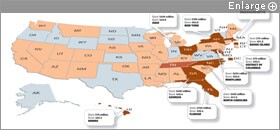
SOURCE: Education Week
“It’s just incomprehensible to us,” said Colorado Lt. Gov. Barbara O’Brien, whose state missed the cut by ranking 17th.
The U.S. Department of Education judged states’ applications on a 500-point scale based on more than 30 criteria. Among them, states could secure points by adopting common academic standards; revamping their data systems; improving teacher and principal effectiveness based on measuring student growth and other factors; turning around low-performing schools; supporting charter schools; and focusing on math and science strategies. States were also encouraged to seek broad support from a diverse set of stakeholders, such as teachers’ unions.
But Ms. O’Brien speculated that reviewers may not have understood the state’s strategy of outlining broad goals for school improvement while leaving implementation details up to local districts.
“It was clear that a couple of reviewers just didn’t understand how you implement [reform] in a local-control state,” said Ms. O’Brien, who added: “What kind of testing systems or scoring of proposals can you have when there’s so much variability and judges score so differently, and states are scored so differently? You can’t say it’s an objective process, and it certainly hasn’t been normed or standardized. I just have no confidence in this process the U.S. Department of Education has put together.”
Colorado lawmakers had revamped their state’s laws on teacher evaluation since round one of the competition, ensuring that half of an educator’s rating will be based on student performance, and that ineffective teachers could be dismissed more easily.
Paul G. Pastorek, the state superintendent of education in Louisiana, which ranked 13th and lost out, said he was surprised that his state did not score better in the teachers-and-leaders section despite having approving teacher-merit-pay legislation before this round.
“I thought the law we passed strengthened the application,” he said. “I have to scratch my head and wonder why, but at the end of the day I know this is the process, and we live it.”
Eight of the 10 winners are located are located on or near the East Coast, and the only winning state west of the Mississippi is Hawaii. Yet Mr. Pastorek, whose state ranked 13th, scoffed at suggestions in a phone session with reporters that the competition favored any type of state. He noted that he had worked closely with winning states such as Rhode Island, Massachusetts, and Florida.
“These are top-flight proposals; this is serious competition,” he said in the conference call. “I’m just glad we’re doing this work nationally. This Race to the Top has moved us all significantly down the path.”
‘National Movement’
That argument was echoed by U.S. Secretary of Education Arne Duncan, who said the competition had fueled innovation in states across the country, regardless of whether they took home a prize.
“This is not about funding states on a pilot basis,” Mr. Duncan said. “This is about a national movement.”
The secretary said that he would like to have funded several other state applications, and he specifically praised the proposals submitted by a few of them, including Colorado, Louisiana, and California. The administration has proposed spending $1.35 billion to extend the program for a third round through the federal budget process.
Mr. Duncan also vowed to closely monitor whether the winning states live up to the promises put forward in their applications. In using their grant money, several victorious round-two applicants have pledged to take bold approaches to turn around low-performing schools and in evaluating teachers.
Florida, which will receive up to $700 million, has promised to set new, more rigorous deadlines and expectations for the restructuring of struggling schools. Schools that fail to make progress under their initial turnaround options will be required to switch to a different turnaround option, a process that will continue until schools either succeed or close.
Another populous state, New York, which also was awarded up to $700 million, plans to expand its “partnership zones” for turnaround schools. Those zones will include clusters of restructured and charter schools that will use their central district offices for services, but have separate scheduling, curriculum, and staffing controls in exchange for agreeing to make dramatic improvements within two years.
Other winners are notable for having taken steps to revamp how teachers are evaluated. The District of Columbia, which will receive up to $75 million, submitted a plan that includes the use of its much-scrutinized IMPACT system, which evaluates teachers on student academic progress and other factors.
Fine-Tuning
Many states significantly revised their applications between rounds one and two of the competition. Florida Commissioner of Education Eric J. Smith recalled that the judges in the competition told state officials that their goals for improving student achievement were not aggressive enough, and so the state revised those benchmarks for round two.
Another state, Maryland, was named a winner despite having not applied for funds in round one. Nancy S. Grasmick, the Maryland superintendent of schools, said she held the state out of the first round because the state was in the process of considering several pieces of major legislation—including one to tie 50 percent of a teacher’s or principal’s effectiveness score to student data—that were eventually approved.
“I thought we really needed to have all these pieces in place,” Ms. Grasmick said. “I wanted to be sure when we submitted something it was of very high quality. Judging by our grades, we did.”



