
Includes updates and/or revisions.
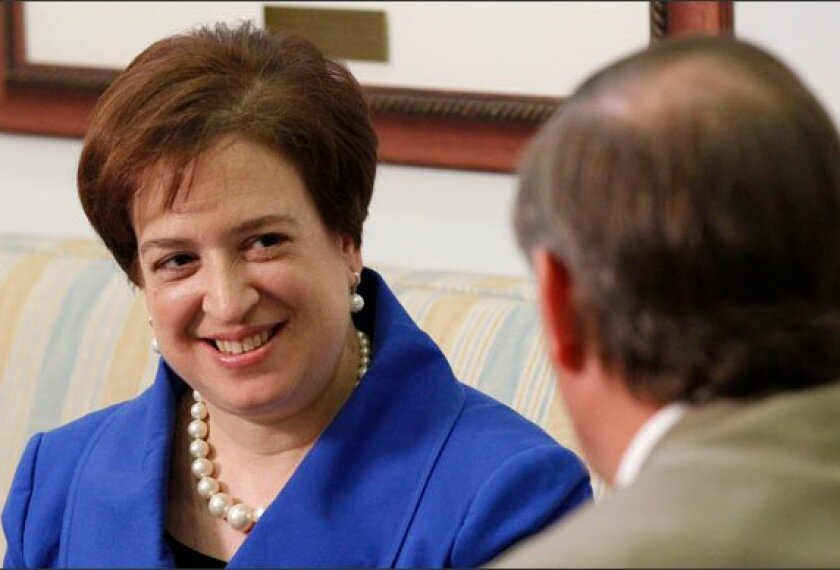
U.S. Supreme Court nominee Elena Kagan lauded the teaching experience of her mother as the Senate Judiciary Committee opened her confirmation hearings Monday.
“I said when the president nominated me that the two people missing were my parents, and I feel that deeply again today,” Ms. Kagan said in her opening statement. “My parents lived the American dream. They grew up in immigrant communities; my mother didn’t speak a word of English until she went to school. But she became a legendary teacher and my father a valued lawyer. And they taught me and my two brothers, both high school teachers, that this is the greatest of all countries, because of the freedoms and opportunities it offers its people.”
Ms. Kagan’s mother, Gloria, taught at Hunter College High School in New York City. Her brothers, Irving and Marc, teach at Hunter College High and Bronx High School of Science, respectively.
Ms. Kagan, 50, was nominated May 10 by President Barack Obama to succeed Justice John Paul Stevens, who stepped down after 35 years on the court, which wrapped up its 2009-10 term Monday. She is a former White House aide to President Bill Clinton, a professor and dean of Harvard Law School, and U.S. solicitor general since last year, although she stepped aside from that position upon her nomination.
In her time in the White House counsel’s office from 1995 to 1997, and as deputy director of the Domestic Policy Council from 1997 to 1999, Ms. Kagan was intimately involved in Clinton administration K-12 education policies, including those involving education funding, testing, social promotion of pupils, bilingual education, single-sex schooling, and affirmative action. Some Republicans have criticized her lack of judicial experience and her handling of military recruiters while dean of Harvard Law School.
The first day of the hearings was one for opening statements, and little was said about education. A few Republicans were willing to raise critical concerns about Ms. Kagan and one of her mentors, Justice Thurgood Marshall, for whom she clerked on the Supreme Court in 1988-89.
Sen. John Cornyn, R-Texas, said that based on “his self-described judicial philosophy and his performance on the bench, it is clear that Justice Marshall was a judicial activist as I have described that phrase earlier. Thurgood Marshall described his judicial philosophy as ‘do what you think is right and let the law catch up.’”
This prompted a defense of Justice Marshall from Sen. Richard Durbin, D-Ill., who is also the Senate majority whip.
“America is a better nation because of the tenacity, judiciary and the integrity and values of Thurgood Marshall,” Sen. Durbin said, adding that Justice Marshall broke down “barriers of racial discrimination that haunted Americans for generations.”
Public Policy Record
Ms. Kagan’s public record has been amplified by hundreds of thousands of pages of documents related to her released in recent weeks by the Clinton Presidential Library in Little Rock, Ark.
For example, in a thorny legal case involving a school district’s defense of its decision to lay off a white teacher over a black colleague for diversity reasons, Ms. Kagan endorsed a 1997 legal memo that concluded the school district failed to justify its race-based decision. (“Papers Show Kagan in Loop on Clinton K-12 Policy,” School Law Blog, June 6, 2010.)
“I think this is exactly the right position—as a legal matter, as a policy matter, and as a political matter,” Ms. Kagan wrote in the margins of the legal memo in the case involving the Piscataway, N.J., school district. (“N.J. District Settles Case On Race Bias,” Nov. 26, 1997.)
Also in 1997, Ms. Kagan discouraged a White House education policy aide from urging President Clinton to call for a voluntary high school test to accompany a proposal for voluntary 4th and 8th grade tests. She told the aide in an e-mail that because the 4th- and 8th-grade testing plan was already slow to win support, the high school testing proposal “will make us look semi-oblivious.” (“Kagan E-Mails Show Resolve on K-12 Issues,” School Law Blog, June 21, 2010.)
The hearings are expected to take about a week, and Democratic leaders are hoping to have a floor vote by the Senate’s August recess.
In preparation for today’s kickoff, the Judiciary Committee altered its schedule to accommodate a rare instance when a confirmation hearing for a Supreme Court nominee would nearly overlap the end of the high court’s term. The justices convene at 10 a.m. to issue opinions, while the Senate panel is to begin at 12:30 p.m., across the street in the Senate’s Hart Office Building.


