
Even though more women and girls are getting college degrees and scoring in the top ranks on national math tests than was the case in the 1970s, their academic gains have not come at the expense of boys, says a report released today by the American Association of University Women.
Some researchers and advocates have made the case in recent years for a “boys’ crisis” in education, pointing out, for instance, that boys have begun to trail girls on key academic indicators, such as in rates of enrollment in and graduation from college.
But the AAUW, the Washington-based group that sparked a national debate about gender disparities in education with a report issued 16 years ago, contends bluntly in its new report that the fears about boys are overstated.
“There is no boys’ crisis,” Linda D. Hallman, the group’s executive director, said in an interview. “On average, both boys’ and girls’ education performance has improved, and all boats rise on the same tide.”
The new report, “Where the Girls Are: The Facts About Gender Equity in Education,” also argues for taking a closer look at gender disparities in education and breaking down statistical trends by students’ racial, ethnic, and family-income levels, as well as by gender.
While girls still outperform boys overall on the National Assessment of Educational Progress in reading, for example, a closer inspection shows that the gaps are most pronounced and most consistent between white male and female students. Girls outscored boys on 29 of the 30 NAEP reading tests given since 1975.
Hispanic girls outperformed Hispanic boys on fewer than half of those tests, the report says. African-American girls outscored their male counterparts on 24 of the 30 tests.
Nonetheless, the report says, gender differences within racial and ethnic groups are small compared with the academic gaps that separate students of different income levels or different racial and ethnic groups.
“We need to understand better how girls in these disadvantaged groups are faring, just as we need to understand how boys in these disadvantaged groups are faring,” said Catherine Hill, the AAUW’s director of research and a study co-author.
Findings Criticized

SOURCE: American Association of University Women
The report drew pointed criticism, though, from Judith S. Kleinfeld, a researcher from the University of Alaska-Fairbanks, who has written on the problems of boys.
“No one makes the absurd argument that `the progress of girls has come at the expense of boys,’ ” Ms. Kleinfeld, a psychology professor, said in an e-mail message to Education Week. “The policy issue is whether boys have gender-specific educational and emotional problems which need attention. Boys most certainly do.”
The problem with the AAUW study, she said, is that it focuses on a narrow set of academic indicators, ignoring key areas in which boys are particularly floundering. In K-12 schools, for example, boys get lower grades, on average, than their female counterparts, get assigned disproportionately to special education classes, and account for the majority of suspensions and expulsions, she said.
SOURCE: American Association of University Women
Suicide rates for young men between the ages of 20 to 24 are six times higher than they are for women in that age group, she added, and young men are more prone to suffer from alcoholism, conduct disorders, and other externalizing psychiatric disorders.
Ms. Hill said the AAUW project intentionally focused on commonly used academic indicators, such as the federally sponsored NAEP and the SAT and ACT college-entrance exams, in part because they allow researchers to track results over time and because the entrance exams play a gatekeeping function for higher education.
Boys Ahead on Some Tests
Among the report’s other findings:
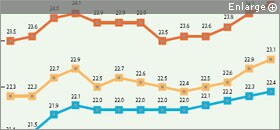
• While average scores for both male and female students have steadily risen on the SAT and the ACT since the 1990s, young men still maintain a slight edge over women overall. They outscore women on both the verbal and the math portions of the SAT and maintain a slightly higher composite score on the ACT. The changes may reflect that fact that higher numbers of women than men elect to take those tests, the report suggests.
• Although girls have made big gains at all grade levels on the NAEP in mathematics, a slight gender gap still favors boys in that subject.
• In states where girls score comparatively high on NAEP, boys also score high. The reverse is also true: Boys and girls both score low in low-scoring NAEP states.
• Even though women have been earning more bachelor’s degrees than men since 1982, more men of all races are earning college degrees today in the United States than at any time in history. Both trends reflect an 82 percent increase, from 1970 to 2005, in the overall size of the college-educated population.
• While women outnumber men in college, there is no gender gap between men and women entering college immediately after high school graduation. According to 2005 enrollment figures, 66 percent of the young women and 65 percent of the men who graduated from high school that year enrolled in college the following fall.
Women Spurred by Pay Gap?
The study also found, however, that the enrollment picture changes markedly among the 50 percent of undergraduate students who are older or financially independent from their parents. Among that group, women outnumber men by a ratio of 2-to-1. One-third of African-American women who eventually graduate from college enroll when they are 25 or older, according to the study.
One possible reason for that disparity, Ms. Hallman and Ms. Hill said, are the pay inequities that women encounter in the workplace. In 2005, earnings for women were 77 percent of men’s earnings, according to a 2007 AAUW analysis. The pay disparities persist, the researchers contend, even when the analysis takes into account factors that might account for those differences, such as varying levels of experience or the fact that women often take time out from the workplace to raise children.
Annual salaries are higher, though, and the gender gap, smaller, for women with college degrees, the report says.
“We see a lot of gains for women in education, but they’re not doing so well in the workplace,” said Ms. Hallman, “and that is ultimately one of the reasons people go back to get a college degree.”


