

Bitter experience has shown this city that if students are going to leave school, they are most likely to do it between the 8th and 9th grades. To combat that problem, the school district has launched a full-on campaign to get its rising freshmen into high school and keep them there.
Two weeks before school opened, the district welcomed more than 800 incoming 9th graders—about one-third of the class—to an unusual orientation. It was not the typical high school program, in which freshmen spend a half-day or so getting acquainted with their school’s floor plan and programs.
See other stories on education issues in Pennsylvania. See data on Pennsylvania’s public school system.
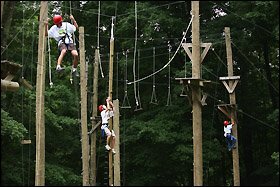
Pittsburgh’s session lasted a full week in mid-August. Students walked the hallways and learned school rules, but they also shook their booties to hip-hop aerobics and went on a scavenger hunt. They discussed a novel they’d all read over the summer, and talked about why it’s important to show up for class and get good grades. They also went with their teachers to a wooded campsite, where they managed an aerial ropes course and shrieked their way across a log suspended high above the ground.
Creating Bonds
The idea was to target not just the teenagers’ heads, but also their hearts. A week of getting used to their new schools, befriending their classmates and teachers, and undertaking adventures together was designed to forge what district officials are calling a “9th Grade Nation”—a freshman class that moves through high school feeling supported and confident.
“Eighth to 9th grade is a pivotal point. That’s where we have our highest dropout, repeat, and opt-out rates [of transfer to charter and private schools],” said Mark Roosevelt, who is starting his third year as the superintendent of the 31,000-student district. “Hopefully, 9th Grade Nation will help kids feel cared about, that there is a connection between them and their classmates, and that they have an adult they trust to go to.”
Pittsburgh’s focus on 9th grade reflects a growing awareness among educators nationally that it is a make-or-break year. Research shows that it is the leakiest part of the graduation pipeline. This month, yet another study illustrated the pivotal role freshman year plays in the potential for high school completion. The Consortium on Chicago School Research found that freshmen who sustain good grades and attendance are far likelier to graduate than lower-performing peers. Chicago schools chief Arne Duncan mailed a summary of the findings to the families of all 30,000 freshmen in his district.
“What Pittsburgh is doing is right on,” said John Q. Easton, the executive director of the consortium and a co-author of the study. “The thoroughness of the program; how well planned it was; the sense of purpose that this is so important for kids, so let’s give it our best. It’s exactly what schools should be doing.”
Miles to Go
Working to give freshmen a strong start is only one part of Pittsburgh’s effort to improve its high schools. And the district has its work cut out for it. Only two-thirds of its students graduate in five years, it reports. A little more than half its 11th graders pass state reading tests, and four in 10 pass the mathematics tests. So this year, the district is embarking on a five-year plan to bolster the experience of all the students in its 10 high schools. It developed the plan after intensive research and community consultation.
The 9th grade part includes instituting a more effective and positive approach to discipline, offering extra academic help to struggling students, providing a mentor for each student, and assigning truancy officers to work with families whose children are often absent. The 9th Grade Nation will also involve itself in civic projects in Pittsburgh as part of a yearlong social studies course designed to help students see how they can improve their community.
Throughout all four grades of high school, the district plans to beef up counseling and offer more advanced courses. It will create more personalized learning environments, probably by dividing its comprehensive high schools into smaller communities. It is in year two of a three-year plan to standardize its curriculum in core subjects for grades 6-12.
“It’s a culture change, and cultures don’t change as quickly as you’d like,” Mr. Roosevelt said. “But if we have a 35 percent dropout rate, we’re making 35 percent mistakes. We have a unique opportunity to do it better.”
That opportunity took shape in various ways at the high schools during the orientation week of Aug. 13. One early morning at Peabody High School found about four dozen freshmen bouncing, clapping, and turning to the booming beats of 50 Cent, Eve, and other hip-hop artists. A few of their teachers were in the mix as well, awkwardly stepping and hip-shaking as instructed by a local aerobics teacher.
It was meant to be fun, and the students’ smiles and laughter showed that it was. But it had a serious purpose as well.
“This is about getting them to go beyond where they’re comfortable, here and in class, and to see that the adults are there with them,” said Peabody’s principal, John Vater, still a little out of breath from hip-hopping a bit himself. “What happens when they don’t deal well with being uncomfortable is that they disengage, and that is a pattern that leads to bad grades.”
Quinneal Johnson, 14, said that after a few days of the summer program, his worries about starting high school had turned into excitement. He especially liked the fact that social studies teacher Liza Simmons and English teacher Terry Benson had bothered to get in there and give the hip-hop moves of his generation a try.
“ ’S cool,” he said.
Putting Rumors to Rest
Dominique Williams, 13, said she was too shy to join the aerobics, but that the week’s activities had made her feel better about coming to high school. “
I heard rumors about it being a bad school, but it doesn’t seem so bad,” she said. “Ms. Benson is really funny and cool. It won’t be as bad as I thought.”
For Ms. Benson, the week offered a valuable window on her students.
“It’s a great chance to build rapport with them and get to know them before they get into my classroom,” she said, surveying the crowd and noting who jumps into the dancing and who stays pasted to the wall. “It helps me see how to individualize instruction for them.”
Minutes after the aerobics ended, students changed gears and gathered around tables to work on literacy skills. Ms. Benson led a group in practicing how to summarize a portion of a novel. The session was part skill-building and part pep talk.
“Remember I’m here to help you, but I can’t do it if you don’t help yourselves,” she told the teenagers.

At another session down the hall, Jeremiah Jackson, an outreach coordinator from one of the school’s community partners, Duquesne University, tried to help students understand why showing up for class and doing homework will pay off down the road. Like the athlete who needs a strong playing history to have a shot at the NFL draft, students need to establish a record of good performance now to have a shot at good college and job opportunities, he said.
“People look at what you’ve done in order to figure out what you’ll do in the future,” Mr. Jackson said.
At Taylor Allderdice High School, students gathered in the library to learn strategies for coping with stress. Student-support specialist Paula McCommons guided them through various ways they could calm themselves, including coming to talk to one of the “caring adults in the building, who are here to help you bounce back when things are hard.” Some listened intently; many dozed off or fidgeted in their seats in the late-summer heat.
In a small group later, students in one classroom talked about how the lead character in Last Chance Texaco, their summer-reading book, learned coping skills of her own.
‘Step It Up’
English teacher Ted Denlinger led them in a discussion of good work habits, and saw vividly how far they had to go. When he asked how many of the 20-odd students had ever spent more than 15 minutes on homework, only three raised their hands. “You’re going to have to step it up,” he told them.
A session in the cafeteria, where students could rotate to various stations to learn about activities such as sports or the robotics team, turned into an impromptu support group in one corner. A freshman boy was worried about handling the honors classes that his aunt made him sign up for.
“Oh, it’s definitely doable,” said a junior girl hosting one of the stations. “Don’t worry.”
Melissa Friez, the school’s testing coordinator, who oversaw its 9th Grade Nation activities, said she made a point of participating in the scary camp activities with the students.
“I figure you lead by example,” she said. “Students see you and say, ‘I can do that.’ Hopefully, that will carry over to the classroom. When they see you trying to walk over that log, they respect you more and realize you are going to be there for them.”
Maybe it made an impact. Jessica Morrison, 14, said one of the Allderdice teachers had intervened to calm down an escalating spat she was having with another girl.
“I like how the teachers care,” she said. “I’m surprised, but I like it.”
Madeline Massey said the week’s activities had helped her have a realistic view of what high school would hold.
“There are definitely going to be some times where it’s rough, but you have all these new people and counselors and teachers and friends to help you,” the 14-year-old said. “I thought I’d be a number in this school, but then I came here, and [saw that] teachers are ready to try to learn about you. So I feel good about the school.”


