Members of the House of Representatives want changes to the No Child Left Behind Act, and the chairman of the chamber’s education committee is saying he’s willing to make some of them.
Twenty-five House members formally presented their ideas for revising the 5-year-old law in a meeting this week with the senior members of the Education and Labor Committee. Among the ideas offered:
• Change the method for calculating districts’ and schools’ yearly progress to measure student academic growth and include factors other than test scores when doing so;
• Assess students with disabilities on the basis of their progress toward meeting goals in their individualized education programs, rather than on the grade-level tests given to their peers; and
• Figure out ways to determine whether teachers are highly qualified other than by the types of credentials they have, and give rural schools leniency on the teacher-quality rules to accommodate their particular teaching needs.
Because K-12 advocacy groups have proposed many of those ideas in recent months, the committee is ready to consider how to incorporate them into a bill to reauthorize the NCLB law, Rep. George Miller, D-Calif., the education committee’s chairman, said in an interview after the three-hour session.
Rep. Miller acknowledged that many of the ideas mentioned at the May 16 meeting would represent a dramatic overhaul for the current law and said that he is willing to make some of them.
“There will be very substantial changes,” Rep. Miller said, mentioning so-called growth models for gauging student progress as an example. “There are portions of this bill that simply aren’t working. That’s what reauthorization is about. It’s not just about standing pat.”
Some House members said this week that they wouldn’t vote to reauthorize the law without big changes.
“The current law is disproportionately geared toward failure,” Rep. Gabrielle Giffords, D-Ariz., told Rep. Miller at the meeting. “If there’s not substantial revision to the law, I will have no choice but to vote against it.”
Moving Ahead
Chairman Miller invited House members to formally express their views on the NCLB law, which is scheduled to be reauthorized this year. In the quasi-hearing, House members gave formal statements, often reading directly from prepared texts. While committee chairmen often solicit input from members who don’t serve on their panel, the formal nature of last week’s event was unusual.
Among those making presentations were the leaders of House caucuses representing Asians–Americans, Hispanics, African-Americans, conservatives, and moderate Republicans.
Rep. Miller and other senior members of the education committee listened to their colleagues’ presentations but didn’t ask questions or respond to them. Rep. Miller stayed for all 25 presentations, while Reps. Dale Kildee, D-Mich.; Howard P. “Buck” McKeon, R-Calif.; and Michael N. Castle, R-Del., attended most of the session.
The chairman and his staff have started preparing for a committee session in which the panel will consider his proposal to reauthorize the NCLB law, which itself was a reauthorization of the Elementary and Secondary Education Act and includes the Title I program for disadvantaged students and many other K-12 programs. The House panel may consider a draft of a bill as early as June.
Sen. Edward M. Kennedy, D-Mass., the chairman of the Senate Health, Education, Labor, and Pensions Committee, also hopes to draft a reauthorization bill for consideration by summer.
The committees probably will have to meet those deadlines if Congress is to complete reauthorization by early next year. By then, the presidential primaries will be the focus of political attention, and the legislative process may take a back seat.
The day after Secretary of Education Margaret Spellings testified about problems in the Reading First and federal student-loan programs, she wrote to leading lawmakers urging them to turn their attention to reauthorizing the No Child Left Behind Act and the Higher Education Act. Here are excerpts from her letter:
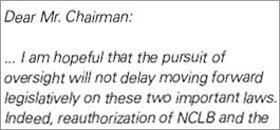
Secretary of Education Margaret Spellings is urging Congress to get to work on renewing the law, implying that recent investigations into the federal Reading First and student-loan programs have distracted lawmakers from the work of reauthorizing the NCLB law as well as the long-pending Higher Education Act.
Lobbyists for districts and schools also are anxious to see congressional action, saying that if the law is left unaltered, its flaws will result in the inaccurate labeling of hundreds of schools as needing improvement.
“At some point, where there is a law that is delivering unfair results, … you have to fix it,” said Anne L. Bryant, the executive director of the National School Boards Association, based in Alexandria, Va.
Last week, NSBA joined groups representing administrators, principals, and teachers in a joint statement. “The current accountability framework does not accurately or fairly assess student, school, or school district performance,” it said.
In reauthorizing the law, the statement said, “Congress must list to the front-line educators.”
No Easy Fixes
Making the fixes that many people say are needed may involve more than subtle tweaks, if the messages from House members last week were any indication.
“The testing-and-accountability requirements have proven to be punitive to diverse students and schools,” Rep. Mike Honda, D-Calif., the chairman of the Congressional Asian Pacific American Caucus.
Rep. Honda and several others suggested that measures other than test scores should be considered when determining whether a school makes adequate yearly progress, or AYP, under the law. As examples, Rep. Honda proposed measuring teacher-student ratios, the availability of after-school programs, and school safety.
“There are other indicators of progress that … should be taken into account,” Rep. Rosa L. DeLauro, D-Conn., said at the event.
Several House members suggested that when tracking student test scores, the law should measure students’ year-to-year academic growth, eliminating the current law’s approach of comparing one year’s class of students with the performance of the students in the same grade the previous year.
Several education groups have recommended that the NCLB law use such growth models, and the House education committee has held a hearing on the topic. (Growth Models for NCLB Accountability Are Weighed, March 28, 2007.)
Special Education Changes
House members also said that the law’s rules for assessing students with disabilities are unfair. Many special education students are unable to show their knowledge on tests designed for their grade levels and shouldn’t be expected to do so, they said.
“It borders on being abusive when we demand an 8th grade child with 4th grade reading skills take a test with questions worded on the 8th grade level,” said Rep. Tim Murphy, R-Pa. “We need to understand … that some children simply cannot perform at 100 percent level for their age and grade.”
Instead, the law should require schools to track such students’ progress over time to document their progress, Rep. Murphy said. Other members suggested that such students could be tracked by determining their success in meeting goals in their individualized education programs, or IEPs, which are developed by educators and the students’ parents under the Individuals with Disabilities Education Act.
Rep. Miller said his committee has heard testimony about the testing of special education students, growth models, and most of the other issues mentioned by House members at the meeting.
He also suggested that he could foresee a way to write a reauthorization bill that would make such changes while retaining the law’s central goals.
“The core to me is that you’re going to insist on high expectations and high standards with accountability,” Rep. Miller said.


