Federal

‘One Stop’ Research Shop Seen as Slow to Yield Views That Educators Can Use

By Debra Viadero — September 26, 2006 4 min read
  • Save to favorites
  • Print

Optimism was running high in September 2002 when the U.S. Department of Education unveiled its plans for a clearinghouse to vet effectiveness studies on educational programs and practices. The hope was that the What Works Clearinghouse, within just a few years, would become an online one-stop shop where practitioners and policymakers could get the lowdown on what research has to say about what works in education.

But four years and nearly $23.4 million later, critics call the What Works Clearinghouse the “nothing works” clearinghouse. As of last week, its Web site had posted reports for only 32 interventions—only eight of which have a “positive” or “potentially positive” effectiveness rating.
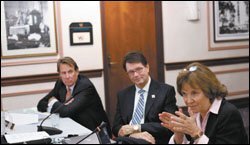
Education Trust Director Kati Haycock speaks last week to the National Board of Education Sciences as board member F. Philip Handy, left, and Grover J. "Russ" Whitehurst, the director of the IES, look on.

“I can’t tell if that’s because so little works, or because the clearinghouse has been so sluggish or so meticulous,” said Chester E. Finn Jr., an assistant secretary for educational research and improvement in the U.S. Department of Education during the Reagan administration. He is now the president of the Thomas B. Fordham Foundation, a Washington-based think tank.

The clearinghouse posted its first reports—10 study reviews on middle school math and peer-assisted learning strategies—in July 2004. Nearly two more years passed before another batch of products rolled off the line.

Acknowledging that the Institute of Education Science’s clearinghouse has not yet lived up to its promise, the site’s developers this month stepped up report production. Seven new reports on programs in the areas of character development, elementary school mathematics, and English-language learning were added on Sept. 14, and project directors plan to publish 40 to 50 more over the next six months.

“It’s been much harder than anybody thought,” said Grover J. “Russ” Whitehurst, the director of the IES, the Education Department’s main research arm and the agency in charge of the clearinghouse. “Now we’ve finally gotten to the point where we can get something out of the investment.”

Rules-Based Process

Still, some critics wonder if the flurry of reports is too little, too late. With growing numbers of schools failing to hit their improvement targets under the No Child Left Behind Act, it’s more important than ever to get practitioners the information they need to raise student achievement, according to analysts.

Examining the Evidence

Since its launch in 2002, the What Works Clearinghouse has reviewed research in four topical areas, including 31 studies on character education, 76 on middle school math, one on English-language learning, and 61 on elementary school math.

BRIC ARCHIVE

SOURCE: What Works Clearinghouse

“It’s gotten to a point where it’s very frustrating to the field, and they feel there are no products coming out,” said Christopher T. Cross. Currently the chairman of Cross & Joftus, an educational consulting firm based in Bethesda, Md., and Danville, Calif., Mr. Cross served in the Education Department as assistant secretary for research under President George H.W. Bush.

The research pickings at the clearinghouse are slim, observers say, because federal officials overestimated the number of studies in the field that could meet the rigorous methodological standards they set.

Even some developers of curricular programs that get comparatively favorable reviews from the clearinghouse contend the screening criteria is unrealistic.

“I find it annoying that even the best-researched mathematics curriculum gets at best left-handed compliments,” said Andrew C. Isaacs, an author of Everyday Mathematics, an elementary school program rated “potentially positive” by the clearinghouse. (“Much-Used Elementary Math Program Gets Qualified Nod From U.S. Ed. Dept.,” Sept. 20, 2006.)

Rebecca S. Herman, the project director for the clearinghouse, said it also took longer than anticipated to build an infrastructure for the systematic reviews.

“We had a pretty good sense of what the standards for review were from the beginning,” she said. “But once you get into reviewing studies and findings, you find lots of subtle variations. If you want to have a rules-based process, then you have to develop all kinds of very specific rules.”

From 2002 to 2004, Ms. Herman said, developers revamped procedures to make reports more useful. The early study reviews critiqued individual studies on particular interventions, giving them check marks, for instance, if they were deemed to “meet the standard” or “meet the standard with reservations.”

The more user-friendly “intervention reports” added this year contain program descriptions, implementation costs, and simple Consumer Reports-style ratings that summarize a program’s overall effectiveness.

The revision also added a “potentially promising” effectiveness rating to broaden practitioners’ choices.

Rival Database?

In the interim, though, other What Works-style projects are stepping into the breach left open by the paucity of scientifically proven programs.

The Education Department’s own office of planning, evaluation, and policy, for instance, is developing a database of “promising practices” that are used in schools and districts with a record of raising achievement among non-English-speaking students. Thomas W. Luce III, the outgoing assistant secretary for that office, said U.S. Secretary of Education Margaret Spellings called for the database in response to practitioners’ requests for more help.

“She said, look, you all need to start finding out what are we learning that has a good chance of working,” he said. “I don’t know that it in any way reflects negatively on IES.” The standards for inclusion in the new database, though not yet fully developed, will be admittedly lower than the screens that What Works reviewers use, Mr. Luce added.

Mr. Whitehurst, the head of the IES, declined in an interview this month to comment on the database, which is expected to be unveiled this winter. “I believe and I hope,” he said, “that the department doesn’t want to send out conflicting signals on what the standards are.”
Associate Editor David J. Hoff contributed to this report.
A version of this article appeared in the September 27, 2006 edition of Education Week as ‘One Stop’ Research Shop Seen as Slow To Yield Views That Educators Can Use

Events

This content is provided by our sponsor. It is not written by and does not necessarily reflect the views of Education Week's editorial staff.
Sponsor
Special Education Webinar
Bridging the Math Gap: What’s New in Dyscalculia Identification, Instruction & State Action
Discover the latest dyscalculia research insights, state-level policy trends, and classroom strategies to make math more accessible for all.
Content provided by TouchMath
This content is provided by our sponsor. It is not written by and does not necessarily reflect the views of Education Week's editorial staff.
Sponsor
School Climate & Safety Webinar
Belonging as a Leadership Strategy for Today’s Schools
Belonging isn’t a slogan—it’s a leadership strategy. Learn what research shows actually works to improve attendance, culture, and learning.
Content provided by Harmony Academy
This content is provided by our sponsor. It is not written by and does not necessarily reflect the views of Education Week's editorial staff.
Sponsor
School & District Management Webinar
Too Many Initiatives, Not Enough Alignment: A Change Management Playbook for Leaders
Learn how leadership teams can increase alignment and evaluate every program, practice, and purchase against a clear strategic plan.
Content provided by Otus

EdWeek Top School Jobs

Teacher Jobs
Search over ten thousand teaching jobs nationwide — elementary, middle, high school and more.
View Jobs
Principal Jobs
Find hundreds of jobs for principals, assistant principals, and other school leadership roles.
View Jobs
Administrator Jobs
Over a thousand district-level jobs: superintendents, directors, more.
View Jobs
Support Staff Jobs
Search thousands of jobs, from paraprofessionals to counselors and more.
View Jobs

Read Next

Federal Trump Talks Up AI in State of the Union, But Not Much Else About Education
The president didn't mention two of his cornerstone education policies from the past year.
4 min read
President Donald Trump enters to deliver the State of the Union address to a joint session of Congress in the House chamber at the U.S. Capitol in Washington, Tuesday, Feb. 24, 2026.
President Donald Trump enters to deliver the State of the Union address to a joint session of Congress in the House chamber at the U.S. Capitol in Washington, Tuesday, Feb. 24, 2026. The president devoted little time in the speech to discussing his education policies.
Kenny Holston/The New York Times via AP, Pool
Federal Education Department Will Send More of Its Programs to Other Agencies
Education grants for school safety, community schools, and family engagement will shift to Health and Human Services.
4 min read
Various school representatives and parent liaisons attend a family and community engagement think tank discussion at Lowery Conference Center on March 13, 2024 in Denver. One of the goals of the meeting was to discuss how schools can better integrate new students and families into the district. Denver Public Schools has six community hubs across the district that have serviced 3,000 new students since October 2023. Each community hub has different resources for families and students catering to what the community needs.
A program that helps state education departments and schools improve family engagement policies is among those the Trump administration will transfer from the U.S. Department of Education to the U.S. Department of Health and Human Services. In this photo, school representatives and parent liaisons attend a family and community engagement discussion on March 13, 2024, in Denver to discuss how schools can better integrate new students and families into the district.
Rebecca Slezak For Education Week
Federal New Trump Admin. Guidance Says Teachers Can Pray With Students
The president said the guidance for public schools would ensure "total protection" for school prayer.
3 min read
MADISON, AL - MARCH 29: Bob Jones High School football players touch the people near them during a prayer after morning workouts and before the rest of the school day on March 29, 2024, in Madison, AL. Head football coach Kelvis White and his brother follow in the footsteps of their father, who was also a football coach. As sports in the United States deals with polarization, Coach White and Bob Jones High School form a classic tale of team, unity, and brotherhood. (Photo by Jahi Chikwendiu/The Washington Post via Getty Images)
Football players at Bob Jones High School in Madison, Ala., pray after morning workouts before the rest of the school day on March 29, 2024. New guidance from the U.S. Department of Education says students and educators can pray at school, as long as the prayer isn't school-sponsored and disruptive to school and classroom activities, and students aren't coerced to participate.
Jahi Chikwendiu/Washington Post via Getty Images
Federal Ed. Dept. Paid Civil Rights Staffers Up to $38 Million as It Tried to Lay Them Off
A report from Congress' watchdog looks into the Trump Admin.'s efforts to downsize the Education Department.
5 min read
Commuters walk past the headquarters of the U.S. Department of Eduction, which were ordered closed for the day for what officials described as security reasons amid large-scale layoffs, on March 12, 2025, in Washington.
The U.S. Department of Education spent up to $38 million last year to pay civil rights staffers who remained on administrative leave while the agency tried to lay them off.
Mark Schiefelbein/AP
